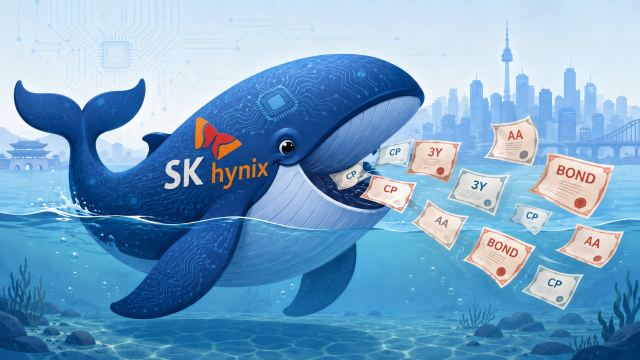
SEOUL, August 10 (AJP) - SK hynix, a dominant force in South Korea’s stock market, is now looming large over its debt market as its AI-fueled cash bonanza gives the chipmaker the deep pockets to gobble up entire bond offerings.
Market participants estimate its purchases of bonds and commercial paper this year at as much as 40 trillion won ($28.2 billion), with individual orders reportedly ranging from 100 billion won to 300 billion won.
In some cases, SK hynix has taken entire offerings.
The company has not disclosed its fixed-income portfolio, while issuers and underwriters involved have declined to comment. Without a disclosed portfolio or calculation method, it remains unclear whether the widely cited 40 trillion won figure represents outstanding holdings or cumulative transactions.
Market reports indicate the buying began in February and accelerated around April, months before SK hynix raised about $26.5 billion through an American depositary receipt offering in July, ruling out the new share proceeds as the source of its earlier investments.
Most of the money has flowed into debt rated AA or higher with maturities of three years or less, including bonds issued by public corporations, banks, financial holding companies, brokerages and credit-finance firms, along with commercial paper.
Market estimates include about 2.7 trillion won of Korea Electric Power Corp. bonds, 1.4 trillion won of NH NongHyup Bank debt and 1.05 trillion won of Shinhan Bank bonds.
SK hynix is also reported to have absorbed the entire 1.26 trillion won long-term commercial-paper offering by Mirae Asset Securities.
A short-term funding-market source cited in local reports said deals often begin with SK hynix asking issuers whether they have debt matching its preferred maturity and credit quality, sometimes ending with the chipmaker taking the entire offering.
Much of the investment is believed to have been made through trust accounts at five large brokerages in a reverse-inquiry process, under which issuers structure debt around the buyer’s requirements.
That buying power is beginning to change the way Korea’s primary credit market operates.
An asset manager who requested anonymity said issuers increasingly check SK hynix’s appetite before approaching broader investors, effectively reducing the amount of new debt available to others.
There is no comprehensive data, however, showing how far its purchases have moved yields or credit spreads.
A bond broker said SK hynix has eased placement pressure for issuers in the primary market but done little to revive secondary-market trading, while there is limited evidence that the liquidity has filtered down to lower-rated borrowers.
Its deep pockets are therefore reinforcing rather than breaking Korea’s existing credit divide.
Public corporate bond issuance totaled 2.96 trillion won in July, down 16.1 percent from June and 37.5 percent from a year earlier, according to the Korea Financial Investment Association.
Refinancing accounted for 96.1 percent of proceeds, while more than 90 percent of issuance carried maturities of two or three years.
Financial companies accounted for 61.9 percent of July issuance.
BBB+ rated Hanjin was the only BBB-rated borrower to conduct public bookbuilding during the month, and its one-year tranche fell short of its target, in sharp contrast with oversubscribed offerings from AA-rated companies.
SK hynix’s demand fits neatly into that market: short-term, highly rated debt carrying relatively little credit risk.
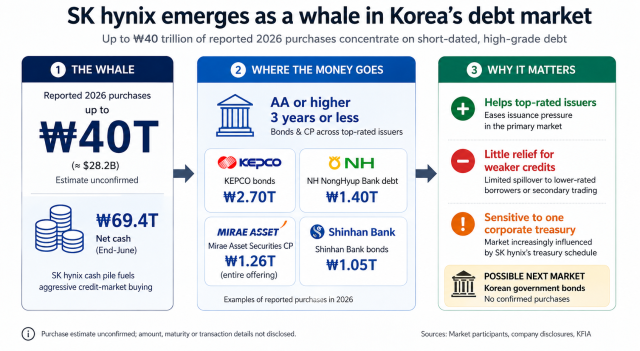
SK hynix reported 88 trillion won in cash and cash equivalents at the end of June, up 33.6 trillion won in just three months. Total debt fell to 18.6 trillion won, leaving net cash of 69.4 trillion won.
First-half operating profit approached 100 trillion won as booming demand for high-bandwidth memory used in artificial-intelligence accelerators transformed the chipmaker’s balance sheet.
The company is also said to be considering a roughly $3 billion stake sale in its chip facility in Chongqing, China, while the value of its holding in Japanese NAND flash maker Kioxia has risen sharply with the broader AI memory boom.
Its July ADR offering added another enormous pool of capital, although SK hynix has said those proceeds will primarily fund the Yongin semiconductor cluster, its Cheongju P&T7 advanced-packaging plant and extreme-ultraviolet equipment.
Only part of the proceeds will be converted into won, and the company has not disclosed the amount or timing.
Nor has SK hynix stopped spending heavily on its core business.
Its board on Friday approved 54.3 trillion won in investment for two new fabs — 35.2 trillion won for its Y2 plant at the Yongin semiconductor cluster and 19.1 trillion won for the M17 fab in Cheongju.
The projects underline the unusual scale of the company’s current financial firepower: SK hynix is simultaneously pouring tens of trillions of won into new semiconductor capacity while emerging as one of the most aggressive cash investors in Korea’s credit market.
Its reach could expand further.
SK hynix has advertised treasury positions covering Korean government bonds, corporate debt and short-term instruments, prompting market participants to view sovereign debt as another possible destination for its cash.
No government-bond purchases have been confirmed.
For now, perhaps the clearest sign of SK hynix’s growing influence is what happens when it briefly steps away.
Reports that some credit-finance companies scrambled for alternative buyers when the chipmaker slowed its investment toward the end of June suggest its treasury schedule is already becoming a market variable in its own right.
After becoming one of the names that can swing Seoul’s stock market, SK hynix is increasingly becoming a name Korea’s debt market cannot ignore.
__________________________________________________________________________________
AJP Takeaways
• SK hynix has emerged as a major buyer of short-dated, high-grade Korean bonds and commercial paper, with 2026 purchases estimated at up to 40 trillion won.
• Its buying is helping top-rated issuers place new debt but doing little to ease financing pressure on lower-rated borrowers.
• With 88 trillion won in cash and massive AI earnings, SK hynix’s treasury decisions are becoming an increasingly important variable across Korea’s credit market.
Copyright ⓒ Aju Press All rights reserved.