Public corporate bond issuance totaled 2.96 trillion won ($2.1 billion) in July, down 16.1 percent from June and 37.5 percent from a year earlier, according to the Korea Financial Investment Association. Only 11 issuers conducted bookbuilding across 23 tranches.
Nearly all proceeds — 96.1 percent — were used to refinance existing debt rather than raise fresh capital, while more than 90 percent of issuance carried maturities of two or three years. Financial companies accounted for 61.9 percent of issuance, underscoring that public bond markets remain largely open only to banks and top-rated borrowers refinancing existing obligations.
The divide was most evident in credit quality.
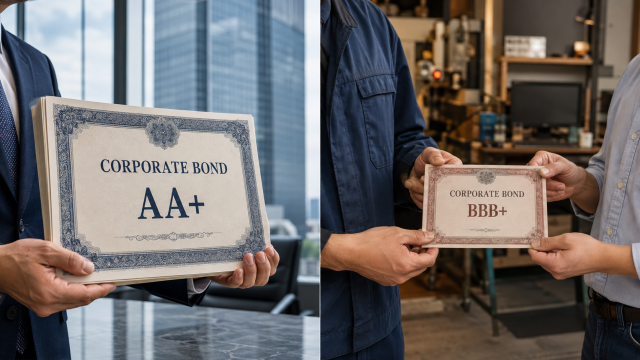
Hanjin was the only BBB-rated company to tap the public bond market in July. The BBB+ logistics company attracted 44 billion won in orders for a 40 billion won offering overall, but its one-year tranche fell 1 billion won short of its target.
By contrast, AA-rated issuers including KCC and Shinhan Securities comfortably exceeded their fundraising goals, highlighting investors' growing preference for top-tier credits rather than a broad shortage of liquidity.
The weakness has persisted throughout the year.
Net corporate bond issuance totaled 4.84 trillion won during the first seven months, down 76 percent from 20.17 trillion won a year earlier.
The deterioration was sharper among non-financial companies, whose first-half issuance fell 31.5 percent to 25.91 trillion won, resulting in net redemptions of 9.60 trillion won.
The market has also become increasingly concentrated. Bonds rated AA+ or higher accounted for 76.9 percent of non-financial issuance, while those rated BBB or below represented only 2.2 percent, suggesting credit differentiation, rather than the seasonal summer lull alone, is keeping lower-rated borrowers out of the market.
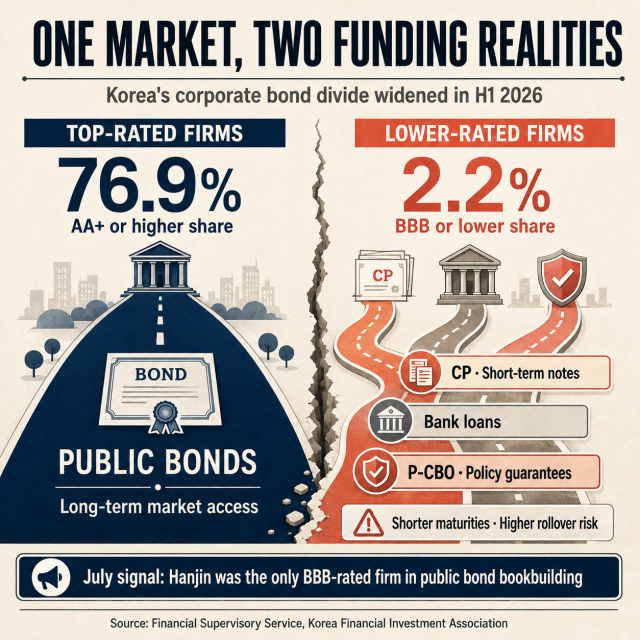
Shut out of long-term bond markets, many companies have turned to shorter-term financing.
Combined issuance of commercial paper and short-term notes surged 68 percent from a year earlier to 1,272.85 trillion won in the first half as companies opted for funding that is cheaper, faster and easier to arrange than public bond offerings.
The shift, however, comes at a cost.
Short-term borrowing must be rolled over more frequently, exposing companies to refinancing risk if liquidity tightens or interest rates remain elevated.
"The gap between long-term bond yields and short-term funding costs remains wide," another credit analyst said. "That is likely to keep corporate bond issuance subdued through September and October."
The financing squeeze is affecting companies unevenly.
Large investment-grade corporations continue to enjoy access to public bond markets, while lower-rated midsized firms increasingly rely on private placements, commercial paper, guaranteed securities and bank loans. Most SMEs remain dependent on bank lending and policy-backed guarantees, while startups rely largely on venture capital and government support rather than debt markets.
Bank financing has also become more expensive. The average lending rate for SMEs rose 23 basis points in June to 4.38 percent, compared with a seven-basis-point increase to 4.17 percent for large companies, according to the Bank of Korea, underscoring the faster rise in borrowing costs facing smaller businesses.
Policy support has helped cushion some of the strain. Korea Technology Finance Corp. (KOTEC) issued 238.9 billion won of primary collateralized bond obligations in the first half to support 129 technology SMEs, including 166 billion won in new funding and 72.9 billion won for refinancing.
The increasingly fragmented funding landscape illustrates a broader divide across corporate Korea.
While the country's semiconductor champions continue to enjoy abundant access to capital, much of the broader corporate sector is relying on shorter-term borrowing, bank credit and government-backed financing instead of long-term bonds.
If that divide persists, pressure on investment, hiring and business expansion is likely to emerge first among midsized companies, SMEs and startups, underscoring how South Korea's AI-driven chip boom continues to mask a much weaker financing environment across much of non-chip Korean Inc.
Copyright ⓒ Aju Press All rights reserved.