

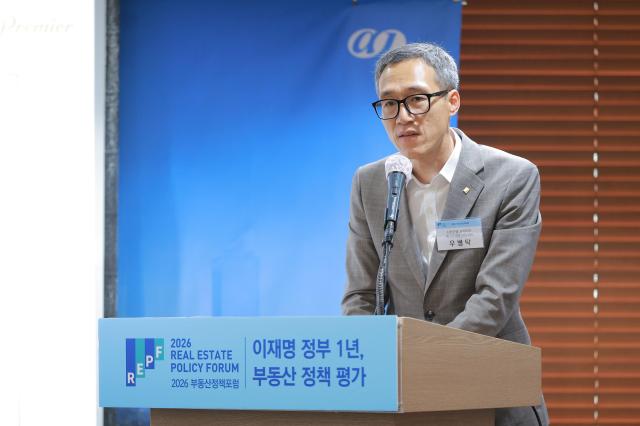
"Following the announcement of the end of the capital gains tax exemption for multiple homeowners, the number of apartments for sale in Seoul increased by about 4,000. However, once the tax was actually implemented, unsold listings were quickly withdrawn. This illustrates that the effects of tax increases can be temporary," said Woo Byeong-tak, a specialist at Shinhan Bank's Premier Pathfinder, during the '2026 Real Estate Policy Forum' held at the Korea Press Center in Seoul on June 24.
In his presentation on the theme of 'Reforming Real Estate Taxation to Protect Genuine Demand and Resolve Market Distortions,' Woo reviewed key tax measures from the past year, stating, "The market does not respond as policymakers expect."
He cited the end of the capital gains tax exemption for multiple homeowners, which was announced on January 27, as a key example. Following the announcement, the number of apartments for sale in Seoul surged by approximately 4,000. However, the actual decrease in prices fell short of expectations, according to Woo.
"Market sentiment does not adjust prices downwards by the amount of the tax increase," he noted, adding that owners do not always respond rationally to policy changes. While policies aimed at increasing tax burdens can temporarily boost listings, if transactions do not occur, it can lead to a re-locking of inventory.
Indeed, after the tax was implemented on May 10, unsold listings were quickly withdrawn, and asking prices rose again, Woo pointed out. He noted that apartment prices in Seoul had increased by 4.72% by April of this year, suggesting that the upward trend could continue in the second half of the year.
Woo also expressed caution regarding proposals to reduce the long-term holding tax exemption for high-value single homeowners. While this would decrease tax benefits for those who have owned their homes for a short time, he argued that the tax difference compared to the capital gains tax for multiple homeowners is relatively small, limiting its potential impact on price stability.
He identified the rental market's response as another variable. If high-value homeowners, seeking to maintain tax benefits, evict existing tenants to move in themselves, this could lead to a decrease in rental properties and an increase in demand for jeonse (long-term lease) in preferred areas of Seoul, where supply is already tight.
While acknowledging the need for stronger property taxes and a renewed push for realistic property valuations, Woo emphasized the importance of a balanced approach and comprehensive design. "We should not only look at the ratio of property taxes to home prices but also consider the overall structure of real estate tax revenue, including inheritance and gift taxes, as well as capital gains taxes, in relation to GDP," he stated.
Regarding the strengthening of the comprehensive real estate tax, Woo explained that the market does not simply respond by listing properties due to increased tax burdens. He cited instances from 2018 to 2022 when some multiple homeowners transferred properties to spouses or children to reduce their tax burdens during a period of rising taxes.
On the topic of realistic property valuations, Woo agreed with the direction but warned against rapid implementation. He noted that attempting to correct a 20- to 30-year gap in property valuations over 7 to 10 years, coinciding with periods of price surges, has led to increased tax resistance and a cycle of regression in the system.
Woo concluded that the core of real estate tax reform is not simply about raising or lowering tax burdens. "We must design the system to protect genuine demand while reducing market distortions," he said, emphasizing the need to consider not only policy effects but also the actual responses and side effects from market participants.
* This article has been translated by AI.
Copyright ⓒ Aju Press All rights reserved.