

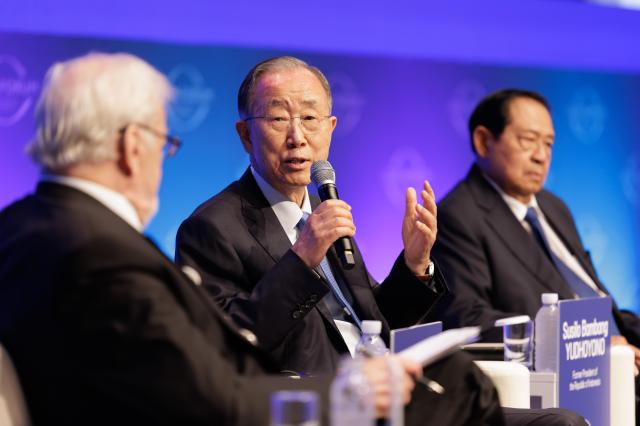
"The next candidates for UN Secretary-General must possess a long-term vision. We need to consider how the UN can accomplish more. Historically, the UN is the only internationally recognized organization," Ban Ki-moon, the former UN Secretary-General, stated during a session on potential candidates for the position at the 21st Jeju Forum for Peace and Prosperity on June 25 in Seogwipo, Jeju.
Ban emphasized that a UN Secretary-General must have moral courage, stating, "The UN's strength lies not in military or financial power, but in its member states. We must utilize international law and the UN Charter with conviction." A special discussion featuring candidates for the next UN Secretary-General is scheduled for later that afternoon at the forum.
Ban, who served as the eighth UN Secretary-General, also addressed the recent announcement that the U.S. is withdrawing from 66 international organizations, including 31 UN-related agencies, urging, "The U.S. must return to international organizations."
He further remarked, "Climate change is an issue that affects all countries globally. Whether you live in Europe, are an American, or reside in Africa, climate change impacts everyone. I hope the U.S. will rejoin the Paris Agreement."
Global leaders attending the session shared their thoughts on reimagining cooperation.
Susilo Bambang Yudhoyono, former President of Indonesia, stated, "An alliance of middle powers with determination is crucial. If Indonesia, ASEAN, South Korea, and Japan unite to voice and act as middle powers, we can prevent the U.S. and China from crossing lines."
Yukio Hatoyama, former Prime Minister of Japan, stressed the need for institutionalizing dialogue around history and security, suggesting that continuous discussions between experts and younger generations could gradually reduce differences. He added that resuming the six-party talks could also help ease tensions in the Taiwan Strait.
Former Mongolian Prime Minister Khurelsukh Khurelsukh remarked, "We must move beyond rigid multilateralism. A more flexible approach to cooperation is needed, including considering mini-lateralism."
* This article has been translated by AI.
Copyright ⓒ Aju Press All rights reserved.