

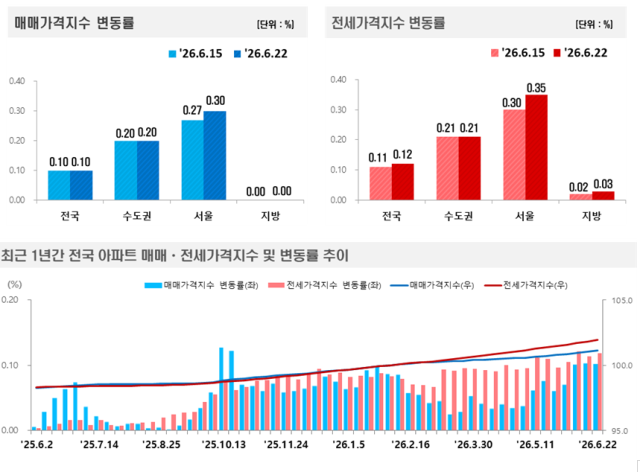
Apartment prices in Seoul have continued to rise, spreading from the Gangnam area to the outskirts of northern Seoul, marking a fourth consecutive week of increases. In Gyeonggi Province, Dongtan saw a significant surge of 1.65%, contributing to the overall strength of the metropolitan area.
According to the Korea Real Estate Agency's report on nationwide weekly apartment price trends for the fourth week of June 2026, apartment prices in Seoul rose by 0.30%, an increase of 0.03 percentage points from the previous week’s 0.27%. The metropolitan area saw a rise of 0.20%, while nationwide prices increased by 0.10%, with regional prices remaining stable at 0.00%.
In Seoul, sustained buyer interest in areas with favorable living conditions and development potential has led to price increases across all districts.
In the northern districts, Dobong-gu recorded the highest increase at 0.46%, driven by the Chang-dong and Banghak-dong station areas. This was followed by Seongbuk-gu (0.41%), Dongdaemun-gu (0.38%), Jung-gu (0.37%), and Eunpyeong-gu (0.36%).
In the southern districts, Guro-gu saw a 0.41% increase, primarily in the Gaebong and Guro-dong areas, while Gangnam-gu rose by 0.35%, focusing on redevelopment projects in Daechi-dong and Apgujeong-dong. Songpa-gu (0.29%), Yangcheon-gu (0.28%), and Gangseo-gu (0.27%) also continued their upward trends.
In Gyeonggi Province, Dongtan in Hwaseong recorded the highest increase at 1.65%, particularly in the Cheonggye-dong and Mokdong semi-new complexes. Other key areas in southern Gyeonggi, such as Seongnam's Jungwon-gu (0.59%), Anyang's Dongan-gu (0.49%), Seongnam's Sujeong-gu (0.47%), and Seongnam's Bundang-gu (0.42%), also maintained strong performance.
Nam Hyuk-woo, a researcher at Woori Bank's Real Estate Research Institute, noted, "Due to the short-term surge in Dongtan, some demand is shifting to nearby areas like Suwon's Yeongtong-gu and Seongnam's Sujeong and Jungwon-gu due to price burdens and regulatory concerns. In southern Gyeonggi, a shortage of rental listings is also leading tenants to consider purchasing."
Conversely, Gwacheon City experienced a decline of 0.15%, primarily in older apartments in Jungang-dong and Burim-dong.
The rental market also continued its upward trend. In Seoul, apartment rental prices increased from 0.30% to 0.35% week-over-week, driven by the depletion of listings in large complexes, school districts, and transit-accessible areas.
In Seoul, Seongdong-gu and Seongbuk-gu recorded the highest rental increases at 0.55%, followed by Dobong-gu (0.53%), Nowon-gu (0.49%), and Songpa-gu (0.42%). In Gyeonggi Province, rental prices rose in Dongtan (0.53%), Gwangmyeong (0.40%), Guri (0.36%), and Suwon's Yeongtong-gu (0.29%).
Nam added, "While rental prices have surged, the increase in sale prices has been relatively slower in areas like Dobong-gu and Guro-gu. This has led to an influx of first-time homebuyers and newlyweds seeking apartments priced around 600 million won, which qualify for policy loans."
He further noted, "As the price strength in popular regulated areas of Seoul continues, we are seeing a phenomenon of demand shifting to non-regulated areas in Gyeonggi, such as Goyang's Deogyang and Ilsanseo-gu, and Suwon's Gwonseon-gu, in a 'price alignment' trend."
* This article has been translated by AI.
Copyright ⓒ Aju Press All rights reserved.