

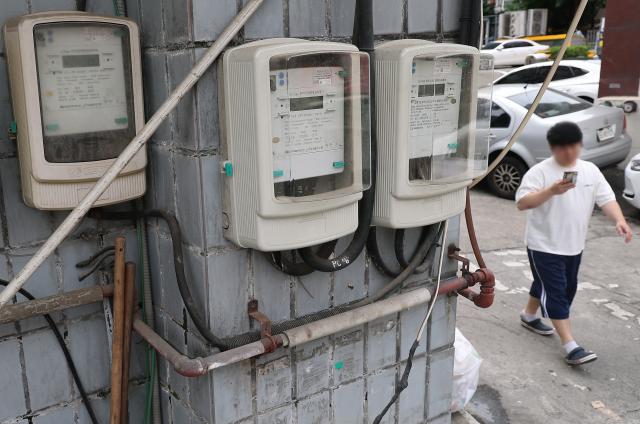
Electric meter installed in a building in Seoul [Photo=Yonhap News]
This summer, power demand is expected to reach unprecedented levels, yet there are concerns about insufficient measures to manage this demand. While efforts to expand renewable energy sources are accelerating, strategies for energy conservation are largely lacking.
According to the Ministry of Climate, Energy, and Environment, peak power demand this summer is projected to reach between 94.1 and 98.8 gigawatts (GW) during the third week of August. This figure surpasses the previous record of 97.1 GW set on August 20, 2024, and is higher than last year's peak demand of 96.0 GW recorded on August 25.
In response, authorities plan to enhance supply capacity by increasing the number of new liquefied natural gas (LNG) combined-cycle power plants and solar energy installations. They have secured a power supply capacity of 107 GW, an increase of 2 GW from last year. Even if peak demand rises to 98.8 GW, this would leave a reserve capacity of 8.2 GW.
However, while supply measures are in place, demand management strategies remain inadequate. A key issue is the repeated freezing of electricity rates. On June 22, Korea Electric Power Corporation (KEPCO) announced it would maintain the fuel cost adjustment rate at the current level of 5 won per kilowatt-hour (kWh) for the third quarter (July to September). This marks the 17th consecutive quarter of unchanged rates since the third quarter of 2022.
The freeze on electricity rates may reduce incentives for households and industries to conserve energy. The third quarter, which sees high demand due to increased use of cooling devices, is particularly sensitive to price changes. If electricity rates do not reflect actual generation costs, both consumers and businesses may have less motivation to invest in energy-saving measures, leading to increased consumption and subsequent demand pressures.
Meanwhile, the burden on power authorities has grown due to unfavorable supply chain conditions following the conflict in the Middle East. The prices of fuels necessary for power generation, such as coal and LNG, have surged, and the exchange rate of the won against the dollar has significantly increased compared to pre-war levels.
In this context, rising demand pressures could translate into financial burdens for KEPCO. While consumer costs for electricity may decrease, KEPCO would bear the financial strain, potentially exacerbating its debt situation. Although KEPCO has recently maintained a profit trend, market assessments suggest that these profits are insufficient to offset accumulated debt and unaccounted fuel costs.
If KEPCO's financial situation worsens, various future projects may face difficulties. Substantial funding is required for the government’s initiative to establish an energy highway.
However, raising funds through bond issuance is challenging due to KEPCO's debt exceeding 200 trillion won. Last year, KEPCO incurred interest expenses of approximately 12 billion won per day, totaling 3.2794 trillion won. Analysts suggest that without an increase in electricity rates, repaying this debt will be difficult.
According to the Ministry of Climate, Energy, and Environment, peak power demand this summer is projected to reach between 94.1 and 98.8 gigawatts (GW) during the third week of August. This figure surpasses the previous record of 97.1 GW set on August 20, 2024, and is higher than last year's peak demand of 96.0 GW recorded on August 25.
In response, authorities plan to enhance supply capacity by increasing the number of new liquefied natural gas (LNG) combined-cycle power plants and solar energy installations. They have secured a power supply capacity of 107 GW, an increase of 2 GW from last year. Even if peak demand rises to 98.8 GW, this would leave a reserve capacity of 8.2 GW.
However, while supply measures are in place, demand management strategies remain inadequate. A key issue is the repeated freezing of electricity rates. On June 22, Korea Electric Power Corporation (KEPCO) announced it would maintain the fuel cost adjustment rate at the current level of 5 won per kilowatt-hour (kWh) for the third quarter (July to September). This marks the 17th consecutive quarter of unchanged rates since the third quarter of 2022.
The freeze on electricity rates may reduce incentives for households and industries to conserve energy. The third quarter, which sees high demand due to increased use of cooling devices, is particularly sensitive to price changes. If electricity rates do not reflect actual generation costs, both consumers and businesses may have less motivation to invest in energy-saving measures, leading to increased consumption and subsequent demand pressures.
Meanwhile, the burden on power authorities has grown due to unfavorable supply chain conditions following the conflict in the Middle East. The prices of fuels necessary for power generation, such as coal and LNG, have surged, and the exchange rate of the won against the dollar has significantly increased compared to pre-war levels.
In this context, rising demand pressures could translate into financial burdens for KEPCO. While consumer costs for electricity may decrease, KEPCO would bear the financial strain, potentially exacerbating its debt situation. Although KEPCO has recently maintained a profit trend, market assessments suggest that these profits are insufficient to offset accumulated debt and unaccounted fuel costs.
If KEPCO's financial situation worsens, various future projects may face difficulties. Substantial funding is required for the government’s initiative to establish an energy highway.
However, raising funds through bond issuance is challenging due to KEPCO's debt exceeding 200 trillion won. Last year, KEPCO incurred interest expenses of approximately 12 billion won per day, totaling 3.2794 trillion won. Analysts suggest that without an increase in electricity rates, repaying this debt will be difficult.
* This article has been translated by AI.
Copyright ⓒ Aju Press All rights reserved.