

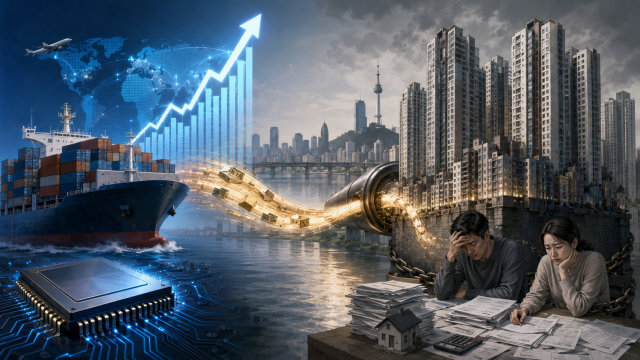
On the surface, South Korea's economy appears to be doing well, buoyed by a resurgence in semiconductor production and stable performances in the automotive and shipbuilding sectors. Amid global supply chain shifts, South Korean companies continue to maintain their presence in international markets. However, the reality for many citizens is starkly different. Salaries have not significantly increased, while housing prices, rent, and loan interest rates have become burdensome. Small business owners report a decline in customers, and young people are postponing marriage and childbirth. If exports are thriving, why are lives becoming more difficult?
The issue extends beyond simple economic downturns. The longstanding growth formula that South Korea has relied on is reaching its limits. Exports from large corporations have traditionally driven the economy, while rising real estate prices have supported consumption, tax revenue, and asset effects. This formula once worked effectively: increased exports led to factory operations, job creation, and wage growth. As housing prices rose, the middle class felt wealthier, stimulating construction investment and household consumption. Exports and real estate were the two pillars of the South Korean economy.
However, the nature of these two pillars has changed. While exports remain crucial, their benefits are no longer widely distributed. Industries such as semiconductors, batteries, and artificial intelligence require substantial capital and technology investments. Although they are highly productive and generate significant value, their impact on job creation is not as robust as during the peak of traditional manufacturing. Even when large corporations report strong earnings, the benefits do not quickly reach local businesses, small enterprises, or youth employment. The era when export booms directly translated into domestic recovery is fading.
Real estate presents an even greater challenge. Rising housing prices were once seen as a sign of economic recovery. Homeowners felt wealthy, banks increased mortgage lending, and governments anticipated revenue from transaction and property taxes. However, the current rise in housing prices no longer reflects a healthy asset effect. For young people, it represents an insurmountable barrier to entry; for households, it means lifelong debt; and for society as a whole, it pressures individuals to forgo childbirth.
While rising housing prices may give the illusion of economic improvement, they essentially draw future consumption into the present. When households take out loans to purchase homes, it temporarily boosts transactions and stimulates construction and finance. However, the subsequent burden of principal and interest payments stifles consumption. Funds that should go toward raising children, education, and retirement savings are diverted to bank interest. The rise in real estate prices is no longer revitalizing domestic consumption; instead, it is eroding it.
The concentration of resources in Seoul exacerbates this issue. With good jobs, universities, hospitals, and cultural infrastructure concentrated in the capital region, young people feel compelled to remain in Seoul. It is not that they do not want to live in rural areas, but rather that opportunities are found in the capital. As a result, housing prices in Seoul continue to rise, while rural areas lose population and consumer bases. Young people in the capital are burdened by high housing costs, while those in rural areas face frustration due to a lack of opportunities. At this point, the housing crisis is not just a real estate issue; it has become a core economic problem affecting growth, distribution, demographics, and regional balance.
A more significant risk is that the government and political circles have yet to abandon outdated formulas. They continue to assert that a strong export performance indicates a healthy economy and express concern that falling housing prices could lead to economic collapse. While exports are indeed vital to South Korea's economy, and a sharp decline in real estate could trigger financial instability, if export performance does not translate into improved living standards and rising housing prices rob future generations of opportunities, it cannot be labeled as growth.
Economic policy standards must also evolve. It is essential to look beyond export figures and growth rates to understand how that money flows into wages, investments, domestic consumption, and regional economies. If semiconductor companies are thriving, pathways must be created to ensure that benefits reach suppliers, research personnel, and local economies. Investments in advanced industries should not be concentrated solely in the capital region; regional hubs must also be developed. The profits generated by large exporting companies should not remain in financial markets and real estate but should lead to productive investments and quality job creation.
Real estate policies must follow suit. It is a misconception to view support for rising housing prices as an economic strategy. Housing stability should not mean continuously increasing prices but rather ensuring that working individuals can afford to live at reasonable prices. If young couples are pushed to the outskirts of Seoul and dual-income families delay childbirth due to loan repayments, the foundation for growth in that society is already shaking. The focus must shift from housing prices to the lives of people.
South Korea's economy stands at a crossroads. Relying on large exporting companies and rising apartment prices is no longer a viable way to persuade the public. An economy where exports are strong, but lives are deteriorating, and housing prices are rising while futures are narrowing cannot be sustained. What is needed is not more loans or higher housing prices, but a new growth circuit where the benefits of exports translate into wages and jobs, housing costs decrease, and opportunities for living are found in rural areas as well.
The era of relying on exports to earn and housing prices to endure is coming to an end. The question South Korea's economy must now ask is not how much exports have increased, but whose lives have improved as a result. It is not about how much housing prices have risen, but who is sacrificing their future because of those prices. If these questions remain unanswered, the numbers reflecting the export boom will increasingly ring hollow.
* This article has been translated by AI.
Copyright ⓒ Aju Press All rights reserved.