

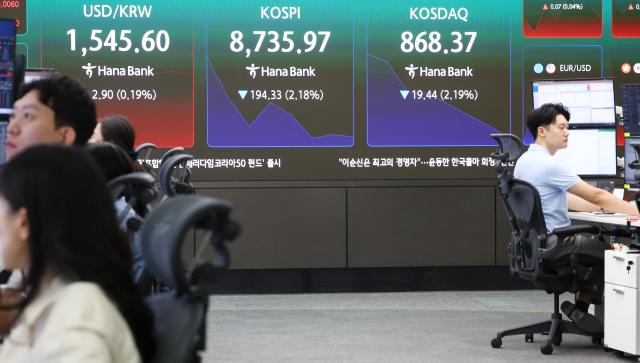
The KOSPI index dropped more than 8% during trading on June 26, leading to a temporary halt in trading on the stock market. A sell sidecar was activated early in the session, but it failed to prevent the decline, which ultimately triggered a circuit breaker (CB). Amid panic selling from foreign and institutional investors, major stocks saw significant losses, causing a sharp decline in investor sentiment.
According to the Korea Exchange, just before the activation of the first stage circuit breaker at 12:10 PM, the KOSPI had fallen 731.97 points (8.19%) to 8,198.33 compared to the previous trading day.
The index showed a downward trend from the start of the session, and the decline persisted for over a minute, leading to the activation of the first stage circuit breaker. The Korea Exchange cited the weakness of major U.S. tech stocks as a contributing factor for this event.
This circuit breaker marks the fifth activation this year and the 11th since the system was introduced.
As a result of the circuit breaker, trading in the KOSPI spot market was suspended for 20 minutes. Following this, a single price auction was conducted for 10 minutes before transitioning to continuous trading. If the index falls more than 15% from the previous closing price and drops an additional 1% from the first stage activation level, a second stage circuit breaker will be triggered, resulting in another 20-minute trading halt. If the index then falls more than 20% and drops an additional 1% from the second stage activation level, a third stage circuit breaker will be activated, ending trading for the day.
Before the circuit breaker was activated, a sell sidecar was triggered at 11:12 AM.
The sell sidecar is a mechanism designed to mitigate the impact of sudden changes in the futures market on the spot market. It is activated when the KOSPI 200 futures price falls more than 5% from the reference price and remains at that level for one minute.
On this day, the mini KOSPI 200 futures dropped from a reference price of 1,454.88 points to 1,382.00 points, meeting the activation criteria. Consequently, the effectiveness of program trading sell orders was suspended for five minutes. At the time of activation, the net selling volume from program trading was 1.6786 trillion won.
The decline was primarily driven by foreign and institutional investors. In the stock market, individuals net purchased 4.6625 trillion won, while foreign and institutional investors net sold 3.7753 trillion won and 1.0212 trillion won, respectively.
Most of the top market capitalization stocks experienced significant declines, including Samsung Electronics (-9.34%), SK Hynix (-9.46%), SK Square (-13.59%), Samsung Electro-Mechanics (-2.20%), Hyundai Motor (-7.55%), Samsung Life (-6.04%), Samsung C&T (-6.74%), LG Energy Solution (-7.24%), Samsung Biologics (-5.12%), SK (-5.36%), and HD Hyundai Heavy Industries (-5.15%).
The KOSDAQ also saw a sharp drop.
Meanwhile, the KOSDAQ, which continued trading, recorded a decline of 45.77 points (5.16%) to 842.04 as of 12:29 PM compared to the previous trading day.
In the KOSDAQ market, individuals net sold 430 billion won, while foreign and institutional investors net purchased 145.5 billion won and 280.6 billion won, respectively.
With the suspension of trading in the spot market, trading in the derivatives market was also halted in tandem.
The Korea Exchange announced that all derivative trading related to the KOSPI 200 futures, options, mini products, KRX 300 futures, and KRX BBIG, secondary battery, bio, semiconductor, and Korea Value-Up Index futures would also be suspended.
Market analysts suggest that the recent volatility was exacerbated by profit-taking in the semiconductor sector following a sharp rebound.
Han Ji-young, a researcher at Kiwoom Securities, noted, "The more than 6% drop in Apple shares on the previous day was due to concerns over rising memory prices leading to product price increases and a subsequent decline in final set demand. This has raised worries not only for consumer goods but also for hyperscaler companies, which may feel the pressure of rising memory prices, potentially weakening their future capital expenditure (CAPEX) intentions."
She added, "In the past two trading days, the KOSPI surged nearly 8.9%, with the semiconductor sector leading the way, but today we saw profit-taking from those stocks. At the same time, the exit of passive funds heavily invested in semiconductors has spread selling pressure across most sectors."
However, she concluded that rumors about the postponement of OpenAI's IPO or renewed uncertainties regarding the Strait of Hormuz had a limited impact on the day's sharp decline.
* This article has been translated by AI.
Copyright ⓒ Aju Press All rights reserved.