

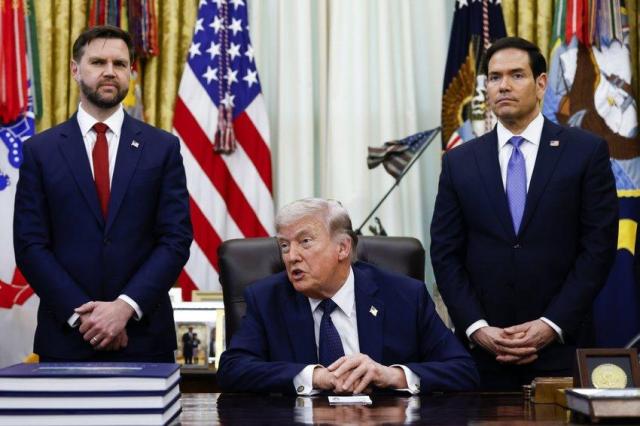
Reuters reported on June 26 that while the Trump administration is presenting a common message regarding the Iran war and peace agreement, Vance and Rubio's recent statements have occasionally conflicted, particularly concerning Israel. Both officials have been on foreign trips to explain the preliminary U.S.-Iran peace agreement signed on June 17.
Vice President Vance recently criticized Israeli officials who have spoken against the U.S.-Iran agreement, stating that Israel's bombing of civilian infrastructure in Beirut under the pretext of weakening Hezbollah is undermining U.S.-led peace efforts.
In contrast, Secretary Rubio defended Israel's military operations during his visit to the Gulf region this week. He described the attacks as a "justified response to Hezbollah's aggression" and avoided directly addressing Vance's criticisms, instead referencing Hezbollah's recent attack on an Israeli checkpoint.
Differences also emerged in their approaches to relations with Iran. After conducting follow-up negotiations with Iranian representatives in Switzerland, Vance expressed optimism about the talks. He mentioned the possibility of Gulf nations supporting Iran's reconstruction costs and the potential for a cooperative relationship between the U.S. and Iran. In a June 25 interview, he revealed that the U.S. had invited an Iranian intelligence official to Qatar to serve as a liaison to prevent conflicts with the Pentagon.
Rubio took a more cautious stance. During his visits to the United Arab Emirates, Kuwait, and Bahrain, he addressed concerns from allies that the U.S.-Iran interim agreement may be too favorable to Iran. On June 24, he assured Gulf nations that the U.S. would not request support for Iran's reconstruction costs, stating that such a possibility is "still a distant prospect."
During a meeting with regional officials on June 26, Rubio emphasized that any agreement must ensure the interests of the U.S. and its allies are firmly protected. He stated, "We want an agreement, but we are not willing to agree at any cost."
The White House and State Department have sought to downplay the differences in their statements, asserting that they do not reflect a divergence in foreign policy. The White House stated, "There is only one camp, and that is President Trump’s camp," while the State Department noted that both officials are following the President's directives. Rubio also told reporters on June 26, "Everyone is aligned behind the President."
However, both officials are seen as representing different foreign policy paths within the Republican Party. Vance has frequently expressed that overseas wars waste American lives and resources, while Rubio has been categorized as a hawk due to his hardline stance on Iran, Russia, and Cuba during his time in the Senate.
Both are also considered potential candidates for the 2028 presidential election. Their differing statements reflect not only the Trump administration's approach to negotiations with Iran but also the competition over the future direction of Republican foreign policy. According to a Reuters-Ipsos poll, only 52% of Republican supporters believe the current conflict with Iran has positioned the U.S. more strongly.
* This article has been translated by AI.
Copyright ⓒ Aju Press All rights reserved.