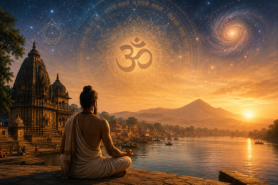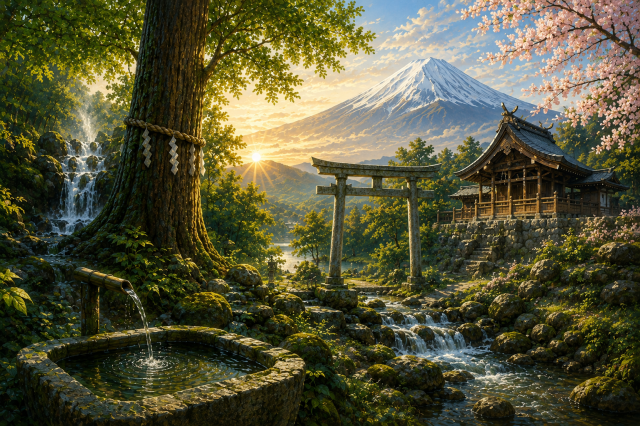
To understand Japan deeply, you must first understand Shinto. Shinto is the oldest religion in the Japanese mind, and also a living sensibility. It is a way of relating to nature. It is an invisible spiritual web connecting ancestors, villages, and the nation. The Japanese did not look at a mountain and see mere terrain. They did not look at the sea and see mere water. In old trees and rocks, in waterfalls and rivers, in sunlight and wind, they sensed something sacred. That is where Shinto begins.
At the heart of Shinto is kami, a word often translated as "god" but nothing like the absolute deity of Western monotheism. Kami dwells in mountains and in seas, in forests and in ancestors, in extraordinary human beings and in the collective memory of communities. Encyclopaedia Britannica describes how, in ancient Shinto, people found kami in the natural world, in the forces that governed sea and mountain, and in exceptional human beings.
The Jinja Honcho, the organization that oversees Shinto shrines across Japan, explains that Shinto has no single founder, no fixed doctrine, and no canonical scripture. It has expressed itself through reverence for nature and ancestors.
This is significant. Shinto is less a religion of doctrine than a religion of sensation. Feeling comes before logic. Ritual comes before scripture. Purification comes before confession. The Japanese did not explain their gods so much as stand before them, wash their hands, bow deeply, clap their palms together, and settle their minds. Rather than proving faith through words, they received the sacred through space and gesture and silence. To understand Shinto, the textbooks are not enough. You need to walk a forest path at dawn, stand before a torii gate at a shrine, hear the sound of water washing over your hands, and watch the light come through ancient cedar trees.
The first face of Shinto is the worship of nature. The Japanese archipelago is a land of volcanoes and earthquakes, typhoons and tsunamis, snow and rain and open sea. Nature was beautiful and, at the same time, terrifying. Cherry blossoms bloomed with an almost painful brightness, then fell within days. Mount Fuji stood in magnificent silence but carried the memory of eruption. The sea gave fish and brought catastrophe. Living inside this reality, the Japanese came to see nature not as something to be conquered but as something to be honored and appeased. Nature was greater than human beings, older than human beings, and beyond human control.
In the world of Shinto, nature is not material but relationship. A single tree is not simply timber. A rock is not simply stone. A waterfall is not only water falling. It is a place where sacred power makes itself visible. A mountain is not a hiking route. It is a space where kami reside. Shinto does not draw a sharp line between humanity and the natural world. Human beings are not masters standing outside nature. They are one presence within it. This sensibility forms one of the deepest foundations of Japanese culture.
Another defining quality of Shinto is its openness to the possibility of the sacred in all things. There is an expression in Shinto, yaoyorozu no kami, which translates literally as eight million gods, but its real meaning is that divine presence is too numerous to count. Sacred energy inhabits every corner of the world. The phrase compresses an entire Japanese worldview. The sacred is not far away in some distant sky. It lives at the entrance to the village, along the ridge of a rice paddy, in the kitchen, in the forest, at the well, in the memory of ancestors, in the noise of festival, in the turn of the seasons.
This worldview flows into the texture of Japanese daily life. The Japanese have a strong instinct for cleanliness, for keeping their homes in order, for presenting food with care, for attending closely to the change of seasons. Not every individual lives this way, of course, but across Japanese culture there runs a powerful current of feeling for cleanliness, order, and restraint. Harae, the Shinto ritual of purification, is the religious root of this cultural disposition. Materials connected to Kokugakuin University, an institution in Tokyo with a long history of Shinto studies, explain that purification ritual is one of the most important elements in Shinto and is deeply linked to Japanese notions of cleanliness.
In Shinto, impurity is not simply a matter of hygiene. It is a state of disorder, of imbalance, of something obscuring the flow of life. The act of washing hands and rinsing the mouth before entering a shrine is not a formality. It is the work of restoring the self, mind and body together. Human beings are not perfect. They become muddied and disordered. So they wash again. They bow again. They begin again. This is one of Shinto's central spirits.
Here we can see how Shinto connects to a Japanese habit of mind that might be called a culture of reset. Japan has a tradition of preserving the old while simultaneously rebuilding it fresh. The clearest example is Ise Jingu, among the most sacred shrine complexes in Japan and one that has maintained, over a very long span of history, the practice of periodically rebuilding its structures. The Associated Press has reported that this rebuilding tradition at Ise Jingu has continued for more than 1,300 years and stands as a symbol of Shinto's spirit of renewal and transmission.
This tradition is genuinely striking. Western approaches to cultural heritage typically prioritize preserving the original physical material. The approach at Ise Jingu is different. The aim is not to hold on to matter indefinitely but to pass form, spirit, and craft from one generation to the next. The building is new, but the spirit continues. The wood changes, but the ritual endures. People die, but the master craftsman passes the technique on. This reveals something about Shinto's sense of time. Eternity is not stillness. It lives in repetition and renewal.
To understand Shinto, the relationship with Buddhism also matters. After Buddhism arrived in Japan, the two traditions did not simply clash. Over long centuries they blended and shaped each other. A Japanese person might visit a Buddhist temple to pray for the peace of a deceased relative and a Shinto shrine to wish for blessings in the new year. Weddings are often celebrated in the Shinto manner, funerals in the Buddhist manner. Harmony in daily life came before strict doctrinal division. This is one of the defining characteristics of Japanese religious culture.
But Shinto cannot be understood simply as a beautiful religion of nature. It created warm traditions of village community, ancestor veneration, and seasonal festival. It also, in the modern era, fused with nationalism and revealed a dangerous face. Reverence for nature and ancestors is a precious thing. When that reverence is combined with state power and made absolute, however, religion can stop being a force that liberates human beings and become an instrument for mobilizing them.
A balanced view of Shinto is therefore necessary. Neither romanticizing it nor dismissing it. There is something genuinely worth learning from Japanese Shinto. The habit of treating nature with care. The commitment to not forgetting ancestors. The culture that preserves the rhythms of village and season. The discipline of maintaining a clean and ordered space. These are values that the world today needs to revisit. In an era of climate crisis and ecological collapse, a civilization that treats nature as pure resource has reached its limits. In that sense, Shinto's way of seeing nature carries a message for the contemporary world.
At the same time, we must look with clear eyes at how Shinto combined with state power across its history. When religion remains in the place of loving nature and honoring ancestors, it becomes a root for living. When it is distorted into the logic of state command and militarism, it becomes dangerous. Spirituality should be a force that humbles and opens human beings, not a means of narrowing and excluding them.
The deep attraction of Japanese Shinto lies in what might be called proximity to the sacred. The divine is not only in a distant sky. It is in the morning light. It is in the shade of an ancient tree. It is in the memory of ancestors. It is in the drumbeat of a village festival. Shinto says to human beings: the world is not an assembly of dead matter. The world is a living web of relationships. So do not treat it carelessly. Do not make it dirty. Do not forget. Give thanks.
This message connects to Asian spirituality as a whole. Hinduism speaks of the vast order of the cosmos. Buddhism speaks of suffering and compassion. Taoism speaks of the flow of nature and the wisdom of non-action. Shinto finds the sacred in nearby nature, in ancestors, in the village. Shinto's philosophical framework is thin, but its daily sensibility is strong. Its canonical texts are few, but the rituals repeated through the body are deep. That is where Shinto's power lives.
For South Koreans, Shinto feels unfamiliar and yet not entirely foreign. South Korea also carries traditions of mountain spirits, dragon kings, village guardian shrines, ancestral rites, community shamanistic rituals, and sacred trees at the edge of a village. The impulse to revere mountains and rivers and ancestors was the shared foundation of East Asian agricultural civilization. Japan simply organized and preserved this under the name Shinto, weaving it into state and culture more systematically. South Korea dispersed and carried the same impulse across Confucianism, Buddhism, shamanism, and folk belief. Understanding Shinto, then, is not only a way of understanding Japan. It is also a way of looking back at the old Asian sensibility that still lives somewhere within us.
The world today stands before nature once again. Industrial civilization made human beings powerful but made it too easy to consume the natural world. As the age of artificial intelligence opens, human beings are moving toward a faster, more convenient world and, at the same time, experiencing a deeper emptiness and disconnection. In this moment, the question Shinto puts forward is simple. Can human beings be happy after losing nature? Can they have roots after forgetting their ancestors? Can they keep a clear mind while dirtying the spaces they inhabit?
Shinto's answer is quiet. First, wash. First, bow your head. First, set down human arrogance before the natural world. Only those who can feel gratitude before a single old tree, before the turning of the seasons, before the memory of those who came before, can live in a way that is truly human.
That is the first conclusion of this story of Japanese Shinto. Shinto is Japan's religion, but running through it is one current of a natural spirituality that Asia has carried for a very long time. The understanding that human beings are not rulers standing over nature but beings living within it. The sensibility that all things are not dead objects but living presences within relationship. The belief that the sacred is not far away but here, right now, in the ground beneath our feet, the water we drink, and the sky we look up at.
Copyright ⓒ Aju Press All rights reserved.