

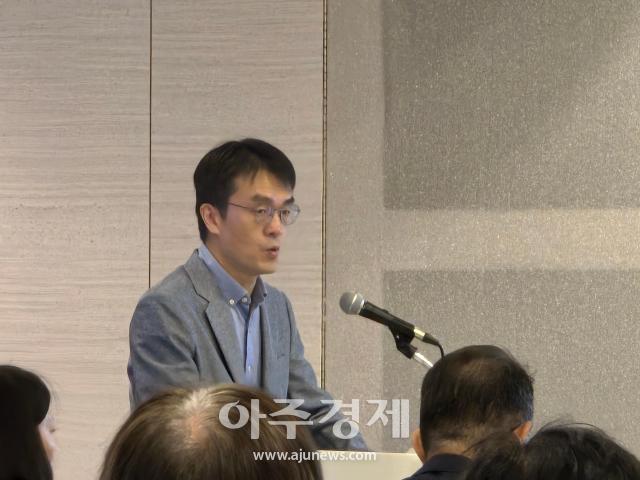
The first session of the 'First Future Social Security Forum,' held on June 26, focused on the dark side of future society brought about by artificial intelligence (AI) and the urgent need for innovative reforms in social security systems. Presenters Kim Ki-tae from the Korea Institute for Health and Social Affairs and Jang Ji-yeon from the Korea Labor Institute warned that the AI transformation (AX) will introduce new threats that the existing welfare system cannot manage.
Kim Ki-tae: "AI Creates Third-Generation Risks... Blurring Human-Nonhuman Boundaries"
Kim Ki-tae categorized the risks posed by technological advancements into three stages, diagnosing that the current AI technology revolution is giving rise to a new type of 'third-generation social risk.'
The first risk he identified is 'institutional exclusion from global digital labor.' He noted a significant increase in workers operating outside the domestic social security system due to the rise of borderless platform labor. He expressed concern, stating, "By 2030, 92 million people worldwide will be engaged in this global digital labor."
The second risk is the emergence of 'cyber risks.' With hacking and data breaches threatening personal privacy and property rights, he argued that there is an urgent need for a public protection system at the national level, rather than relying solely on private insurance.
Furthermore, Kim highlighted the serious long-term threats posed by the advent of a 'post-labor society' and changes in the concepts of human relationships and social rights. He warned that as people form attachments to robots or AI, traditional concepts of social rights and solidarity could be fundamentally shaken.
As a solution, Kim emphasized the need for broad policy imagination, including the restructuring of tax systems such as robot and digital taxes, the introduction of universal basic services (UBS) and basic assets, and the redefinition of the boundaries between human and nonhuman entities.
The first risk he identified is 'institutional exclusion from global digital labor.' He noted a significant increase in workers operating outside the domestic social security system due to the rise of borderless platform labor. He expressed concern, stating, "By 2030, 92 million people worldwide will be engaged in this global digital labor."
The second risk is the emergence of 'cyber risks.' With hacking and data breaches threatening personal privacy and property rights, he argued that there is an urgent need for a public protection system at the national level, rather than relying solely on private insurance.
Furthermore, Kim highlighted the serious long-term threats posed by the advent of a 'post-labor society' and changes in the concepts of human relationships and social rights. He warned that as people form attachments to robots or AI, traditional concepts of social rights and solidarity could be fundamentally shaken.
As a solution, Kim emphasized the need for broad policy imagination, including the restructuring of tax systems such as robot and digital taxes, the introduction of universal basic services (UBS) and basic assets, and the redefinition of the boundaries between human and nonhuman entities.
Jang Ji-yeon: "AI Employment Shock Already Affecting Youth... Double Pressure on Welfare State"
Jang Ji-yeon narrowed the focus to the labor market, using data to demonstrate that the threat from AI is not a future concern but a 'current reality.'
She identified the 'youth' as the first victims of the employment shock caused by AI, noting that companies are maintaining existing staff while reducing new hires due to AI implementation, leading to what she termed 'delayed entry' for young people. Jang warned, "This initial failure to enter the job market will leave a lifelong scar, resulting in severe polarization in the labor market."
Jang cautioned that these changes could lead to even greater issues beyond just delayed entry into the labor market, potentially undermining the foundations of existing social security systems. She pointed out, "Korea's welfare system fundamentally relies on social insurance premiums based on wage earners. If AI replaces human labor and reduces wage shares, the financial foundation of social insurance will inevitably collapse."
Additionally, she warned that as society ages, the explosive increase in costs for essential services like care and healthcare could create a 'dual squeeze' situation.
As a solution, Jang urged immediate targeted support for job-seeking youth in the short term, and in the long term, a transition from the current social insurance system reliant on wages to a diversified funding model through general taxation or new revenue sources (such as an AI tax) and a shift towards a basic social structure.
* This article has been translated by AI.
She identified the 'youth' as the first victims of the employment shock caused by AI, noting that companies are maintaining existing staff while reducing new hires due to AI implementation, leading to what she termed 'delayed entry' for young people. Jang warned, "This initial failure to enter the job market will leave a lifelong scar, resulting in severe polarization in the labor market."
Jang cautioned that these changes could lead to even greater issues beyond just delayed entry into the labor market, potentially undermining the foundations of existing social security systems. She pointed out, "Korea's welfare system fundamentally relies on social insurance premiums based on wage earners. If AI replaces human labor and reduces wage shares, the financial foundation of social insurance will inevitably collapse."
Additionally, she warned that as society ages, the explosive increase in costs for essential services like care and healthcare could create a 'dual squeeze' situation.
As a solution, Jang urged immediate targeted support for job-seeking youth in the short term, and in the long term, a transition from the current social insurance system reliant on wages to a diversified funding model through general taxation or new revenue sources (such as an AI tax) and a shift towards a basic social structure.
* This article has been translated by AI.
Copyright ⓒ Aju Press All rights reserved.