

"A little indulgence is forgivable. Let’s melt away stress. Desire is not the enemy; it’s a lifelong friend." This is the tagline from the advertisement for Suntory Beverage & Food's new carbonated drink, 'Guilty Carbonated NOPE,' launched in March. The drink boasts an array of flavors, combining over 99 types of fruits and spices, and has a sweetness level of 13.3, significantly higher than the typical 9-11 found in regular sodas. Despite this, within just 50 days of its release, 55 million bottles were shipped, marking the fastest sales rate for Suntory's carbonated drinks since 2019. This comes at a time when the market has been declining due to a growing health-conscious trend. According to the Japanese research firm Beverage Market, carbonated drink shipments fell by about 9% in 2025 compared to seven years prior, making the success of 'Guilty Carbonated NOPE' noteworthy.
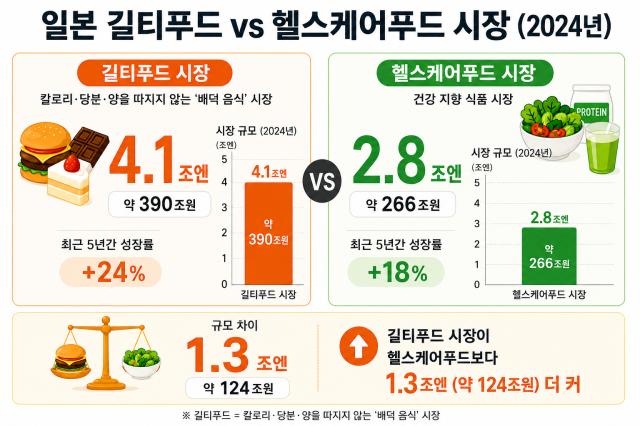
The concept of 'guilty consumption' is rapidly gaining traction in Japan's food market. This term refers to the enjoyment of "delicious foods that induce guilt" without concern for calories, sugar content, or portion sizes. According to a report by the Asahi Shimbun, citing data from the market research firm Fuji Economic, the guilty food market in Japan is projected to reach 4.1 trillion yen (approximately $39 billion) by 2024, a 24% increase from five years ago. In contrast, the health-focused healthcare food market grew only 18% to 2.8 trillion yen (about $26 billion) during the same period, indicating that the guilty consumption market is expanding more rapidly.
Food companies have shifted their messaging. Once secretive about high-calorie and high-sugar products, they now prominently feature terms like 'guilt,' 'forbidden,' and 'pork lard' in their product names and advertisements. Instead of promoting health benefits, they emphasize indulgence and irresistible flavors. Products launched under this new strategy have seen significant success. For instance, House Foods' retort curry 'Curry de Nikuru,' released in February last year, contains 50 grams of beef (or 55 grams of pork) in a 160-gram package, making it the meatiest option in their lineup. Without any advertising, it surpassed 1 million units sold within a year. The curry developer stated, "The star is not the curry; it’s the meat. We did not target health-conscious consumers."
Additionally, FamilyMart's frozen bibimyeon 'Starman Maze Soba,' enriched with garlic, rich soy sauce, and pork lard, has become the second-best-selling frozen food as of May, with 535 calories. Pasco's 'Guilty Whipped Melon Bread' (375 calories), developed in collaboration with Gakushuin University students, ranked second among new products in March.
Interestingly, the primary consumers of these products are not those indifferent to health, but rather the health-conscious MZ generation, aged 15 to 44. A survey conducted by Gakushuin University found that while 70% of the 50 students considered themselves health-conscious, 80% expressed a desire for high-calorie meals.
Yukihiro Aoki, an honorary professor at Gakushuin University, attributes this contradiction to the digital age and a stressful society. He told Asahi, "With the abundance of health information due to digitalization, young people's health consciousness is high, but they need a break from that mindset. 'Isn't it okay sometimes?' is the justification for guilty consumption." He noted that for young people burdened by part-time jobs, studies, and job hunting, easy meals serve as an escape. Associate Professor Tomoko Ikari of Meisei University highlighted the importance of efficiency, suggesting that young consumers prioritize satisfaction and time-saving, as well as stress relief. She stated, "Guilty consumption leads to psychological stability by easily filling calories while enduring a stressful society."
Ultimately, in Japan, guilt is no longer a hidden flaw but has become a product concept. While health foods target the 'self that must endure,' guilty foods appeal to the 'self that wants to break down just for today.' Amid a backdrop of low growth, health obsession, and social media fatigue, Japanese food companies are transforming guilt into a new demand. This trend resonates with the consumption patterns of the MZ generation in South Korea, who also prioritize value and visual appeal.
* This article has been translated by AI.
Copyright ⓒ Aju Press All rights reserved.