SEOUL, June 29 (AJP) - More than one-third of South Korea's newly minted Ph.D. graduates were without jobs last year, with the share of unemployed or economically inactive doctorate holders exceeding 30 percent for the first time since the government began compiling the data, according to a government survey released Monday.
The survey also showed that more than half of doctorate recipients under age 30 were jobless, underscoring worsening employment prospects even among the country's most highly educated young workers.
According to the 2025 Survey of New Domestic Doctorate Recipients, conducted by the Korea Research Institute for Vocational Education and Training and released through the government's statistical portal, 66.7 percent of new Ph.D. graduates were employed or had secured jobs, while 27.7 percent were unemployed and 5.6 percent had left the labor force.
Combined, the jobless rate — including both unemployed people seeking work and those classified as economically inactive — reached 33.3 percent, the highest level since the survey began in 2014.
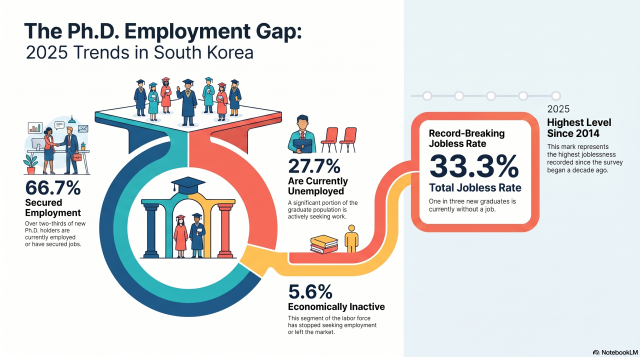
The increase was driven largely by a sharp rise in economically inactive doctorate holders, whose share nearly doubled to 5.6 percent from 3.0 percent a year earlier. By comparison, the unemployment rate edged up only 1.1 percentage points to 27.7 percent.
South Korea has been producing a record number of Ph.D. graduates, but the expansion of high-quality positions requiring doctoral degrees has failed to keep pace, according to analysts.
Universities, traditionally the largest employers of Ph.D. holders, have reduced the number of tenured faculty positions as the country's school-age population shrinks while relying more heavily on adjunct instructors. Government-funded research institutes and private-sector research and development positions have also failed to absorb the growing supply of doctorate recipients.
Young graduates faced the greatest challenges.
Among 569 respondents younger than 30, 51.1 percent were jobless, marking the first time the figure exceeded half. The share of economically inactive doctorate holders in the age group also jumped to 7.9 percent from 2.6 percent a year earlier.
Employment conditions remained weak across other age groups. The jobless rate stood at 44.2 percent among doctorate recipients aged 30 to 34, 32.8 percent for those aged 35 to 39, 22.1 percent for those aged 40 to 44, 16.6 percent for those aged 45 to 49 and 22.7 percent for those aged 50 and older — all record highs for their respective age groups.
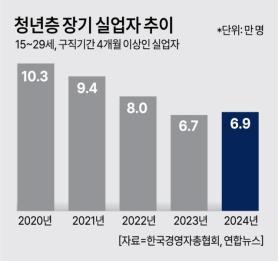
The findings come as South Korea's youth labor market continues to weaken. The employment rate for people aged 15 to 29 stood at 43.8 percent in May, down 2.4 percentage points from a year earlier and extending its decline to 25 consecutive months.
Some economists also believe artificial intelligence may be reducing entry-level opportunities for highly educated workers. The Bank of Korea said in a report last year that youth employment has declined in industries including computer programming, publishing, professional services and information services since the launch of ChatGPT in late 2022.
The survey also highlighted widening income disparities by field of study.
Among employed doctorate holders, 15.9 percent earned annual salaries of at least 100 million won ($64,800), up from 14.4 percent a year earlier. Business, administration and law graduates recorded the highest share of top earners at 29.8 percent, followed by health and welfare at 26.5 percent and information and communications technology at 24.1 percent.
By contrast, only 3.7 percent of arts and humanities doctorate holders earned at least 100 million won annually, while 26.8 percent reported annual incomes below 20 million won.
Women were more likely than men to be jobless after earning doctoral degrees.
Among male doctorate recipients, 29.6 percent were unemployed or economically inactive, compared with 38.4 percent of women. Men were also more likely to earn annual salaries above 100 million won, at 20.6 percent, compared with 8.3 percent for women. Conversely, 17.2 percent of women earned less than 20 million won annually, compared with 6.3 percent of men.
Rep. Ahn Sang-hoon, a lawmaker from the People Power Party and a former professor of social welfare at Seoul National University, said the problem stems from the government's failure to anticipate and prepare for future labor demand.
"The education authorities should work closely with employment policymakers to forecast future industries and cultivate the talent they will need in advance, but that mechanism is not functioning properly," Ahn said.
He also described South Korea's entrenched credentialism as a chronic social problem, saying, "The excessive production of advanced degrees in fields with little socioeconomic demand reduces the country's overall productivity."
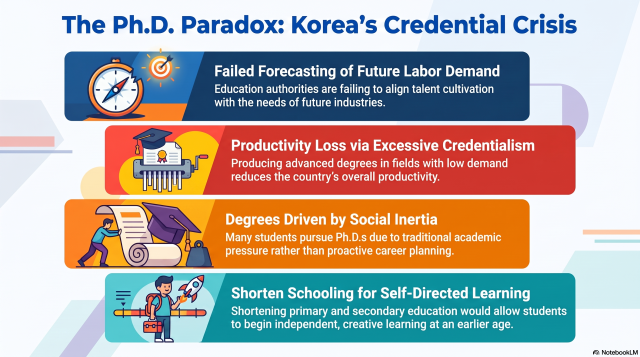
Suh Yi-jong, a sociology professor at Seoul National University, said relatively few people pursue doctoral degrees based on their own long-term career planning. Instead, he argued, many earn Ph.D.s under the influence of South Korea's traditional emphasis on academic pedigree and inertia, leaving them ill-prepared to respond proactively to sweeping social changes.
"Having taught at the university for more than 30 years, I've seen many young people enter graduate school to pursue doctoral degrees not because they have anticipated the social changes ahead and chosen to respond to them proactively, but because they passively follow conventional ways of thinking," Suh said.
He added that South Korean students generally enter university at a later age than their counterparts in many other countries.
"Until they finish high school, students mainly follow prescribed curricula rather than studying independently and creatively," Suh said.
"We should shorten the elementary, middle and high school education process so students can begin self-directed learning at an earlier stage."
Copyright ⓒ Aju Press All rights reserved.