

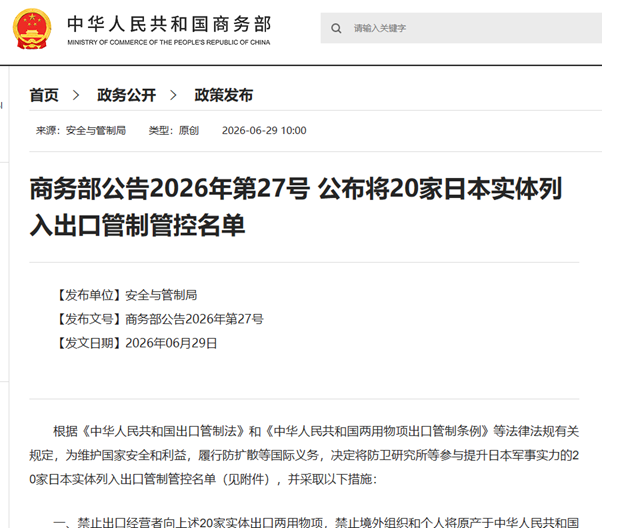
China's government has placed numerous Japanese defense companies and institutions, including the Japan Defense Research Institute, under export controls for dual-use items (goods that can be used for both civilian and military purposes) as of June 29.
This marks China's renewed export restrictions on Japanese firms after a four-month hiatus, aimed at countering Japan's rearmament and attempts to acquire nuclear capabilities.
The Ministry of Commerce announced on its website that 20 Japanese entities, including the Japan Defense Research Institute, Ground System Research Center, Naval System Research Center, Aerospace System Research Center, and subsidiaries of Mitsubishi Heavy Industries, have been added to the export control list. Other firms affected include Nippon Aircraft Manufacturing Co. (Nippon), Aoki Precision, and others involved in Japan's defense industry, which encompasses aerospace, maritime, robotics, and rare earths.
As a result of these sanctions, Chinese exporters are prohibited from exporting dual-use items to these companies. Additionally, organizations or individuals from other countries or regions are barred from transferring or providing Chinese dual-use items to these firms. Ongoing exports must be halted immediately.
The sanctions take effect immediately. Should there be a special circumstance requiring exports, exporters must submit an application to the Ministry of Commerce.
The Ministry explained that these sanctions are in accordance with export control laws and related regulations, aimed at safeguarding national security and interests while fulfilling international obligations to prevent proliferation.
Separately, the Ministry also included another 20 Japanese companies and institutions, such as Subaru, in a watch list for dual-use export controls, citing the inability to verify end users and purposes. This list includes Mitsui E&S Holdings, Terra Drone, ACSL, Fujitsu Network Solutions, and Hitachi Advanced Systems.
Companies wishing to export dual-use items to those on the watch list must apply for general permits or register and provide information to obtain export certificates. Instead, they must apply for individual permits and undergo stricter scrutiny from the Ministry. Specifically, they are required to submit a risk assessment report for companies on the watch list and a written commitment stating that dual-use items will not be used for any purposes contributing to Japan's military enhancement.
The Chinese government claims this action is intended to deter Japan's rearmament and nuclear ambitions.
The Ministry emphasized that Japan is accelerating its "new militarism" and rearmament by deploying offensive weapons and launching missiles abroad. It stated, "China's actions are entirely justified, reasonable, and legal," asserting that they are aimed at firmly curbing Japan's new militaristic movements.
The Ministry expressed hope that Japan would correct its wrong actions, genuinely reflect, and return to the right path, adding that these measures target only a small number of Japanese companies and will not affect normal economic and trade exchanges between China and Japan. It reassured that compliant and law-abiding Japanese companies need not worry.
* This article has been translated by AI.
Copyright ⓒ Aju Press All rights reserved.