

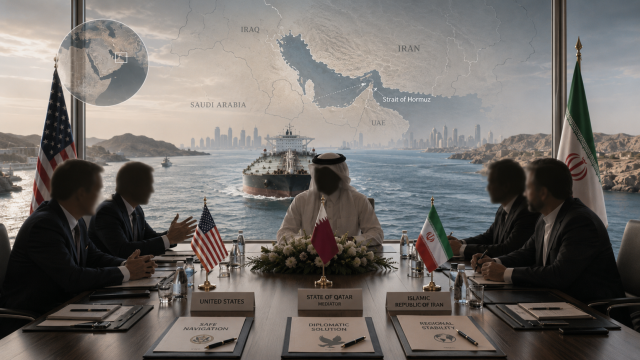
The United States and Iran are set to engage in negotiations in Doha, Qatar, to address ongoing tensions surrounding the Hormuz Strait. Just ten days after signing a memorandum of understanding (MOU) to cease hostilities, both nations faced renewed fears of a ceasefire collapse following attacks on commercial vessels and retaliatory airstrikes. However, both sides have agreed to avoid further escalation for the time being. The negotiations will focus on who will manage maritime traffic in the strategically vital strait, leaving the outcome uncertain.
Axios reported on June 28, citing a senior U.S. official, that the two countries have agreed to halt military actions targeting each other. The official stated, "We have decided to stop all physical military operations," adding that this decision could allow for the resumption of shipping traffic.
On July 30, the two sides will meet in Doha to discuss issues related to the Hormuz Strait. Initially, the talks were scheduled to take place in Switzerland, focusing primarily on Iran's nuclear program. However, due to the recent military clashes in the Hormuz Strait, the venue has shifted to Qatar, with maritime traffic now the main agenda. Nick Stewart is expected to lead the U.S. delegation.
The latest round of clashes began on June 25 when Iran attacked a commercial vessel transiting the Hormuz Strait. In response, the U.S. launched airstrikes targeting Iranian facilities related to communications, surveillance, drones, and missiles along the Iranian coast. Iran retaliated by firing drones and missiles at U.S. military bases in Bahrain and Kuwait.
On June 27, President Donald Trump warned on Truth Social that Iran had violated the agreement, stating, "There may come a time when we need to finish things militarily." In contrast, the Islamic Revolutionary Guard Corps (IRGC) of Iran condemned the U.S. airstrikes as a violation of the ceasefire and hinted at the possibility of halting negotiations.
The core of the conflict lies in how maritime traffic in the Hormuz Strait should be managed. The previous MOU stipulated that Iran would take necessary measures to ensure the safe passage of commercial vessels. However, interpretations of this clause differ. The U.S. believes it does not grant Iran control over the waterways, insisting that freedom of navigation must be guaranteed for international vessels. Conversely, Iran claims that the responsibility for resuming traffic and maintaining order lies solely with them.
According to the Wall Street Journal, Iranian Foreign Minister Abbas Araghchi stated on June 28, "The management of shipping traffic in the Hormuz Strait and its full normalization is Iran's responsibility," asserting that no other country or entity has authority over this issue. He warned that attempts to bypass Iran's established procedures could lead to further attacks.
However, the U.S. has made it clear that it cannot accept Iran's unilateral claims of control. U.S. Ambassador to the United Nations Mike Waltz stated in a Fox News interview that if Iran believes it can continue attacking international shipping or U.S. bases without facing a response, it is mistaken. He emphasized that the U.S. will continue to neutralize facilities that attempt to illegally control international waterways if necessary.
Preventive measures to avoid further clashes have yet to be implemented. During previous high-level talks in Switzerland, both sides agreed to establish a hotline between U.S. military forces and the IRGC to prevent accidental confrontations, but this has not yet been activated.
The instability in the Hormuz Strait is also affecting the energy market. The Wall Street Journal recently reported that the recovery of this crucial shipping route for global oil transport is being delayed due to the recent hostilities. Concerns over supply disruptions in the Middle East have led to a rise of about 1% in the prices of West Texas Intermediate (WTI) and Brent crude oil on Asian markets on June 29.
The key issue in the upcoming Doha talks will be how to establish order for maritime traffic in the Hormuz Strait. While both sides have agreed to cease military actions, the potential for a renewed ceasefire remains uncertain if they cannot find common ground on maritime navigation and route adjustments.
* This article has been translated by AI.
Copyright ⓒ Aju Press All rights reserved.