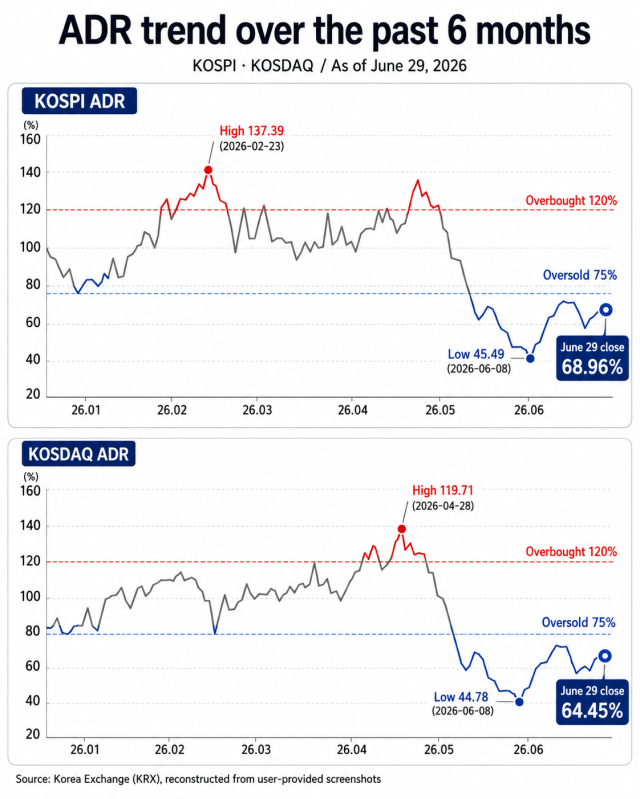
The latest evidence came Monday as the market's advance-decline ratio (ADR), a widely watched measure of market breadth, remained in oversold territory, highlighting how gains continue to be concentrated in a handful of heavyweight semiconductor stocks rather than spread across the broader market.
According to the Korea Exchange (KRX), the KOSPI's ADR stood at 68.96 percent on Monday, while the KOSDAQ's measured 64.45 percent.
Both improved from Thursday's readings of 59.79 percent and 55.04 percent, respectively, but remained below the 75 percent level widely regarded by technical analysts as an oversold threshold.
The ADR compares the number of advancing and declining stocks over the previous 20 trading sessions. A reading below 100 percent means more stocks have fallen than risen. When the ratio remains weak while the headline index climbs, it typically signals that only a small number of large-cap stocks are carrying the market higher.
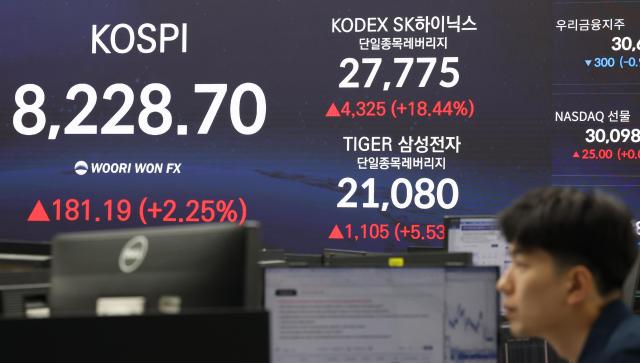
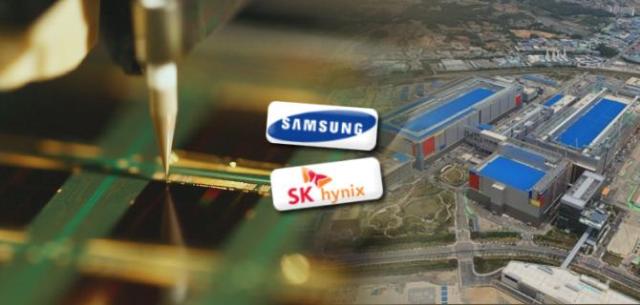
Samsung Electronics and SK hynix have dominated the rally as investors poured into AI-related memory-chip plays, while much of the rest of the market has struggled to keep pace.
According to Korea Exchange data, the KOSPI's market capitalization climbed 44.36 percent between March 3 and last Thursday. During the same period, the combined market value of Samsung Electronics and SK hynix surged 113.24 percent.
By comparison, the KOSPI 200 Ex-Top 10 Index—which excludes the market's ten largest companies—expanded by only 1.1 percent, underscoring how little of the rally has filtered into the broader market.
Retail investors have become even more concentrated.
Last month, regulators approved leveraged single-stock exchange-traded funds linked to Samsung Electronics and SK hynix, allowing Korean investors to trade domestically products that had previously been available mainly in overseas markets such as Hong Kong.
The funds seek to deliver roughly twice the daily movement of each underlying stock, making them products primarily suited to short-term traders willing to accept significant volatility.
The immediate policy objective appears to have been achieved.
Financial authorities said Korean investors became net sellers of comparable Hong Kong-listed products after domestic ETFs were introduced, suggesting that some trading activity has returned to the local market.
Rather than reducing overseas investment, Korean retail investors have shifted aggressively toward leveraged U.S. semiconductor products.
According to Korea Securities Depository data, Korean investors purchased a net $1.76 billion of the Direxion Daily Semiconductor Bull 3X Shares (SOXL) during the second week of June alone.
SOXL attracted more than eight times the net buying of KORU, the leveraged ETF tracking the Korean market.
Over the past month, SOXL ranked as the single most-purchased U.S. security by Korean investors, with cumulative purchases reaching $5.39 billion. Other AI and semiconductor-related names—including Micron Technology, Marvell Technology, Nvidia, Arm, the iShares Semiconductor ETF and the Roundhill Memory ETF—also dominated overseas buying.
The trend suggests that Korean retail investors are becoming more concentrated in semiconductor exposure rather than more diversified.
Foreign investors, meanwhile, have continued heading in the opposite direction.
According to Korea Exchange data, overseas investors have sold more than 40 trillion won worth of KOSPI shares during June, including more than 37 trillion won through Thursday and another 4.3 trillion won on Monday.
Domestic investors may be sustaining the stock rally, but they cannot replace foreign capital when it comes to supporting the Korean won. At the same time, Korean households continue sending money abroad to purchase overseas semiconductor and AI products, reinforcing capital outflows even as local equities remain near record highs.
The result is an unusual market dynamic: rising equity prices accompanied by a persistently weak currency.
Monday's trading illustrated that uneven picture.
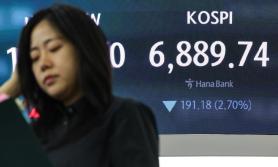
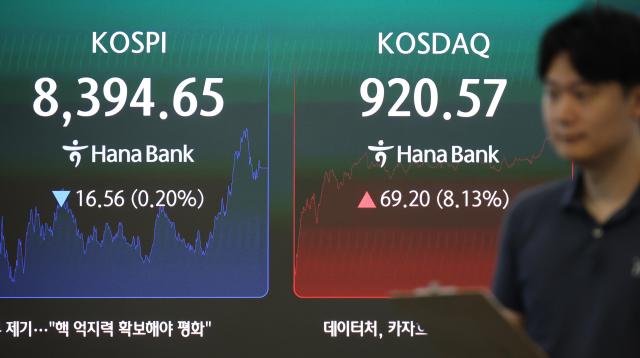
The KOSPI slipped 0.2 percent to 8,394.65 as concerns over the U.S.-Iran standoff, Apple's planned price increases and questions over whether the memory cycle is approaching a peak weighed on large-cap semiconductor shares.
The KOSDAQ, by contrast, surged 8.23 percent to 920.57 amid renewed expectations that the government will introduce measures to revive smaller growth companies.
Even so, the KOSDAQ's advance-decline ratio remained below the oversold threshold, indicating that the rebound has yet to broaden meaningfully.
The derivatives market painted an equally cautious picture.
The VKOSPI—South Korea's equivalent of the VIX volatility index—closed at 96.94, indicating traders continue to expect unusually large market swings despite the relatively modest movement in headline indices.
The next test will come with July earnings.
Another round of blockbuster results from Samsung Electronics and SK hynix could extend the chip-led rally while making the market even more concentrated. Any disappointment, however, could expose just how dependent both the KOSPI and retail sentiment have become on a remarkably small group of AI-related stocks.
For now, the headline index continues to suggest strength.
The market beneath it tells a far more fragile story.
Copyright ⓒ Aju Press All rights reserved.