

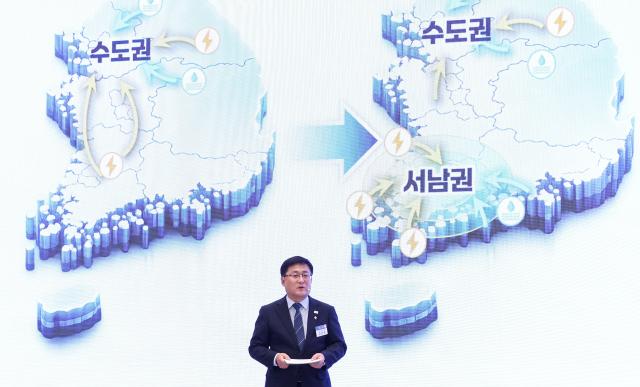
Minister Kim Sung-hwan of the Ministry of Climate, Energy and Environment presents policies during the National Report Meeting on Three Major Mega Projects, chaired by President Lee Jae-myung at the Blue House. [Photo=Blue House Press Corps]
As the government pushes forward with three major mega projects centered on semiconductors and artificial intelligence (AI), it is making a concerted effort to support infrastructure, including power, water, and land. Plans are underway to supply 6.3GW of power and 650,000 tons of water to the Honam region, along with a separate electricity pricing system for AI data centers. The goal is to ensure a steady supply of electricity to semiconductor factories and AI data centers, facilitating the transition to a power powerhouse.
On June 29, the Ministry of Climate, Energy and Environment announced infrastructure expansion plans to support the Manufacturing AI 2030 strategy during the National Report Meeting on Three Major Mega Projects held at the Blue House. The focus is on establishing a power and water supply network necessary for semiconductors and advanced industries through proactive investment in power infrastructure.
Minister Kim Sung-hwan stated at the meeting, "We will timely supply the necessary water and electricity to support the South Korean economy," adding, "While the Honam region has produced energy using nuclear and solar power, it has only sent electricity to the metropolitan area due to a lack of consumption demand. Now, the electricity produced in Honam can be used to operate semiconductor fabs in the region."
The government plans to supply power to the southwestern semiconductor industrial complex using renewable energy and nuclear power, while also utilizing various alternative water resources, such as multipurpose dams and water for power generation. The construction of necessary power connections will proceed swiftly to address the insufficient power grid.
To supply power to the Yongin semiconductor industrial complex, existing transmission lines will be maximized, and underground construction will be undertaken when unavoidable. For water supply, the existing integrated water supply project will be expedited, and measures to increase reuse rates will be implemented.
For AI data centers, the government plans to ensure stable power supply by harmoniously utilizing renewable energy, nuclear power, and some fossil fuel sources based on site conditions. Information about 345kV substations will be disclosed, and expedited processing of power system impact assessments for non-metropolitan AI data centers will be pursued.
The government also aims to create a stable power supply system through investment in power infrastructure. By 2030, it plans to achieve a target of 100GW of renewable energy deployment through the activation of private investment. Additionally, two nuclear reactors are scheduled for completion by 2027, and nine reactors currently in operation will be brought online in a timely manner to boost electricity generation.
The expansion of the power grid will also lead to stable supply. Existing line capacities will be increased, and new lines will be constructed underground as needed. Substations will be built in non-metropolitan areas, where renewable energy generation is abundant.
A separate electricity pricing system will be established to support the competitiveness of advanced industries. Starting in the second half of this year, a regional pricing system will be introduced, along with a new electricity pricing system for ultra-large AI data centers. Minister Kim emphasized, "Semiconductors, AI data centers, and physical AI cannot operate without electricity," stating, "We are entering an era where the production of semiconductor chips and the smooth supply of electricity for this purpose are key to national competitiveness. We will do our utmost to transition to a power powerhouse."
Additionally, to support large-scale local investments by companies, a 'corporate-type advanced city' will be created as a regional hub where mass production, demonstration, and research can be realized simultaneously. This will involve providing desired locations for companies and promoting regulatory relief. Furthermore, if anchor companies wish, measures will be established to allow them to directly participate in project implementation and development.
On June 29, the Ministry of Climate, Energy and Environment announced infrastructure expansion plans to support the Manufacturing AI 2030 strategy during the National Report Meeting on Three Major Mega Projects held at the Blue House. The focus is on establishing a power and water supply network necessary for semiconductors and advanced industries through proactive investment in power infrastructure.
Minister Kim Sung-hwan stated at the meeting, "We will timely supply the necessary water and electricity to support the South Korean economy," adding, "While the Honam region has produced energy using nuclear and solar power, it has only sent electricity to the metropolitan area due to a lack of consumption demand. Now, the electricity produced in Honam can be used to operate semiconductor fabs in the region."
The government plans to supply power to the southwestern semiconductor industrial complex using renewable energy and nuclear power, while also utilizing various alternative water resources, such as multipurpose dams and water for power generation. The construction of necessary power connections will proceed swiftly to address the insufficient power grid.
To supply power to the Yongin semiconductor industrial complex, existing transmission lines will be maximized, and underground construction will be undertaken when unavoidable. For water supply, the existing integrated water supply project will be expedited, and measures to increase reuse rates will be implemented.
For AI data centers, the government plans to ensure stable power supply by harmoniously utilizing renewable energy, nuclear power, and some fossil fuel sources based on site conditions. Information about 345kV substations will be disclosed, and expedited processing of power system impact assessments for non-metropolitan AI data centers will be pursued.
The government also aims to create a stable power supply system through investment in power infrastructure. By 2030, it plans to achieve a target of 100GW of renewable energy deployment through the activation of private investment. Additionally, two nuclear reactors are scheduled for completion by 2027, and nine reactors currently in operation will be brought online in a timely manner to boost electricity generation.
The expansion of the power grid will also lead to stable supply. Existing line capacities will be increased, and new lines will be constructed underground as needed. Substations will be built in non-metropolitan areas, where renewable energy generation is abundant.
A separate electricity pricing system will be established to support the competitiveness of advanced industries. Starting in the second half of this year, a regional pricing system will be introduced, along with a new electricity pricing system for ultra-large AI data centers. Minister Kim emphasized, "Semiconductors, AI data centers, and physical AI cannot operate without electricity," stating, "We are entering an era where the production of semiconductor chips and the smooth supply of electricity for this purpose are key to national competitiveness. We will do our utmost to transition to a power powerhouse."
Additionally, to support large-scale local investments by companies, a 'corporate-type advanced city' will be created as a regional hub where mass production, demonstration, and research can be realized simultaneously. This will involve providing desired locations for companies and promoting regulatory relief. Furthermore, if anchor companies wish, measures will be established to allow them to directly participate in project implementation and development.
* This article has been translated by AI.
Copyright ⓒ Aju Press All rights reserved.