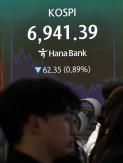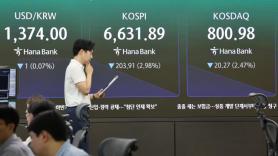
The benchmark KOSPI fell 0.2 percent, shedding 20.19 points to 8,374.46, while the KOSDAQ rose 0.9 percent to 929.33.
Foreigners drove the move, selling a net 808.7 billion won (522.0 million dollars) on the main board against buying from individuals and institutions, as the market braced for an eventual pension-fund unwind that brokerages estimate at 50 trillion to 60 trillion won.
The drag is a calendar one. The fund's temporary suspension of portfolio rebalancing expires at the end of June, and the market reads July 1 as the start of sustained selling by Korea's largest investor.
The pension fund has already been trimming, selling a net 2.5 trillion won on the main board through late June, with most of that concentrated in a single week.
The KOSPI 200 Volatility Index (VKOSPI), often dubbed Korea's "fear gauge," closed at a record 96.94 on Monday, the highest since the Korea Exchange began publishing the index in April 2009.
The unease persisted despite the government's unveiling of a 1,500 trillion won ($1.1 trillion) three-mega-project investment initiative.
Foreign investors dumped a record 7.7 trillion won worth of KOSPI shares on Monday, extending their selling streak to seven consecutive sessions and fueling fears that pension fund rebalancing could further pressure the market if it coincides with continued foreign outflows.
The mood is fragile for a reason. The KOSPI is steadying only after a brutal stretch, including a near 10 percent plunge on June 23 and a 5.8 percent drop on June 26 tied to chip-sector profit-taking.
Samsung Electronics bucked the weakness, rising 1.2 percent to 327,000 won (211.16 dollars).
SK hynix slipped 0.4 percent to 2,618,000 won (1,690.56 dollars), pressured by the same chip-sector caution.
The split widened at SK square, the holding company whose value rests almost entirely on its roughly 20 percent SK hynix stake. It fell 4.0 percent to 1,575,000 won (1,016.92 dollars), amplifying its affiliate's smaller decline.
Tokyo went the other way. The Nikkei 225 rose 0.5 percent to 69,781.99 in morning trade, with chip-equipment maker Tokyo Electron among the gainers, a reminder that the same memory-driven optimism unsettling Seoul's heavyweights is still lifting Japan's.
The pension story is not a crash signal. The fund has said it will spread sales over time to limit market impact, and several analysts argue the feared selling wave is overstated against daily KOSPI turnover. But as a steady supply of stock from a former net buyer, it caps the upside that carried the index this far.
Copyright ⓒ Aju Press All rights reserved.