

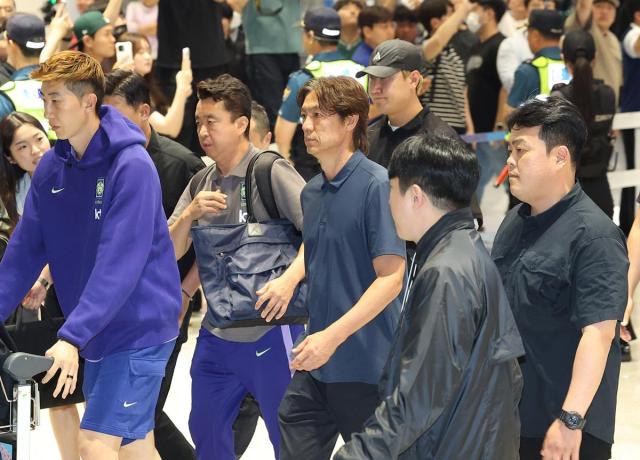
After South Korea's exit from the group stage of the 2026 FIFA World Cup in North and Central America, the national football team is facing criticism over the resignation of coach Hong Myung-bo, a leadership vacuum in the Korea Football Association (KFA), and broader issues in football administration. The BBC reported that this failure is not merely a result of poor performance but rather a culmination of long-standing systemic problems within South Korean football.
In an article published on June 30, titled "World Cup Exit Puts South Korean Football in Crisis," the BBC noted that Hong's resignation has sparked scrutiny of the KFA's management and leadership.
Hong stepped down immediately after South Korea's group stage elimination, expressing his sincere apologies. A former captain who led the team to the semifinals in the 2002 World Cup, he failed to prevent another group stage exit, following a similar outcome in the 2014 World Cup in Brazil.
South Korea began the tournament positively, winning their first match against the Czech Republic 2-1, but subsequently lost 1-0 to Mexico and suffered a disheartening defeat to South Africa, leading to their elimination. Controversy surrounded Hong's decision to bench captain Son Heung-min in the final match.
The BBC reported that after the match, a journalist asked Hong if there had been a food poisoning incident affecting the team, highlighting the difficulty in explaining their performance. Former national team player Lee Young-pyo described the game as "the worst match in 21st-century South Korean football."
The atmosphere within the team during the tournament was also strained. Some domestic reporters mocked Son's military service exemption, leading the players to refuse interviews with the media. The BBC speculated that as Son approaches his 34th birthday in July, it would not be surprising if he chose to retire from international duty.
However, the BBC noted that public anger is directed more at football administration than at the players. President Lee Jae-myung commented on social media, stating that the early exit appears to be a failure of organizational management and personnel decisions, warning that prioritizing connections over competence would lead to predictable outcomes.
The BBC explained that KFA President Chung Mong-kyu faced controversy over procedural transparency in the appointment of Hong Myung-bo in 2024, followed by conflicts surrounding audits by the Ministry of Culture, Sports and Tourism and the KFA's operations. Chung expressed his intention to resign in May, acknowledging that the controversies during his tenure were due to his shortcomings.
The BBC assessed that the gap between South Korean football and Japan has widened significantly. Unlike the K League, which once led Asian football, the J League now surpasses it in competitive strength and player exports to Europe.
Citing a South Korean football fan, the BBC reported, "Japan has a 100-year vision that everyone participates in, while in Korea, the coach keeps changing based on the judgment of one person who knows nothing about football."
The BBC concluded that South Korean football currently lacks both a coach and a KFA president, suggesting that the failure in the 2026 World Cup could serve as a turning point for the declining Asian football powerhouse to rise again.
* This article has been translated by AI.
Copyright ⓒ Aju Press All rights reserved.