

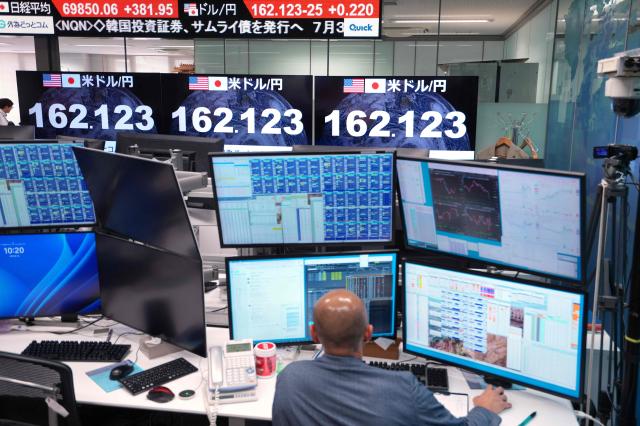
The fates of the yen and yuan have diverged sharply. Once synonymous with safe assets, the yen is now on the brink of being classified as a risk asset, while the yuan, previously viewed as a risk asset, is emerging as a new safe haven.
On June 30, the yen's exchange rate surpassed 162 yen per dollar, marking its highest level in 40 years since 1986. This surge is largely attributed to the strengthening of the dollar amid rising expectations of interest rate hikes by the U.S. Federal Reserve. However, concerns about the economic policies of Prime Minister Sanae Takaichi's cabinet also play a significant role. While the Bank of Japan (BOJ) is signaling a shift toward interest rate hikes to manage inflation, Takaichi's cabinet has announced an expansionary fiscal policy aimed at stimulating the economy, raising fears of policy inconsistency.
The yen's depreciation may enhance price competitiveness for exporters, but it could also lead to rising import prices, potentially weakening domestic consumption. Additionally, Japan's limited competitiveness in AI-related exports, such as semiconductors, is a growing concern. Evidence of this is seen in Japan's export rankings, which fell to seventh place last year, trailing behind countries like South Korea. Former BOJ board member Sayuri Shirai predicted last week that the yen could rise to 165 yen per dollar.
In contrast, the People's Bank of China set the yuan's reference exchange rate at 6.8109 yuan per dollar on the same day, nearing the 6.8088 yuan level recorded on June 15, the lowest since February 2023. This situation reflects China's managed floating exchange rate system and limited foreign investment in its domestic financial markets. However, strong economic fundamentals, bolstered by robust exports of semiconductors and electric vehicles, are considered major contributing factors.
The Bank of Korea, in its report on the outlook for the Chinese economy, stated on June 29 that "Chinese companies are expanding their global market share, particularly in electric vehicles, batteries, and electronics. The investments in manufacturing and capacity expansion are translating into actual export growth, which will support a favorable increase in Chinese exports in the second half of the year."
Moreover, as China is viewed as a significant beneficiary of the ongoing conflicts in the Middle East, the yuan's status has risen amid a weakening outlook for the dollar. UBS has described the yuan as a "structurally undervalued currency based on solid external balances and policy support," suggesting a potential 3-4% increase against the dollar and euro this year.
However, China's economy also faces structural challenges, including a real estate downturn and sluggish domestic demand. Notably, the strength of its high-tech manufacturing exports is helping to offset these issues. Conversely, Japan's reliance on the yen's depreciation highlights that without a recovery in industrial competitiveness, a weaker currency could become a burden on the economy.
The contrasting trends of the yen and yuan illustrate that the status of safe assets is not permanent, nor is the classification of risk assets fixed. Markets are increasingly prioritizing industrial competitiveness and economic fundamentals over the names of currencies. South Korea, facing significant fluctuations in the won's exchange rate, must focus its policy efforts on securing overwhelming technological competitiveness in AI, semiconductors, and future manufacturing. Ultimately, the value of a currency is determined by the strength of its economy, and the divergent fates of the yen and yuan signal what South Korea needs to prepare for in the future.
* This article has been translated by AI.
Copyright ⓒ Aju Press All rights reserved.