

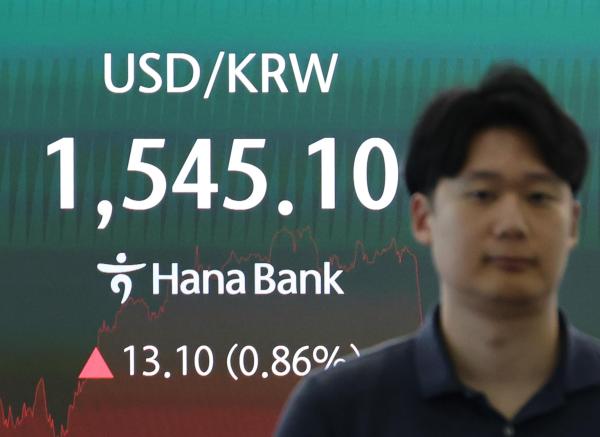
The exchange rate of the Korean won against the dollar has soared to around 1500 won, prompting urgent concerns over capital management in the banking sector. The high exchange rate has led to a significant increase in risk-weighted assets (RWA), which have risen by over 20 trillion won, putting pressure on the common equity tier 1 (CET1) capital ratio, a key indicator of bank soundness. If the upward trend in the exchange rate continues, there are fears that it could hinder the expansion of productive finance and shareholder return policies.
As of the end of the first quarter, the four major banks—KB Kookmin, Shinhan, Hana, and Woori—reported a total RWA of 886.4588 trillion won. This marks an increase of 24.3340 trillion won, or 2.9%, compared to 862.1248 trillion won at the end of the previous year.
RWA is calculated by applying risk weights to the assets held by banks and serves as the basis for calculating the Basel III capital adequacy ratio and CET1 ratio, which reflect bank soundness.
The increase in RWA is attributed to a rise in corporate lending alongside the climbing won-dollar exchange rate. When the exchange rate rises, the won-denominated value of foreign currency loans and securities held by banks increases. Since the CET1 ratio is calculated by dividing common equity capital by RWA, an increase in RWA results in a lower CET1 ratio. This creates a direct pressure on bank soundness indicators.
Compounding the issue is the prolonged high exchange rate. While geopolitical risks in the Middle East have somewhat eased, structural demand for dollars continues due to the interest rate differential between South Korea and the U.S. and increased overseas investments by domestic investors.
According to the Bank of Korea, the average exchange rate for the won against the dollar in the first quarter was 1465.16 won. In the second quarter, the average rate surged to 1500.85 won as of June 29. Unless there is a sharp decline in the exchange rate in the remaining trading days, the average for the second quarter is expected to exceed 1500 won. This would mark the first time the quarterly average exchange rate has surpassed 1500 won since the first quarter of 1998, during the Asian financial crisis, when it was 1596.8 won.
In the banking sector, it is estimated that for every 10 won increase in the exchange rate, the CET1 ratio declines by 0.01 to 0.03 percentage points. According to the Financial Supervisory Service, the average CET1 ratio for domestic banks in the first quarter was 13.41%, well above the regulatory requirement of 8%. However, there are concerns that if the exchange rate continues to rise, banks' capital buffers could diminish rapidly.
A prolonged high exchange rate could also lead to a contraction in productive and inclusive finance, such as corporate lending. As the exchange rate continues to rise, banks may need to accumulate more capital to defend their CET1 ratios, which could make them more cautious in expanding loans to businesses, particularly those with higher risk weights or small and medium-sized enterprises. Additionally, if high exchange rates increase the cost burdens for importers and repayment pressures for foreign currency borrowers, this could further strain banks' capital ratio management.
The government's value-up policy could also be affected, as a decline in the CET1 ratio would reduce the capacity for shareholder returns, such as dividends and stock buybacks.
A banking sector official stated, "The rise in the exchange rate is not just a simple profit and loss variable; it directly impacts banks' capital ratios and lending capacity. If high exchange rates persist, banks will inevitably prioritize capital management over growth strategies like expanding loans."
* This article has been translated by AI.
Copyright ⓒ Aju Press All rights reserved.