

The judiciary is expanding its use of artificial intelligence (AI) to enhance public access to legal services. By incorporating AI illustrations into rulings, the court aims to assist vulnerable populations in understanding legal documents. In the future, an intelligent ruling search system is expected to facilitate easier access to case law.
According to legal sources on June 30, the 7th Administrative Division of the Seoul Administrative Court, led by Chief Judge Kang Woo-chan, ruled in favor of a plaintiff with intellectual disabilities in a lawsuit against the Yangcheon District Office, seeking the cancellation of a decision regarding the degree of disability.
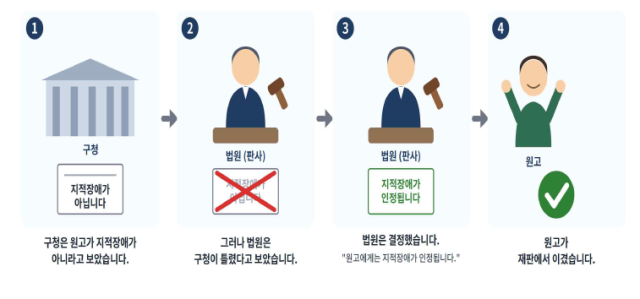
The court provided the plaintiff with an 'Easy Read' ruling. This format, implemented this year under the Supreme Court's guidelines for judicial support for socially vulnerable individuals, is designed to be more accessible for those with reading difficulties.
For example, the ruling's statement that 'the defendant (Yangcheon District Office) cancels the decision regarding the degree of disability for the plaintiff (individual with intellectual disabilities)' was simplified to 'The plaintiff won the case.' Similarly, the phrase 'the defendant will bear the litigation costs' was rephrased as 'The district office will pay the costs of the lawsuit.'
Notably, the ruling utilized AI-generated illustrations to enhance comprehension for vulnerable groups. An illustration depicting two individuals exchanging welfare cards accompanied the statement that 'the decision of the district office is canceled, allowing registration as an individual with intellectual disabilities.' This approach has been praised for improving accessibility compared to traditional rulings focused on legal jargon.
A representative from the Seoul Administrative Court explained, "The images were created by training a large language model (LLM) AI on materials published by the Judicial Policy Research Institute, which were then generated as 'skills.'" They added, "Compared to the environment for drafting rulings in 2021, the process has become so convenient that it incurs no costs beyond the subscription fee, maximizing efficiency."
On June 8, the Court Administration Office announced plans to introduce an intelligent ruling search system. Currently, most rulings can be accessed through the 'Internet Access to Rulings' service on the Judicial Information Disclosure Portal, but users have noted difficulties in finding specific rulings without precise keywords.
The intelligent ruling search system will allow users to request rulings in natural language, with AI analyzing the intent of the queries to locate the relevant documents.
This system is expected to proceed with development as part of the 2027 Information Strategy Plan, following budget approval for the current year's ISP budget application.
* This article has been translated by AI.
Copyright ⓒ Aju Press All rights reserved.