

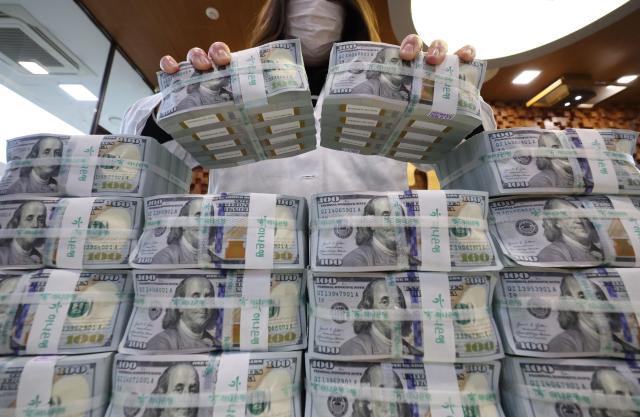
In the first quarter of this year, the won-dollar exchange rate remained high in the upper 1,450 won range, prompting South Korea's foreign exchange authorities to sell over $13.6 billion to stabilize the market. While this intervention was lower than the record high in the fourth quarter of last year, it still marked the fourth-largest dollar supply in history.
According to the "Foreign Exchange Authorities' Net Transaction Report" released by the Bank of Korea on June 30, the authorities sold a net total of $13.628 billion in the foreign exchange market during the first quarter. This figure represents a decrease from the fourth quarter of last year, which saw net sales of $22.467 billion. However, it significantly exceeded the net sales of $2.96 billion in the first quarter and $797 million in the second quarter of last year, as well as $1.745 billion in the third quarter.
The foreign exchange authorities intervene by supplying dollars and purchasing won when the won-dollar exchange rate surges or when market volatility becomes excessive. Since the third quarter of 2019, the government has been disclosing the difference between total dollar purchases and sales by the foreign exchange authorities quarterly to enhance market transparency.
In the fourth quarter of last year, despite a current account surplus, significant dollar outflows due to residents' overseas securities investments led to the largest net sales by the foreign exchange authorities on record. The trend of high exchange rates continued into the first quarter of this year, resulting in continued large-scale net dollar sales by the authorities. The combined net sales of dollars in the fourth quarter of last year and the first quarter of this year reached $36.095 billion.
Throughout the first quarter, the won-dollar exchange rate remained elevated. The average exchange rate for the won against the dollar in the Seoul foreign exchange market was recorded at 1,466.9 won. The monthly average rates were 1,456.51 won in January and 1,449.32 won in February, with a significant rise to 1,486.64 won in March amid the outbreak of conflict in the Middle East. Notably, in March, the average daily fluctuation of the exchange rate expanded to 11.4 won, indicating extreme volatility.
However, the net purchases of U.S. stocks by residents decreased compared to the previous quarter. According to the Korea Securities Depository, domestic investors' net purchases of U.S. stocks in the first quarter amounted to $10.644 billion, down approximately 22% from $13.587 billion in the previous quarter.
These measures to defend the exchange rate have led to a decrease in foreign exchange reserves. South Korea's foreign exchange reserves fell from $428.05 billion at the end of last year to $423.66 billion at the end of the first quarter. In March, the authorities' market intervention resulted in a sharp decline of $3.97 billion in reserves within a month, marking the largest decrease since April of last year, which saw a drop of $4.99 billion. However, foreign exchange reserves are influenced by various factors, including market interventions, fluctuations in the value of the dollar, and returns on foreign asset management.
As the trend of high exchange rates continues into the second quarter, attention is focused on the scale of net transactions by the foreign exchange authorities. The average won-dollar exchange rate in the second quarter was 1,501.6 won, marking the first time in 28 years and three months that the quarterly average exchange rate reached the 1,500 won level since the first quarter of 1998 during the Asian financial crisis. Details of the foreign exchange market stabilization measures taken in the second quarter will be disclosed at the end of September.
Experts attribute the persistent strong dollar phenomenon to the Federal Reserve's hawkish stance and robust U.S. economy, along with structural dollar demand driven by increased private overseas asset investments as a major cause of the won's depreciation.
Jeon Gyu-yeon, a researcher at Hana Securities, stated, "Despite a current account surplus due to strong semiconductor exports, capital outflows through the financial account have increased, keeping the won-dollar exchange rate at a high level. The accumulation of private overseas assets is creating structural dollar demand, exerting downward pressure on the won."
* This article has been translated by AI.
Copyright ⓒ Aju Press All rights reserved.