

[Editor’s Note] The first half of 2026 has passed. The stock market soared, and the economy cheered. Yet, fortunes diverged. Behind the smiles of those reaping massive investment gains are tears from those who miscalculated. The same applies to publicly traded companies. Stock prices reflect a company's image in the market. In the same industry, fortunes fluctuate. Who are the winners and losers? We assess the performance of various sectors in the first half based on stock market metrics.
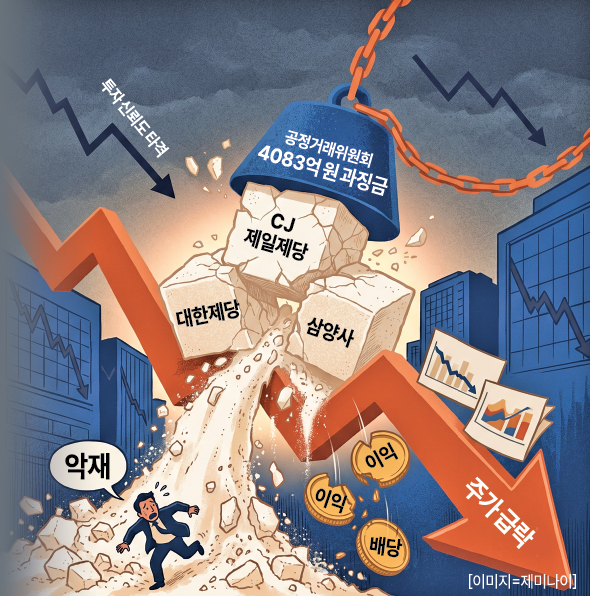
This year, South Korea's sugar industry has faced significant challenges. The booming stock market seemed distant for major players like CJ CheilJedang, Daehan Sugar, and Samyang Foods, which have maintained stable performance but could not escape the massive blow from the Fair Trade Commission's price-fixing penalties. The three companies collectively received fines totaling 408.3 billion won. This hit to corporate credibility has led to a sharp decline in stock prices, with CJ CheilJedang, the industry leader, experiencing a nearly 25% drop in the past year.
Stock Prices Plummet Following Price-Fixing Scandal
According to the Korea Exchange, CJ CheilJedang's stock price fell from 254,500 won on July 1 of last year to 191,400 won on June 29, a decrease of 24.8%. During the same period, Daehan Sugar's stock dropped from 3,020 won to 2,385 won, a decline of 21.0%, while Samyang Foods saw a decrease from 53,800 won to 44,150 won, or 17.9%. All three stocks significantly underperformed compared to the KOSPI index. The ongoing domestic market slump since the second half of last year and deteriorating investor sentiment in the food sector also contributed to this decline, but the decisive factor was the Fair Trade Commission's penalties for collusion.In February, the Fair Trade Commission uncovered collusion among the three sugar companies and imposed hefty fines. CJ CheilJedang was fined 150.7 billion won, Samyang Foods 130.3 billion won, and Daehan Sugar 127.4 billion won. From the announcement date of the penalties on February 12 until June 29, CJ CheilJedang's stock fell from 230,500 won to 191,400 won, a drop of 17.0%. Daehan Sugar's stock decreased by 15.6%, and Samyang Foods' stock fell by 14.1%.
Earnings Decline and Trust Issues Weigh on Companies
The fines have impacted not only corporate credibility but also financial performance. The penalties were recorded as non-operating expenses, dragging down last year's net profits. CJ CheilJedang reported sales of 27.34 trillion won and operating profit of 1.23 trillion won, but incurred a net loss of 417 billion won. Samyang Foods had sales of 2.56 trillion won and operating profit of 111.7 billion won, yet reported a net loss of 302.4 billion won. Daehan Sugar recorded sales of 1.36 trillion won, operating profit of 56.6 billion won, and a net loss of 60.3 billion won.In the first quarter of this year, profitability also suffered. CJ CheilJedang's operating profit decreased by 28.5% compared to the same period last year, while Samyang Foods and Daehan Sugar reported declines of 12.6% and 33.6%, respectively.
However, analysts suggest that the financial impact of the fines and the ability to recover vary by company. Korea Credit Rating Agency assessed that the effects of the penalties on each company's financial structure are different. CJ CheilJedang and Samyang Foods are expected to have limited financial impact due to their strong cash flow and diverse business portfolios. In contrast, Daehan Sugar faces the largest burden, as the fine is relatively large compared to its capital and profit.
Which Company Will Recover Quickly from Setbacks?
The three sugar companies are grappling with multiple challenges as they seek to boost their stock prices. Each company is also pursuing long-term plans focused on shareholder returns and improving profitability. CJ CheilJedang is expected to recover the fastest, as it aims to expand its global business based on the K-food trend and enhance corporate value through shareholder return policies and increased investor communication. Hana Securities recently set a target stock price of 370,000 won for CJ CheilJedang, anticipating profit growth in the second half.Daehan Sugar also outlined plans to enhance corporate value, aiming for a 7% return on equity and a price-to-book ratio of 0.8 by 2028, along with increasing annual dividends to over 10 billion won. Despite this, both companies' stock prices remain sluggish, and the securities market has refrained from setting target prices for them for some time.
* This article has been translated by AI.
Copyright ⓒ Aju Press All rights reserved.