

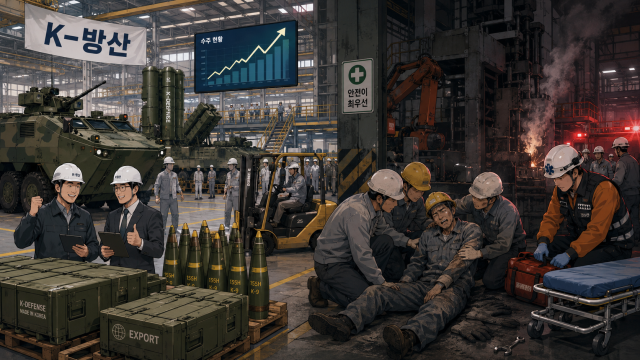
In the past decade, most workplace injuries in South Korea's defense industry have been classified as serious, with the fatality rate reaching twice that of other sectors. Critics argue that as K-defense expands through increased exports and production, safety management in manufacturing has been neglected. The recent explosion at Hanwha Aerospace's Daejeon facility highlights these ongoing safety gaps.
According to data from the Ministry of Employment and Labor obtained by Aju Economy through Democratic Party lawmaker Kim Jeong-ho, a total of 426 employees from five major domestic defense companies suffered workplace injuries from 2017 to the first quarter of this year.
In addition to 18 fatalities, 280 workers required long-term care lasting over three months, accounting for 65.7% of all injured employees. This indicates that two out of three injured workers sustained serious injuries.
According to the latest data from the National Statistical Portal (KOSIS) for 2024, the average proportion of injured workers requiring more than three months of treatment across all industries is 54%. The serious injury rate among the five defense companies is 11.7 percentage points higher than this average.
The trend of serious accidents is also reflected in the fatality risk indicators. As of 2023, the estimated fatality rate for the five defense companies was 1.30 per 10,000 workers, which is double the average of 0.66 for all industries with over 1,000 employees. Although the fatality rate slightly decreased in 2024, it spiked for some companies.
The scale of workplace injuries in the defense industry has remained stubbornly high. Since 2018, annual injuries at the five defense companies have been recorded at 51 in 2019, 50 in 2020, 53 in 2023, 52 in 2024, and 50 in 2025. This year alone, 18 injuries and one fatality have already been reported in the first quarter. Rather than decreasing, the annual figures are expected to rise significantly, potentially reaching the 70s.
The situation worsens with the explosion at Hanwha Aerospace's Daejeon facility on June 1, which adds to the total number of injuries in the defense sector. Including this incident, the number of injured workers this year has risen to 20, with six fatalities. Given the nature of the industry, which involves high-risk processes such as explosives and heavy machinery, there are calls for a more robust safety management system compared to general manufacturing.
Choi Gi-il, a professor of military studies at Sangji University, stated, "The predecessor of Hanwha Group, Korea Explosives, has previously experienced major casualties from incidents like the Iri Station explosion. Such accidents can also impact overseas defense sales. It is time to comprehensively overhaul safety management guidelines."
* This article has been translated by AI.
Copyright ⓒ Aju Press All rights reserved.