

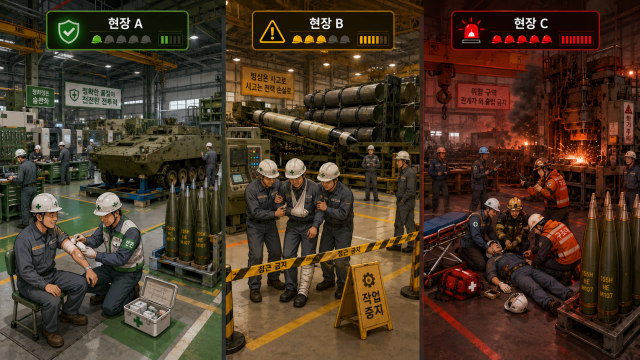
Over the past decade, workplace injuries in South Korea's defense industry have been concentrated in specific companies and facilities, prompting calls for enhanced management and oversight of vulnerable workplaces.
An analysis of data from the Ministry of Employment and Labor, obtained by Aju Economy through Democratic Party lawmaker Kim Jeong-ho's office, revealed that from 2017 to the first quarter of this year, 426 workplace injuries occurred at five major domestic defense companies. Of these, 139 injuries, or 32.6%, were reported at Company A alone, indicating that one in three injuries occurred at this firm. Following Company A, Company B reported 127 injuries, Company C had 87, Company D had 66, and Company E had 7. The disparity in injury numbers among these companies reached as high as 20 times.
Company A's injury rate significantly exceeded the industry average, partly due to its involvement in sectors beyond defense. Most injuries at Company A were categorized under its headquarters, with 135 incidents occurring there and only 4 at its own factories. Notably, incidents at subcontractor sites were included in the headquarters statistics, but current data classifications do not clearly separate incidents involving primary and subcontractors. This highlights the need for improvements in systems that reflect actual working conditions and risks.
The risk levels in defense manufacturing vary significantly based on the type of products being produced. Processes involving ammunition, explosives, and pyrotechnics are particularly hazardous, with a high likelihood of explosions, fires, and fatalities if accidents occur. This is reflected in the fact that the rate of serious injuries among defense industry workers is nearly 12 percentage points higher than the overall industrial average.
In fact, fatalities have consistently occurred in certain high-risk sectors. Among the 18 fatalities resulting from workplace accidents at the five defense companies over the past decade, 11 (61.1%) were linked to Company B. Notably, one of Company B's facilities reported 8 fatalities, including a recent incident involving an explosion. This pattern suggests a troubling trend of repeated accidents due to accumulated risks. There is a pressing need to strengthen management of high-risk processes and address the issue of recurring accidents.
Additionally, Company C has experienced repeated fatalities at one of its facilities over several years. This site recorded fatalities in 2020, 2021, 2023, and again in the first quarter of this year. While Company C operates multiple facilities, accidents have been particularly concentrated at this one location.
Experts emphasize that to sustain growth and improve performance in South Korea's defense industry, addressing safety complacency is essential. They recommend identifying companies and facilities with frequent accidents and managing high-risk processes, subcontractor work, and safety training separately. There are also increasing calls for regular inspections and tailored oversight of accident-prone facilities. Given the nature of defense manufacturing, where primary and subcontract workers often share the same workspace, greater attention to safety management is crucial.
Jang Won-jun, a professor at Jeonbuk National University's Department of Advanced Defense Studies, stated, "Safety incidents are linked to the credibility of K-defense, so ongoing improvements to ensure a safe environment must be supported through corporate investment and government assistance. Along with safety measures, infrastructure such as automation, remote facilities, and unmanned systems should also be developed." He added, "If accidents continue to occur, it will delay the supply of weapon systems, which will attract scrutiny from foreign purchasing countries. Ultimately, this is an ecosystem issue, and a safety roadmap for K-defense must be established."
There are also calls for a thorough analysis of the root causes of persistent major accidents. Lee Jun-gon, an adjunct professor at Konkuk University's Department of Defense Acquisition, noted, "Accidents involving hazardous materials have been recurring for years. It is crucial to accurately analyze whether this is due to a lack of process automation or low safety awareness among employees." He cautioned, however, that excessive government oversight of safety incidents could impact the productivity of defense companies, which is a sensitive issue.
* This article has been translated by AI.
Copyright ⓒ Aju Press All rights reserved.