SEOUL, July 01 (AJP) - A research team at the Korea Advanced Institute of Science and Technology has built an artificial intelligence model that treats an animal's body movements the way a language model treats words, and the system used that approach to find, entirely on its own, the core social deficit in a mouse model of autism. The result points toward a new class of AI tool for brain research, one whose reasoning scientists can actually inspect rather than take on faith.
The model, called BehaVERT, outperformed the previous best systems on five international benchmarks covering social interaction, multi-animal behavior, three-dimensional motion analysis and autism-related behavior, according to the research team. It was developed by a group under professor Kim Dae-soo in the Department of Brain and Cognitive Sciences, with Shin Seung-jae as first author, and the findings were published in the International Journal of Computer Vision (IJCV), one of the leading journals in computer vision research, on March 24, 2026. KAIST announced the results on July 1, 2026.
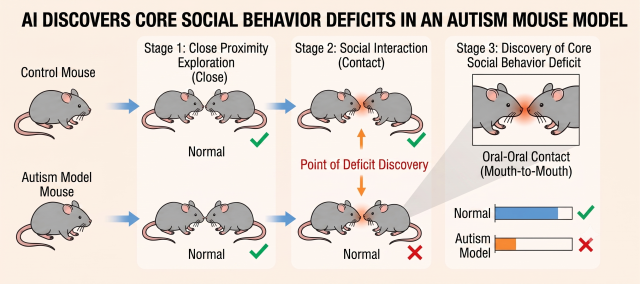
Autism spectrum disorder involves a wide range of social and behavioral traits, and researchers have long relied on mutations tied to human cases to build mouse models that mimic those traits in the lab. One such mutation, in a gene called SHANK3, disrupts a protein that anchors connections between brain cells and is linked to roughly 0.5 to 2 percent of autism and intellectual disability cases in humans, according to prior published research. Mice missing this gene show the same pattern seen in some autism patients: their instinct to approach others stays intact, but the quality of their social contact once they get there falls apart. That distinction, subtle and easy to miss with the naked eye, became the test case for what BehaVERT could do.
The KAIST team built the model by converting the skeletal movements of a mouse, tracked at the nose, ears, spine, limbs and tail, into tokens, the same kind of basic unit a language model uses to represent a word. Those tokens were then fed into a transformer network built on BERT, an architecture widely used in natural language processing, and trained without being told in advance what any given movement meant. Rather than simply sorting behaviors into preset categories, the researchers said, the model learned to track how the meaning of a movement shifted over time, much as a word's meaning shifts with the sentence around it.
When the researchers set BehaVERT loose on a group of mice carrying the Shank3B mutation alongside typical mice, the model zeroed in on one detail: contact between the mouths of two mice during social encounters. It flagged that specific behavior as the clearest marker separating the two groups, a finding that lines up precisely with earlier studies showing that Shank3B mice approach other mice normally but falter in the actual exchange that follows. BehaVERT reached that conclusion without ever being told what autism looks like in a mouse. It found the pattern by watching.
The system also lets researchers see its reasoning, rather than simply handing over a verdict. Shin said the project began with a basic question about whether animal movement might carry a structure similar to language. The team trained the model without supplying correct answers in advance, letting it work from behavioral data alone, and found that a version trained on rat movement could be applied successfully to mice as well, a sign that a single model might eventually generalize across species.
Kim, the professor who led the study, said BehaVERT goes beyond sorting behavior into categories and can grasp what a behavior actually means. He said the team expects the model to become a core tool for new discoveries across drug development, psychiatric research and behavioral genetics.
The KAIST group has built this kind of work before. Kim's lab previously developed AVATAR, a system that reconstructs a mouse's movements in a virtual, three-dimensional space, and spun that technology into a company, Actnova, which now sells automated animal behavior analysis software used in dementia and Parkinson's disease drug research. BehaVERT extends that line of work from tracking motion to interpreting it, a step the researchers describe as a foundation for what they call a behavior foundation model, a general-purpose AI system trainable on one species and adaptable to others.
Every author on the BehaVERT paper trained originally in life sciences rather than computer science or engineering, a detail the research team pointed to as evidence that the tools of AI have become accessible enough for biologists to build their own, purpose-built models instead of relying on off-the-shelf systems built for other tasks.
"BehaVERT is a new AI model that goes beyond classifying behavior to understanding what that behavior means," Kim said, adding that he expects the tool to drive new discoveries across the life sciences.

Copyright ⓒ Aju Press All rights reserved.