

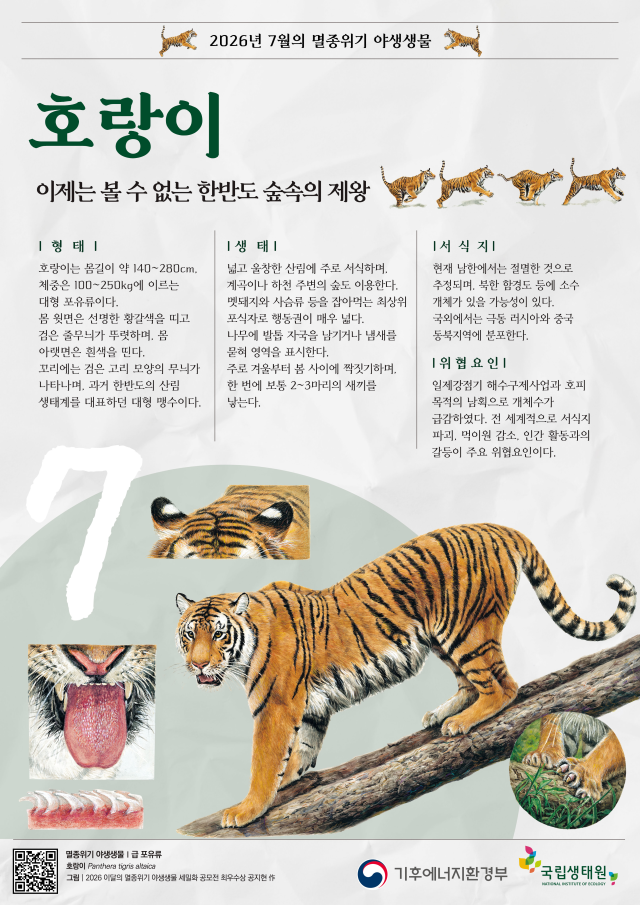
The tigers that once roamed the Korean Peninsula belong to the Amur subspecies. Globally, tigers are divided into nine subspecies, three of which—the Caspian, Javan, and Bali tigers—are already extinct. Only six subspecies remain, including the Amur, Bengal, Sumatran, Indochinese, Malayan, and South China tigers.
Tigers are large mammals, measuring between 140 and 280 centimeters in length and weighing between 100 and 250 kilograms. They are characterized by their distinctive orange-brown coats with black stripes and ringed patterns on their tails. Males are generally larger than females, with more developed heads, necks, and shoulders.
These big cats primarily inhabit dense forests, valleys, and riverine areas, hunting prey such as wild boars and deer. Their territories are extensive, with males covering about 1,400 square kilometers and females about 400 square kilometers. Tigers also mark their territory by leaving claw marks on trees or by scent marking.
The last confirmed sighting of a tiger in South Korea was in 1924, when one was captured in Hoengseong, Gangwon Province. It is currently estimated that a small population may still exist in North Korea's Hamgyong Province, while major habitats abroad include northeastern China and the Russian Far East.
Globally, tiger populations continue to decline due to habitat destruction, food shortages, and conflicts with humans.
In response, the South Korean government is strengthening legal protections for endangered wildlife. Under the current Wildlife Protection and Management Act, individuals caught capturing, collecting, harming, or killing endangered species level 1 without permission could face up to five years in prison or fines ranging from 5 million to 50 million won.
* This article has been translated by AI.
Copyright ⓒ Aju Press All rights reserved.