

The Ministry of Climate, Energy and Environment announced on July 1 that the revised "Public Electric Vehicle Charging Fee System" will take effect on August 1.
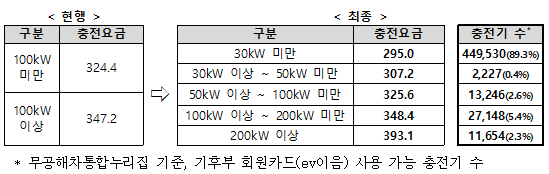
With this reform, the public charging fee system will expand from two tiers to five, incorporating both slow and fast charging segments. The fees will be set based on electricity costs, operational expenses, and mandatory inspection fees.
Slow chargers, which account for about 90% of all charging stations (under 30 kW), will see a reduction of 29.4 won (approximately 9.1%) per kWh. Consequently, the charging fee will drop from 324.4 won to 295.0 won per kWh, easing the financial burden on users.
Conversely, fast chargers, which require higher installation and operational costs, will see some fees increase due to the need for ongoing investment in technology to enhance service quality, including ultra-fast charging and power distribution.
For ultra-fast chargers (over 200 kW), which represent about 2.3% of all charging stations, the fee will rise by 45.9 won (13.2%) to 393.1 won per kWh. Fees for chargers between 30 kW and 50 kW will be set at 307.2 won, while those between 50 kW and 100 kW will be 325.6 won, and between 100 kW and 200 kW will be 348.4 won.
The revised fee structure will apply to public chargers operated by the Ministry of Climate, Energy and Environment and private chargers that have agreements with the government, allowing payments through the ministry's membership card (ev이음) for roaming services.
The ministry plans to introduce a "time-based linked rate system" that will lower charging fees during periods of high renewable energy generation.
The ministry aims to gradually improve the electric vehicle charging fee system, starting with this fee reform.
Jeong Seon-hwa, Director of Green Transition Policy at the ministry, stated, "This fee system reform not only reflects the operational costs of charging stations but also sets a standard for charging fees in the market. We will continue to enhance the fee structure to maximize the use of renewable energy and alleviate the cost burden on electric vehicle users."
* This article has been translated by AI.
Copyright ⓒ Aju Press All rights reserved.