

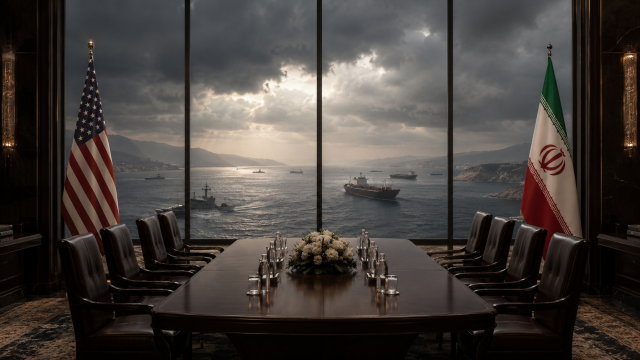
Discussions between the United States and Iran regarding a peace memorandum of understanding (MOU) are facing significant challenges from the outset. The U.S. sent special envoys Jared Kushner and Steve Witkoff to Doha, Qatar, in an attempt to resume negotiations. However, Iran has stated it has no plans for direct talks with U.S. representatives. Complications surrounding control of the Hormuz Strait, frozen Iranian assets, the Lebanon front, and debates over U.S. military operations have further disrupted the 60-day negotiation framework.
According to Reuters, Kushner and Witkoff visited Doha on June 30. The White House described the visit as a "high-level meeting." However, both Iran and Qatar provided conflicting accounts, indicating that U.S. officials would meet with Qatari mediators rather than the Iranian delegation.
Iranian Foreign Ministry spokesman Esmail Baghaei stated, "There are no plans for any level of talks with the U.S. side in the coming days." He clarified that discussions in Doha would not involve direct negotiations with the U.S. but would focus on verifying the implementation of the MOU through Qatar. Qatar also noted that high-level contacts between the U.S. and Iran would only be possible if practical discussions yield results.
Nevertheless, communication channels are not entirely closed. A senior U.S. official told Bloomberg that "positive discussions" took place with Qatari officials in Doha, adding that there has been progress through separate practical channels. While direct talks did not occur, mediation efforts appear to be ongoing.
Iran maintains that it must first assess the implementation of the agreement before engaging in direct negotiations. Baghaei stated, "We will evaluate the progress of existing provisions," which include the release of frozen Iranian funds, lifting maritime blockades, and allowing the sale of Iranian crude oil and petrochemical products. He added that the timing and manner of final agreement discussions would be determined based on the evaluation results.
The primary contention revolves around control of the Hormuz Strait. Iran argues that the 60-day free passage during the negotiation period is a temporary measure. After mid-August, they insist that the terms and costs of passage through the Strait must be renegotiated.
Mohammad Bagher Ghalibaf, head of the Iranian negotiating team, emphasized in a state television interview that "free passage through the Hormuz Strait is only permitted for 60 days." He asserted that sovereignty over the Strait belongs to Iran and Oman, and that passage must follow Iranian-defined methods and procedures. This stance conflicts with U.S. demands for unrestricted maritime movement in the Strait.
Oman's proposal for service fees also introduces a new variable. According to The New York Times and other outlets, Oman has recently suggested that vessels using the Hormuz Strait pay service fees. Oman describes these fees as necessary for navigation safety, pollution prevention, and emergency response, rather than tolls. However, the U.S. maintains that any fees, whether service charges or tolls, should not be linked to the use of the Strait.
The release of frozen assets remains another contentious issue. The Associated Press reported that Qatar plans to release $6 billion in frozen Iranian assets, although those funds have not yet been transferred to Iran.
Military tensions are also undermining the momentum for negotiations. Despite the MOU being signed, both nations have continued military confrontations around the Hormuz Strait. The U.S. has struck Iranian military facilities in retaliation for attacks on commercial vessels and drone strikes. Iran has also claimed to have attacked U.S. military bases in Bahrain and Kuwait. Baghaei labeled recent U.S. attacks as violations of the MOU's first article, asserting that such military actions undermine the cessation of hostilities. He warned that repeated violations could hinder negotiations.
The U.S. has not ruled out military options entirely. The Wall Street Journal reported that President Trump has recently been briefed on potential additional strikes against Iran. However, he is said to prefer continuing diplomatic efforts for now. Should military confrontations escalate again, the debate over military responses could intensify.
The situation in Lebanon also presents complications. Iran views the cessation of hostilities in Lebanon and the withdrawal of Israeli forces as key conditions for implementing the peace agreement. Recently, Israel and Lebanon agreed to a basic framework mediated by the U.S., which involves the Lebanese army taking control of certain areas previously held by Hezbollah, paving the way for a phased withdrawal of Israeli forces.
However, Israeli Prime Minister Benjamin Netanyahu has expressed his determination not to retreat. During a visit to southern Lebanon, he stated, "We will not leave southern Lebanon until the threat from Hezbollah is completely eliminated." The Lebanon issue remains a significant obstacle to reaching a final agreement.
Political pressures in the U.S. are also mounting. According to USA Today, House Speaker Mike Johnson indicated that if hostilities with Iran escalate again, President Trump may need to seek new congressional approval under a 60-day deadline. The War Powers Act limits the duration a president can conduct military operations abroad without congressional approval. The Trump administration argues that the existing ceasefire has paused this deadline. However, both Democrats and some Republicans have raised concerns about continuing military operations without congressional consent.
The U.S. emphasizes the need to resume negotiations, while Iran prioritizes verifying the implementation of the MOU over direct talks. The issues of Hormuz control, service fees, frozen assets, troop withdrawals from Lebanon, nuclear program restrictions, and sanctions relief are all interconnected. The peace agreement has faced significant challenges from the beginning.
* This article has been translated by AI.
Copyright ⓒ Aju Press All rights reserved.