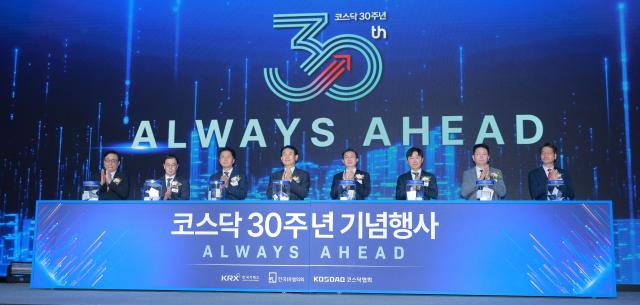
SEOUL, July 01 (AJP) – KOSDAQ, South Korea's answer to the Nasdaq, turned 30 on Wednesday. But the celebration was notably subdued as the junior market remains trapped in a kind of Peter Pan syndrome, unable to match the spectacular rise of its bigger sibling, the KOSPI.
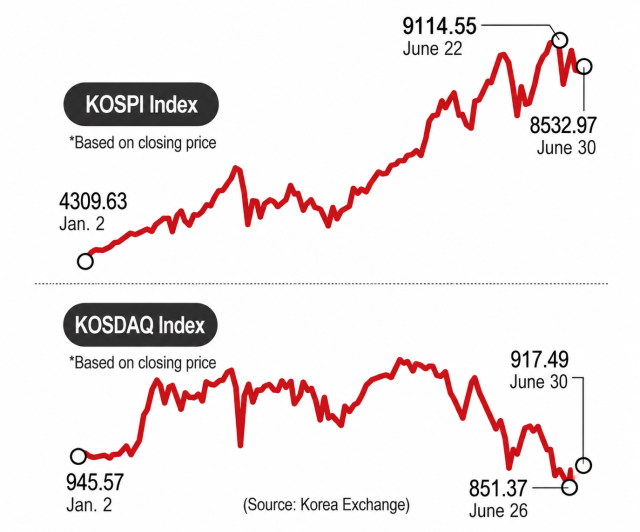
While the benchmark KOSPI has quadrupled over the past 18 months, KOSDAQ has barely moved. After standing at 925 eighteen months ago, it closed its 30th anniversary at 929.35. The market debuted at 1,000 points on July 1, 1996.
The divergence has widened this year. The KOSPI has surged 92.67 percent on an artificial intelligence-driven rally led by Samsung Electronics and SK hynix, while the KOSDAQ has slipped 1.72 percent into negative territory. Many of KOSDAQ's biggest success stories have graduated to the main board, while retail investors — once the backbone of the junior exchange — have shifted their money into large-cap AI stocks.
Rather than celebrating its milestone, the exchange enters its fourth decade under mounting pressure to restore investor confidence through another round of market reforms.
The contrast is stark. KOSDAQ's share of South Korea's total stock market capitalization has shrunk to about 6 percent from roughly 12 percent at the beginning of the year, according to Korea Exchange.
All talk, no solution?
The Korea Exchange launched KOSDAQ CONNECT 2026, a three-day conference beginning Wednesday to coincide with the market's 30th anniversary.
Jointly organized by the Korea Investor Relations Service and the KOSDAQ Association, the event brings together listed companies, institutional investors, investment banks, venture capital firms and retail investors in what the exchange describes as its largest investor relations conference dedicated to the KOSDAQ market.
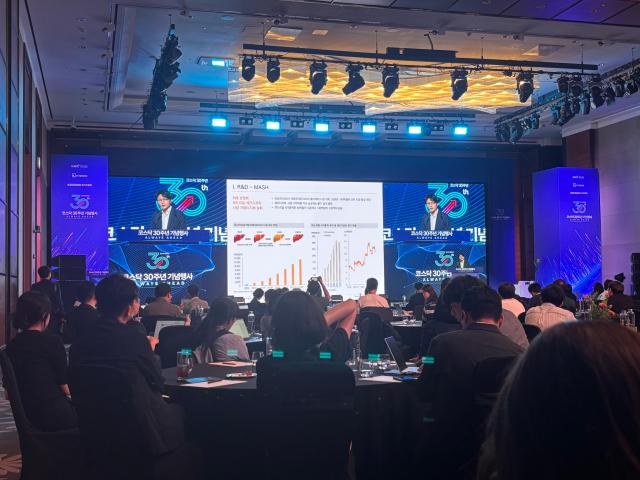
Speaking at the opening ceremony in Seoul, Korea Exchange Chairman Jeong Eun-bo pledged to strengthen the market's fundamentals and restore credibility. "The exchange will actively improve the quality of the market so that KOSDAQ can become a trusted marketplace," he said. "By ensuring the efficient allocation and circulation of venture capital, we will build a market where productive finance functions at its best."
He added that he hoped KOSDAQ CONNECT 2026 would become "a meaningful platform for enhancing corporate value."
The opening day featured presentations on KOSDAQ's three-decade history and future roadmap, panel discussions on its direction, and industry sessions covering pharmaceuticals, biotechnology and medical devices. Over the following two days, policymakers are scheduled to unveil additional measures to improve market quality, expand technology-track listings, increase venture capital funding and strengthen disclosure requirements.
Analysts, however, say the success of those initiatives will ultimately depend on whether they restore investor confidence and improve the quality of listed companies.
Kim Jung-hoon, an analyst at Trust Investment Advisory, said KOSDAQ needs to attract companies with sustainable growth prospects instead of merely increasing the number of technology-track IPOs. "As delisting requirements become stricter, IPOs should focus on companies with proven growth potential," he said.
He also argued that improving investor communication is just as important as raising listing standards. "Many KOSDAQ companies don't even have dedicated investor relations teams. There needs to be a better system for communicating with shareholders."
Recent policy initiatives, he added, have done little to bring investors back. "There have been plenty of policy measures, but on the ground it's difficult to feel their impact because investors remain focused on Samsung Electronics and SK hynix."
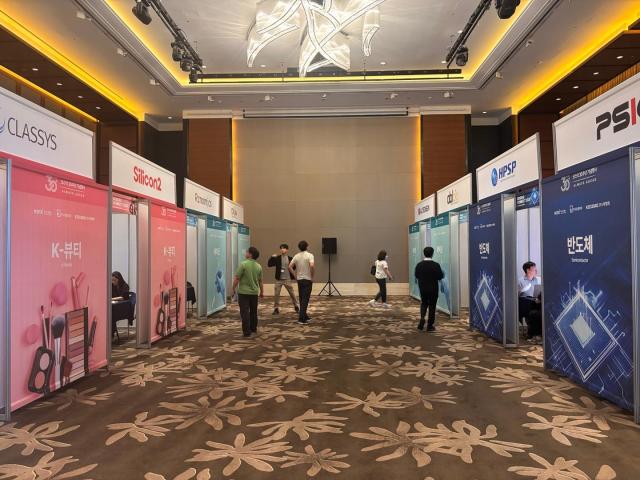
Outside the conference hall, the market's challenges were on full display. The exhibition booths of KOSDAQ-listed companies were largely empty, with few visitors stopping by despite the anniversary event.
KOSDAQ's fortunes have mirrored South Korea's changing industrial landscape.
The market enjoyed a spectacular boom during the venture-capital frenzy of 1999 and 2000, reaching a record high of 2,834.40 in March 2000 — a peak it has never revisited. It plunged after the Nasdaq-led dot-com crash, falling below 300 by 2004 and to 261.19 during the global financial crisis in 2008.
It later found renewed momentum through a biotech rally led by Celltrion in the mid-2010s and again in 2023 as battery makers including EcoPro, EcoPro BM and L&F surged. But as the electric-vehicle boom faded and investors rotated into AI-driven semiconductor stocks, KOSDAQ failed to produce a new generation of market leaders, leaving even a return to the 1,000-point level increasingly elusive.
Analysts say the market's prolonged stagnation reflects structural weaknesses, including the steady migration of successful companies to the KOSPI, the growing number of so-called zombie companies and repeated surprise share issuances that have eroded investor confidence.
The loss of blue-chip companies has been particularly painful. Naver, Kakao and Celltrion all began on KOSDAQ before transferring to the main board. Alteogen, now the market's largest company by market capitalization, is also pursuing a KOSPI listing.
Retail investors have been voting with their feet. Individuals have sold a net 10 trillion won ($7.3 billion) worth of KOSDAQ shares this year, rotating into major semiconductor stocks as the AI investment boom accelerated. Foreign and institutional investors have been net buyers, purchasing roughly 6 trillion won and 4 trillion won worth of shares, respectively.
The government is betting that stricter listing standards can help reverse the decline.
Beginning Wednesday, listed companies must maintain a market capitalization of at least 20 billion won, up from the previous 15 billion won threshold, to remain on the exchange. Stocks trading below 1,000 won will also face tougher delisting requirements.
The Korea Exchange also plans to introduce a three-tier KOSDAQ structure in October, dividing the market into premium, standard and management segments in an effort to channel investment toward stronger companies while weeding out weaker ones.
Three decades after its launch, however, KOSDAQ is still searching for a way to become a destination for tomorrow's market leaders instead of merely serving as a nursery for future KOSPI companies.

Copyright ⓒ Aju Press All rights reserved.