

The history of golf in Korea cannot be told without mentioning Seoul and Hanyang Country Club. This venue is more than just a golf course; it is the birthplace of Korean golf, a significant chapter in the country's modern sports culture, and a living cultural heritage that has evolved alongside industrialization, urbanization, and globalization. When golf was still an unfamiliar Western sport, this was the first place to establish a course, create a club, and teach people the etiquette, competition, camaraderie, and discipline associated with the game.
The origins of Korean golf trace back to the Kyungsung Golf Club in 1924. Despite the dark times of Japanese colonial rule, the seeds of a new sports culture were sown. The histories of the Gunja Course and Seoul CC, along with the establishment of Hanyang CC in 1964, are intertwined with the growth of golf in Korea. While Seoul CC laid the foundation for Korean golf, Hanyang CC pioneered the era of popular golf culture and commercial golf courses. The shared history of these two clubs reflects the journey of Korean golf.
Seoul and Hanyang CC are special not only because of their long history. There are two types of age: one that is worn out and another that is deepened. The passage of time at Seoul and Hanyang CC represents depth rather than decay. This place holds the first memories of Korean golf, the lives of senior members, and significant moments in the history of Korean sports.
The Korean Amateur Golf Championship, the Korean Open, the golf event at the 1986 Seoul Asian Games, and visits from world-class golfers highlight that this golf course is not merely a private club but a public stage for Korean golf.
Particularly, the sweat of Korea's golf pioneers is embedded in the soil and grass here. The name of Lee Yeon-deok, considered the country's first professional golfer, is inseparable from the history of Korean golf. In an era without precise surveying equipment and design programs, courses were created by reading the natural contours and feeling the land's flow, using only string to measure fairways and greens. The courses of that time were crafted not by machines but by human eyes, hands, and a sensitivity to nature. Thus, the layout of Seoul and Hanyang CC showcases the essence of nature rather than artificial displays.
The criteria for a prestigious golf course are not determined solely by an opulent clubhouse or expensive memberships. Prestige is built over time, by people, and through an attitude toward nature. Seoul and Hanyang CC is nestled against the backdrop of Bukhansan Mountain, embraces the historical breath of Seosamneung, and incorporates pine forests and seasonal flowers, including cherry blossoms in spring and autumn foliage, into its course. This venue has long demonstrated that golf is not a sport of conquering nature but one of conversing with it.
Golf is not merely about hitting a ball far; it is about mastering oneself. Each swing embodies ambition and restraint, judgment and patience, skill and spirit. Therefore, a golf course becomes a place for personal cultivation. A good golf course humbles its players. The wind does not blow according to calculations, the grass does not respond as expected, and the ball does not deceive the heart's fluctuations. This is why Seoul and Hanyang CC has been cherished for nearly a century; it is a place that questions the dignity of individuals through golf.
The culture of membership is also a vital asset of Seoul and Hanyang CC. Long-standing members, families who have held memberships for generations, senior golfers enjoying rounds past the age of 90, and the club's oldest member, who is over 100, illustrate that this club is not just a sports facility but a community where generations and memories connect. Golf is not an activity solely for the young; it deepens with age. Rhythm becomes more important than strength, balance more crucial than power, and etiquette more significant than competition.
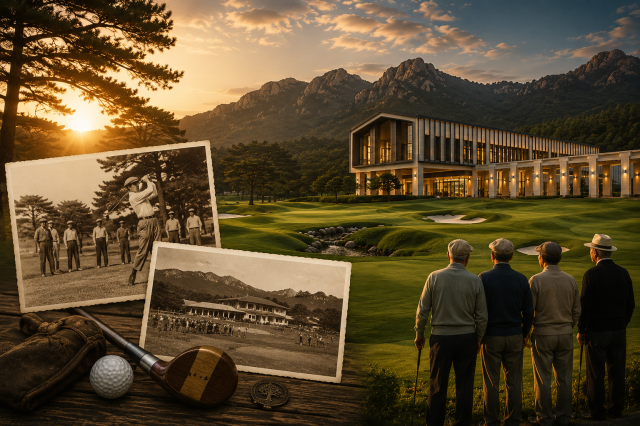
The senior members of Seoul and Hanyang CC have embodied this truth.
The recent completion of a new clubhouse at Seoul and Hanyang CC and the declaration of a new century is not merely a facility upgrade. It marks a significant event as the birthplace of Korean golf opens its doors to the future once again. The clubhouse is the face of the golf course; however, more profoundly, it is a cultural hub where people meet. It is a place for the excitement before a round, conversations after, greetings between generations, memories of long-time members, and the hopes of new members. The new clubhouse should not erase the past but serve as a vessel that carries the elegance of the past into the future.
The 'Korea Centenarian Golf Tournament' scheduled for September 9 will amplify this symbolism. Over 60 golfers aged 80 and above will gather, including centenarian Kim Du-man, along with notable figures such as Shin Young-kyun, Kwon No-gap, Lee Gil-yeo, former Minister Lee Yong-man, and Yoon Se-young, chairman of SBS. Their presence, having witnessed various moments in modern Korean history, is a historical event in itself. This tournament is not just a friendly match; it is a celebration of humanity, culture, and nature in the context of the centenarian era through the language of golf.
The significance of the centenarian golf tournament lies not in competition but in transcending it. How should humans live in the centenarian era? Can old age be a time of maturity rather than decline? Can exercise become a culture that preserves the dignity of life beyond a means for health? Can a golf course be a space that teaches harmony between nature and humanity rather than one that harms nature? This tournament poses these questions to our society.
The 100-year history of Seoul and Hanyang CC can ultimately be summarized in three words: humanity, culture, and nature. Humanity learns to master itself and respect others through golf. Culture connects generations and builds the dignity of the community. Nature teaches humility and restores balance in life. When these three elements harmonize, golf transcends mere sport and becomes civilization.
South Korea has grown rapidly. Industrialization demanded speed, urbanization required efficiency, and globalization called for competition. However, our society has now entered an era that cannot be explained solely by speed and efficiency. It has become more important to consider how we live rather than how long we live, and to focus on what dignity we maintain rather than how much we possess. In this regard, the century of Seoul and Hanyang CC embodies values that South Korean society must reconsider. Tradition is not merely a relic of the past but the root that supports the future.
Korean golf has now reached a world-class level. Korean players have astonished the world on the LPGA and PGA stages, and the country's golf industry has developed a vast ecosystem encompassing equipment, apparel, broadcasting, leisure, tourism, and culture. However, a truly advanced golf culture cannot be completed solely through performance. It must also encompass etiquette, dignity, respect for nature, intergenerational courtesy, club culture, and a spirit of record-keeping and preservation. This is what Seoul and Hanyang CC must focus on moving forward: documenting, preserving, and passing on the history of 100 years of Korean golf.
The new clubhouse and the centenarian golf tournament are the starting points for this journey. The new building must encapsulate a new era. The centenarian golf tournament should not be a one-time event but evolve into a cultural brand that showcases the dignity of Korean golf to the world. The lives and stories of senior golfers must be recorded, the names of Korean golf pioneers must be remembered, and the philosophy of coexistence with nature must set the standard for future generations.
Seoul and Hanyang CC will remain a true prestigious club not by dwelling on past glories but by embracing the past while opening the future. From the first step in 1924 to the new declaration in 2026, this venue has held the timeline of Korean golf. The remaining task is to elevate that timeline into culture. Golf must become a symbol of dignity rather than wealth, and a school of friendship, health, and nature rather than a stage for competition.
The 100 years of golf in South Korea began at Seoul and Hanyang CC. And the next 100 years will also pose new questions here. What kind of golf culture will we pass on to the next generation? We must create a golf that is not just played for a long time but played beautifully, enjoyed with dignity rather than merely winning, and one that breathes with nature rather than consuming it. This is the mission that Seoul and Hanyang CC must undertake as it welcomes a new century.
* This article has been translated by AI.
Copyright ⓒ Aju Press All rights reserved.