

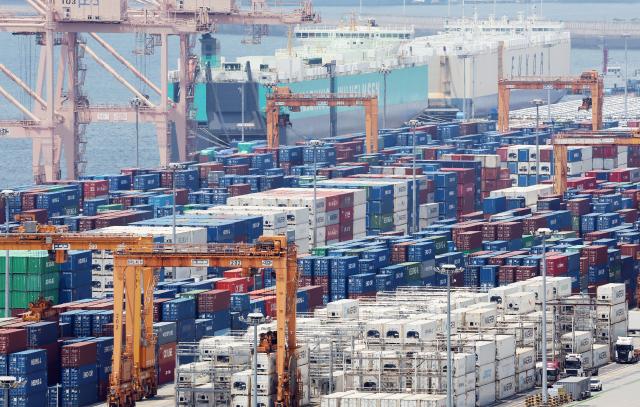
Containers stacked at Pyeongtaek Port in Gyeonggi Province on July 1. [Photo=Yonhap News]
South Korea's exports reached a record high last month, but experts warn that underlying risks remain. The country is increasingly reliant on semiconductor exports, while global protectionist trends are intensifying. Additionally, stalled peace negotiations between the U.S. and Iran have kept oil price risks unresolved.
According to the Ministry of Trade, Industry and Energy, exports in June totaled $102.25 billion, a 70.9% increase from the previous year. This marks the first time monthly exports have exceeded $100 billion, continuing a 13-month streak of growth.
However, the growing share of semiconductors in total exports is raising concerns about over-reliance. In June, semiconductor exports amounted to $44.82 billion, accounting for 43.8% of total exports. While current trends in artificial intelligence (AI) investment and a semiconductor supercycle are boosting export figures, excessive dependence could make the economy vulnerable to external factors. Concerns are rising that fluctuations in memory chip prices, the performance of U.S. tech companies, and speculation about an AI bubble could increase economic volatility in South Korea.
Some analysts suggest that the recent surge in exports may be a temporary effect of rising semiconductor prices. Yang Jun-seok, a professor of economics at Catholic University, stated, "There appears to be a clear illusion regarding semiconductors," adding that the increase in semiconductor exports is largely driven by price hikes rather than an increase in sales volume.
The global trend toward protectionism is also contributing to uncertainties for exports in the second half of the year. On July 1, the European Union reduced its tariff-free quota for steel by nearly half. While South Korea's specific quota saw a relatively modest decrease of 19.7%, experts predict a decline in steel exports is inevitable.
U.S. tariff pressures could also pose challenges. Although the U.S. Supreme Court ruled that the administration's tariffs based on the International Emergency Economic Powers Act (IEEPA) were illegal, companies are proceeding cautiously, refraining from seeking refunds. In fact, the U.S. has increased steel tariffs from 25% to 50% since last month, raising the barriers of protectionism. Furthermore, investigations into non-tariff barriers for key industries have raised the possibility of new tariffs.
Uncertainties stemming from the Middle East remain unresolved. With U.S.-Iran peace negotiations stalled, any resurgence of conflict could disrupt raw material markets. Rising oil prices could increase energy import costs and maritime logistics expenses, potentially leading to a worsening trade balance and higher manufacturing costs.
Kang Gam-chan, head of the Trade and Investment Bureau at the Ministry of Trade, Industry and Energy, stated during a briefing, "Due to protectionist measures such as U.S. tariffs and EU steel TRQ adjustments, uncertainties in the second half of the year are likely to be greater than in the first half," adding, "It is still difficult to say that the Middle East conflict has been resolved, so oil price forecasts remain uncertain."
Ultimately, achieving this year's export target of $1 trillion will depend on minimizing external risks and sustaining the semiconductor boom. Additionally, the recovery of the Chinese economy and the timing of U.S. interest rate hikes are expected to be significant factors.
Professor Yang noted, "The construction of AI data centers in the U.S. is likely to influence South Korea's export situation," expressing concern over increasing skepticism about AI data centers in the U.S. and signs of impending interest rate hikes.
According to the Ministry of Trade, Industry and Energy, exports in June totaled $102.25 billion, a 70.9% increase from the previous year. This marks the first time monthly exports have exceeded $100 billion, continuing a 13-month streak of growth.
However, the growing share of semiconductors in total exports is raising concerns about over-reliance. In June, semiconductor exports amounted to $44.82 billion, accounting for 43.8% of total exports. While current trends in artificial intelligence (AI) investment and a semiconductor supercycle are boosting export figures, excessive dependence could make the economy vulnerable to external factors. Concerns are rising that fluctuations in memory chip prices, the performance of U.S. tech companies, and speculation about an AI bubble could increase economic volatility in South Korea.
Some analysts suggest that the recent surge in exports may be a temporary effect of rising semiconductor prices. Yang Jun-seok, a professor of economics at Catholic University, stated, "There appears to be a clear illusion regarding semiconductors," adding that the increase in semiconductor exports is largely driven by price hikes rather than an increase in sales volume.
The global trend toward protectionism is also contributing to uncertainties for exports in the second half of the year. On July 1, the European Union reduced its tariff-free quota for steel by nearly half. While South Korea's specific quota saw a relatively modest decrease of 19.7%, experts predict a decline in steel exports is inevitable.
U.S. tariff pressures could also pose challenges. Although the U.S. Supreme Court ruled that the administration's tariffs based on the International Emergency Economic Powers Act (IEEPA) were illegal, companies are proceeding cautiously, refraining from seeking refunds. In fact, the U.S. has increased steel tariffs from 25% to 50% since last month, raising the barriers of protectionism. Furthermore, investigations into non-tariff barriers for key industries have raised the possibility of new tariffs.
Uncertainties stemming from the Middle East remain unresolved. With U.S.-Iran peace negotiations stalled, any resurgence of conflict could disrupt raw material markets. Rising oil prices could increase energy import costs and maritime logistics expenses, potentially leading to a worsening trade balance and higher manufacturing costs.
Kang Gam-chan, head of the Trade and Investment Bureau at the Ministry of Trade, Industry and Energy, stated during a briefing, "Due to protectionist measures such as U.S. tariffs and EU steel TRQ adjustments, uncertainties in the second half of the year are likely to be greater than in the first half," adding, "It is still difficult to say that the Middle East conflict has been resolved, so oil price forecasts remain uncertain."
Ultimately, achieving this year's export target of $1 trillion will depend on minimizing external risks and sustaining the semiconductor boom. Additionally, the recovery of the Chinese economy and the timing of U.S. interest rate hikes are expected to be significant factors.
Professor Yang noted, "The construction of AI data centers in the U.S. is likely to influence South Korea's export situation," expressing concern over increasing skepticism about AI data centers in the U.S. and signs of impending interest rate hikes.
* This article has been translated by AI.
Copyright ⓒ Aju Press All rights reserved.