

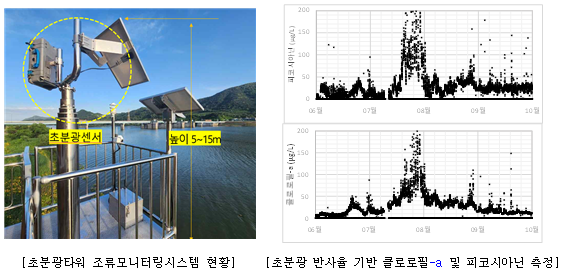
On July 2, the National Institute of Environmental Research announced plans to enhance its regional algal bloom monitoring system by integrating field observations with satellite image analysis.
The monitoring system will focus on real-time observations using fixed hyperspectral towers and the establishment of a satellite-based monitoring system for widespread algal blooms.
Hyperspectral sensors can analyze a significantly greater range of wavelengths than standard cameras, allowing for real-time measurements of algal pigments such as chlorophyll-a and phycocyanin, which are difficult to detect with the naked eye.
Currently, hyperspectral towers are operational at two locations: the Nakdong River in Chilseo and the Daecheong Lake in the Geum River. The National Institute of Environmental Research plans to add three more towers this month at Haepyeong, Gangjeonggoryeong, and Mulgeummari along the Nakdong River, bringing the total to five.
Data collected from these observations will be analyzed using an AI-based deep learning model, in conjunction with information from water quality sensors, weather monitoring equipment, and CCTV. Presently, the system provides real-time data on chlorophyll-a and phycocyanin concentrations, and future developments will include automatic analysis of harmful algal cell counts, a key management indicator for algal bloom alerts.
Once developed, this technology is expected to aid in the real-time detection of changes in algal bloom concentrations and unusual signs.
For broader monitoring, the European Space Agency's Sentinel-2 satellite imagery will be utilized. The National Institute of Environmental Research is applying atmospheric correction and AI image analysis techniques to quantitatively assess the distribution of chlorophyll-a and phycocyanin concentrations. Algal bloom distribution maps for the Nakdong, Geum, and Yeongsan River basins are being made available through the water environment information system.
By combining field observations with satellite monitoring, the institute believes it can simultaneously capture precise hourly changes and the spatial distribution across large water bodies. This will enhance the operation of algal bloom alert systems and improve responses from local governments and related agencies regarding water treatment and seasonal management of algal blooms.
Kim Kyung-hyun, head of the Water Environment Research Division at the National Institute of Environmental Research, stated, "The integration of AI and advanced remote sensing technology is a key innovation in transforming water quality management systems in the era of climate change. We will continue to enhance our real-time, predictive-based intelligent algal bloom response system to ensure a safe water environment for the public."
* This article has been translated by AI.
Copyright ⓒ Aju Press All rights reserved.