

"We will lead with the world's best quality pilot," and "Pursuing uncompromising perfection for our customers."
On July 1, as the summer heat began, I drove an hour and a half from Anguk Station in Seoul to visit Hyundai Motor Group's Namyang Research Center. Upon entering the Pilot Center, phrases emphasizing quality and completeness immediately caught my eye, reflecting the employees' commitment to developing high-quality vehicle technology.
The Namyang Research Center is the core hub for research and development (R&D) of mobility technologies for Hyundai Motor and Kia. Established in 1995 with a comprehensive driving test facility, it has become a key site for new vehicle development, design, testing, and evaluation.
Despite its over 30-year history, the Namyang Research Center continues to evolve. A representative stated, "We plan to operate the equipment 24 hours a day," adding that they are internally reviewing whether to enable mobile alerts for dashboard data or if additional personnel will be needed. The latest equipment will be installed by July 20, after which they will consider a 24-hour operation model.
The research center is divided into several key areas: the Driving Simulator, NOVA Lab, Digital Measurement Center (DMC), and Additive Manufacturing Solutions Center (AMSC).
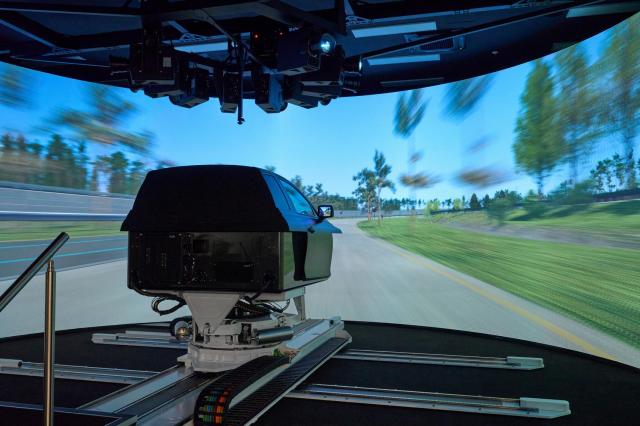
The first area I visited was the Driving Simulator, which resembled a real road driving environment. Inside the simulator, designed to mimic the Genesis G80, the cockpit moved in accordance with the steering wheel's direction. Various road surface impacts were felt, and when crossing a virtual speed bump, the vehicle jolted accordingly.
The simulator is already capable of autonomous driving using artificial intelligence (AI). Jeong Pil-young, head researcher of the Driving Performance Concept Development Team, stated, "It can operate without a human driver using AI," adding, "A lot of data is needed for perfect AI driving." The driving simulator, which arrived at the Namyang Research Center in February, is also set to be completed at the European research center by the end of the year.
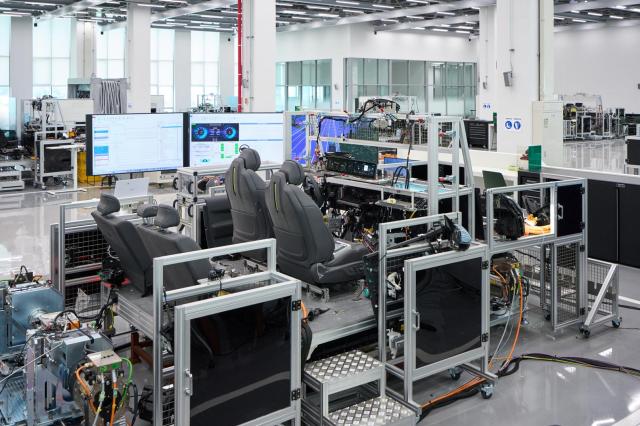
Next, I ascended to the sixth floor, where the NOVA Lab is located. This space is dedicated to validating next-generation open controllers. A standout feature was the 'wire-car,' which connected wiring, controllers, and electronic components on a vehicle structure testing bench. Among them, only two wire-cars are designated for validating Software Defined Vehicles (SDV).
Lee Woo-jin, head of the Pilot Electrical Control Development Team, emphasized, "SDVs require larger and more complex validation equipment than traditional legacy vehicles," noting that the development period is extended and continuous validation is necessary to enhance reliability. He added, "We will continue to improve development completeness while validating SDVs."
* This article has been translated by AI.
Copyright ⓒ Aju Press All rights reserved.