
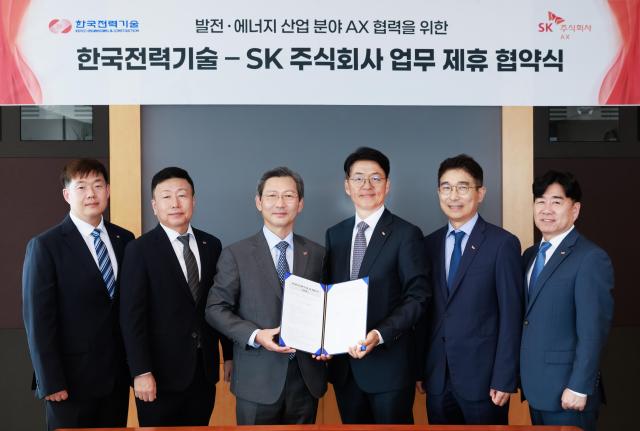
The firm announced Thursday its agreement was signed at SK U-Tower in Seongnam, Gyeonggi Province, with SK AX Chief Executive Kim Wan-jong and KEPCO E&C Chief Executive Kim Tae-kyun attending alongside executives from both companies.
The two firms plan to apply AI across plant design, project management, operations and maintenance, aiming to sharpen operational efficiency as electricity demand surges. KEPCO E&C, the country's sole comprehensive power plant design institution, holds top-tier expertise in nuclear reactor design and has been expanding into small modular reactors and renewable energy.
"AI innovation demand is rapidly expanding across the power and energy industry, from design to operations and maintenance," Kim Wan-jong said, adding that the partnership would build an "AI augmentation" system to deliver tangible results across processes and governance.
Under the deal, KEPCO E&C will adopt SK AX's AI platforms, including AXgenticWire AiPMO for project management and AXgenticWire NPO Agent Builder, a no-code tool that lets employees build their own AI agents for tasks such as document review and issue tracking.
The companies will also jointly develop an offshore wind operations and maintenance platform covering power output forecasting and predictive maintenance, with plans to pursue both domestic and global projects.

Kim Dong-young
Kim Dong-young is a bilingual journalist at AJU Press (AJP), covering Korean tech, energy, and bio/pharma.
He reports from the field at events like CES and APEC, runs AJP's YouTube channels,
and is pursuing a master's at Sogang's MOT program.
Copyright ⓒ Aju Press All rights reserved.
Related News
-
 Meta's Cloud Venture Shakes Semiconductor Stocks, Samsung and SK Hynix Drop 6%
On July 1, the KOSPI closed at 8303.41, down 173.07 points (2.04%) from the previous trading day. News of Meta's entry into the cloud business has led to a sharp decline in U.S. semiconductor stocks, prompting expectations of a weak start for the domestic market, particularly in the semiconductor sector. However, analysts suggest that the recent capital flow from semiconductors into sectors like power equipment, defense, and biotechnology may limit the overall decline in indices. According to the Korea Exchange, the KOSPI closed at 8303.41 on July 1, down 173.07 points (2.04%) from the previous trading day. The index opened 115.02 points (1.36%) higher at 8591.50 and peaked at 8620.15 during the day, but later reversed course, dropping to as low as 8143.33 amid significant volatility. Despite June's export figures exceeding market expectations, profit-taking in semiconductor stocks erased all gains. U.S. markets also fell sharply due to weakness in semiconductor stocks. On July 1 (local time), the Dow Jones Industrial Average closed down 13.96 points (0.03%) at 52,305.24. The S&P 500 dropped 16.13 points (0.22%) to 7483.23, while the tech-heavy Nasdaq Composite fell 173.69 points (0.66%) to close at 26,040.03. In the pre-market trading in South Korea, the impact of the U.S. semiconductor slump is already evident, with both Samsung Electronics and SK Hynix experiencing declines of around 6%. Despite the Federal Reserve Chair Kevin Warsh's dovish inflation outlook, Meta's strategic shift has captured market attention. Meta announced plans to leverage surplus AI computing power for its cloud business, raising concerns that the AI infrastructure investment cycle may slow down sooner than expected. Consequently, Micron's stock plummeted by 10.4%, and SanDisk fell by 10.5%. In contrast, Meta's shares surged by 8.8%. Market sentiment largely views this adjustment as a short-term profit-taking phase rather than a slowdown in the AI industry itself. In South Korea, June exports rose by 70.9% year-on-year, significantly surpassing the market forecast of 60.7%. The growth rate for semiconductor exports also increased from 169.4% in May to 199.5% in June, reaffirming an improving industry outlook. Han Ji-young, a researcher at Kiwoom Securities, stated, "Meta's entry into the cloud business introduces a new variable to the AI investment narrative, but there is no confirmation of a slowdown in AI demand or a decline in earnings. Given the recent high gains in semiconductor stocks, this adjustment should be viewed as a strong profit-taking correction." Investor focus is now shifting to the U.S. non-farm payroll report for June, with expectations of new jobs slowing to 125,000 from 172,000 the previous month. However, as the Federal Reserve's policy focus has shifted more towards inflation than employment, any stronger-than-expected job figures are likely to have a limited impact on the stock market. On this day, the domestic market is expected to show weakness in the semiconductor sector due to the sharp decline in U.S. semiconductor stocks. However, with ongoing capital rotation into sectors like power equipment, defense, and biotechnology, and a slight easing of U.S. interest rate pressures, there is a prevailing belief that funds will continue to shift between sectors rather than exit the market entirely. Additionally, with key events such as Samsung Electronics' second-quarter preliminary results announcement and SK Hynix's U.S. ADR listing and earnings report on the horizon, analysts maintain that the earnings momentum remains valid despite potential short-term volatility.* This article has been translated by AI.
-
 Apple Negotiates Memory Chip Purchases from Chinese Firms on US Defense Department Blacklist
Apple is in negotiations to purchase memory chips from Chinese semiconductor companies that are on the U.S. Defense Department's blacklist, according to a report by Bloomberg on July 1, citing sources familiar with the matter. The report indicates that Apple is exploring options to acquire memory components from Changxin Memory Technologies (CXMT) and Yangtze Memory Technologies Co. (YMTC) for devices sold in China. However, sources noted that no agreements have been finalized as negotiations are still ongoing. Additionally, Apple’s leadership, including CEO Tim Cook, has reportedly requested that U.S. Treasury Secretary Scott Morrison and other key officials from the Trump administration help mitigate the political fallout from transactions with Chinese memory semiconductor firms. CXMT and YMTC were added to the U.S. Defense Department's list of companies supporting the People's Liberation Army in 2025 and 2024, respectively, raising suspicions from the U.S. government. YMTC was also placed on the U.S. Commerce Department's blacklist in 2022, prohibiting it from acquiring technology from U.S. suppliers without special permission. While Apple does not require formal approval from the U.S. government to purchase products from CXMT and YMTC, the heightened tensions between the U.S. and China could lead to significant backlash regarding national security concerns. Some Trump administration officials and hardline lawmakers have expressed opposition to such transactions. Rep. Brian Mast (R-Fla.), chair of the House Foreign Affairs Committee, stated, "CXMT and YMTC are military enterprises that accelerate the Chinese Communist Party's goals of military modernization and AI dominance. If this decision (to purchase memory from China) is allowed, it would undermine President Trump's policies on supply chain security and the AI arms race." Apple's move comes amid a surge in demand for memory semiconductors driven by the recent AI boom, which has caused prices to skyrocket. In response to rising memory chip costs, Apple raised prices on several key products, including Macs and iPads, last week. If Apple proceeds with transactions with CXMT and YMTC, its sources for memory semiconductors would expand from three (Samsung Electronics, SK Hynix, and Micron) to five, according to Bloomberg.* This article has been translated by AI.
-
 Finding National Growth Potential in the Southwest Semiconductor Industry
Im Ki-cheol, President of Gwangju Institute of Science and Technology. The experiences from four industrial revolutions have left a clear lesson: countries that successfully connected science and technology with industry and markets have led the next era. The first industrial revolution in late 18th-century Europe was not merely a victory of the steam engine; it was a transformative shift that opened the modern age, driven by new power sources, open markets, and supportive institutions and entrepreneurship. Adam Smith's "The Wealth of Nations," published in 1776, provided the economic rationale for this revolution. Two years later, Park Je-ga's "Northeast Asia" was published, hinting at the potential for industrial promotion under the new trade system implemented during King Jeongjo's reign. However, the failure to connect technological innovation, markets, and institutions led to the loss of modernization opportunities in Joseon history. This historical lesson remains relevant today in the southwest region of South Korea. The government recently announced a historic investment plan to rewrite the nation's semiconductor history in this area during the "Korea's Great Leap: Three Mega Projects National Report Meeting." While there are diverse criticisms surrounding this initiative, it is clear that AI and semiconductors are at the center of technological supremacy, with national security expanding into the realms of economy, industry, and science and technology. We are at a pivotal moment in what is termed the politics of technology. The strategic choices made during critical moments, such as the emergence of smartphones in 2007, AlphaGo in 2016, and ChatGPT in 2022, underscore the importance of these decisions. If the region does not act now, opportunities will slip away again, as South Korea must chart its course in the global economy and digital industry in the AI era. From an economic and industrial perspective, five key factors for successfully leading new industrial clusters include AI infrastructure, energy including power networks, talent, the presence of anchor companies, and the expansion of venture capital. The recent announcement of semiconductor investments and production base construction by Samsung and SK Hynix in the Honam region fulfills the criteria for anchor companies, instilling hope for the future. Given the promise of large-scale job creation, success is already more than halfway assured. Contrary to critical debates, the southwest region possesses ample potential and possibilities. Gwangju has established an AI infrastructure with the National AI Data Center, AI cluster, and AX demonstration base. Jeonnam boasts nuclear power alongside renewable energy and ample growth space. If combined with the research capabilities and talent development functions of the Gwangju Institute of Science and Technology (GIST), the southwest could emerge as a hub for designing, validating, and demonstrating AI semiconductors. Above all, the key is to connect the semiconductor industry's value chain within the southwest region. When design talent, advanced packaging, validation infrastructure, companies, and energy are linked, a self-sustaining ecosystem can be established. In this regard, GIST serves as a crucial starting point for nurturing the semiconductor industry in the southwest. Already operating a semiconductor contract program with Samsung Electronics, GIST has begun formalizing its educational system through collaborations with leading global semiconductor IP firm Arm to train specialized AI semiconductor design talent and with global testing and measurement company NI (National Instruments) to establish the GIST-NI School. Recently, major domestic companies, including Samsung Electronics and SK Hynix, have unveiled investment plans for the southwest region, including the establishment of semiconductor production bases. This marks a significant turning point in the development of a semiconductor cluster in the southwest. It reflects that the government's policies are not merely artificial resource allocations for specific regions but are strategic decisions made by companies considering power, land, talent, and validation infrastructure comprehensively. Now, the government is reviewing bold support policies in terms of incentives. Beyond the incentives provided for economic free zones or research and development special zones, a "Triple 5" strategy is proposed to further increase the real income of local workers and reduce the investment burden on companies. For instance, this strategy would involve raising local workers' salaries by 5% compared to similar industries in the metropolitan area while lowering income and corporate tax burdens by 5% each, creating incentives for people and companies to move together to the southwest cluster. The lessons of history are clear: windows of opportunity only open in prepared regions. The philosophy of integrating Jeonnam and Gwangju must extend beyond administrative unification to encompass new industrial governance. When Gwangju's AI, Jeonnam's energy, and the semiconductor education and research capabilities of local universities, including GIST, are connected, the southwest will not be a periphery but will write a new chapter as a new forward base for South Korea's AI semiconductor industry.* This article has been translated by AI.