

News of Meta's entry into the cloud business has led to a sharp decline in U.S. semiconductor stocks, prompting expectations of a weak start for the domestic market, particularly in the semiconductor sector. However, analysts suggest that the recent capital flow from semiconductors into sectors like power equipment, defense, and biotechnology may limit the overall decline in indices.
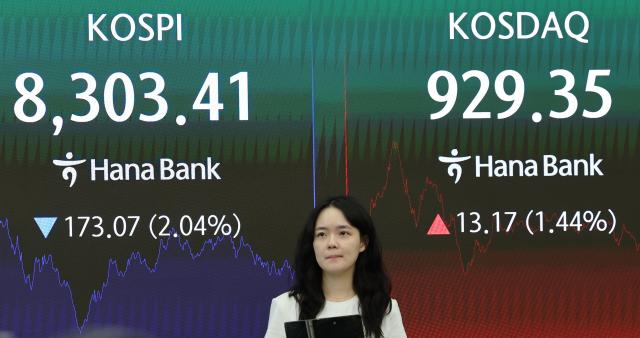
According to the Korea Exchange, the KOSPI closed at 8303.41 on July 1, down 173.07 points (2.04%) from the previous trading day. The index opened 115.02 points (1.36%) higher at 8591.50 and peaked at 8620.15 during the day, but later reversed course, dropping to as low as 8143.33 amid significant volatility. Despite June's export figures exceeding market expectations, profit-taking in semiconductor stocks erased all gains.
U.S. markets also fell sharply due to weakness in semiconductor stocks. On July 1 (local time), the Dow Jones Industrial Average closed down 13.96 points (0.03%) at 52,305.24. The S&P 500 dropped 16.13 points (0.22%) to 7483.23, while the tech-heavy Nasdaq Composite fell 173.69 points (0.66%) to close at 26,040.03.
In the pre-market trading in South Korea, the impact of the U.S. semiconductor slump is already evident, with both Samsung Electronics and SK Hynix experiencing declines of around 6%.
Despite the Federal Reserve Chair Kevin Warsh's dovish inflation outlook, Meta's strategic shift has captured market attention. Meta announced plans to leverage surplus AI computing power for its cloud business, raising concerns that the AI infrastructure investment cycle may slow down sooner than expected. Consequently, Micron's stock plummeted by 10.4%, and SanDisk fell by 10.5%. In contrast, Meta's shares surged by 8.8%.
Market sentiment largely views this adjustment as a short-term profit-taking phase rather than a slowdown in the AI industry itself. In South Korea, June exports rose by 70.9% year-on-year, significantly surpassing the market forecast of 60.7%. The growth rate for semiconductor exports also increased from 169.4% in May to 199.5% in June, reaffirming an improving industry outlook.
Han Ji-young, a researcher at Kiwoom Securities, stated, "Meta's entry into the cloud business introduces a new variable to the AI investment narrative, but there is no confirmation of a slowdown in AI demand or a decline in earnings. Given the recent high gains in semiconductor stocks, this adjustment should be viewed as a strong profit-taking correction."
Investor focus is now shifting to the U.S. non-farm payroll report for June, with expectations of new jobs slowing to 125,000 from 172,000 the previous month. However, as the Federal Reserve's policy focus has shifted more towards inflation than employment, any stronger-than-expected job figures are likely to have a limited impact on the stock market.
On this day, the domestic market is expected to show weakness in the semiconductor sector due to the sharp decline in U.S. semiconductor stocks. However, with ongoing capital rotation into sectors like power equipment, defense, and biotechnology, and a slight easing of U.S. interest rate pressures, there is a prevailing belief that funds will continue to shift between sectors rather than exit the market entirely.
Additionally, with key events such as Samsung Electronics' second-quarter preliminary results announcement and SK Hynix's U.S. ADR listing and earnings report on the horizon, analysts maintain that the earnings momentum remains valid despite potential short-term volatility.
* This article has been translated by AI.
Copyright ⓒ Aju Press All rights reserved.