

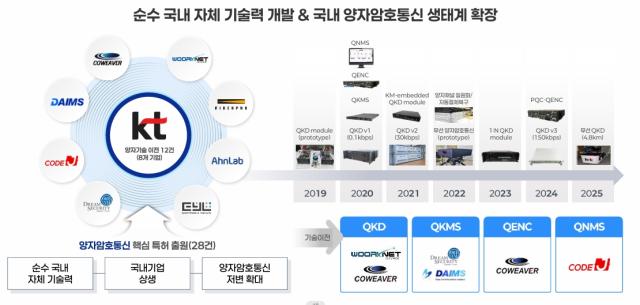
KT is expanding its quantum encryption strategy from focusing solely on Quantum Key Distribution (QKD) to include Quantum-Resistant Encryption (PQC). After concentrating on proof-of-concept and testbed development last year, the company is now prioritizing the acquisition of PQC capabilities and commercialization to respond to the national encryption system transition.
On July 1, KT held a press briefing in Jongno, Seoul, to outline its quantum encryption strategy. The company plans to expand its public and defense sector projects centered around a "Quantum-Safe Network" that combines QKD and PQC, aiming to establish an integrated security system in preparation for the era of quantum computing.
Quantum encryption communication is a next-generation security technology that utilizes the principles of quantum mechanics to protect data. QKD enhances the security of the key distribution process, while PQC involves encryption algorithms that are difficult to decrypt even with quantum computers. The industry views the combination of these two technologies as essential for next-generation communication security.
While last year focused on establishing proof-of-concept and testbeds based on QKD, recent efforts have shifted towards building security systems that integrate PQC capabilities.
To achieve this, KT is developing a Quantum-Safe Network that applies QKD for secure key distribution during network transmission and utilizes PQC to ensure the safety of the encryption algorithms themselves in service and connection segments. This approach allows for the gradual implementation of quantum security while maintaining compatibility with existing communication networks.
The initiative is moving beyond proof-of-concept to commercialization. KT is applying PQC-based security systems to key defense systems through a pilot project this year, validating the technology in various environments, including drones, CCTV, and control systems. The company has completed demonstrations of approximately 300 kbps QKD technology and wireless QKD over 4.8 kilometers, with plans to expand services to include Q-VPN and transmission network security.
A KT official stated, "In the past, our approach to quantum encryption was equipment-centric, but now securing capabilities that include quantum-resistant encryption has become our top priority. We plan to expand our business based on an integrated security system that combines QKD and PQC to prepare for the era of quantum computing."
Additionally, KT is participating in "Quantum Korea 2026," which runs from July 2 to July 4 at the Dongdaemun Design Plaza (DDP) Art Hall in Seoul.
* This article has been translated by AI.
Copyright ⓒ Aju Press All rights reserved.