

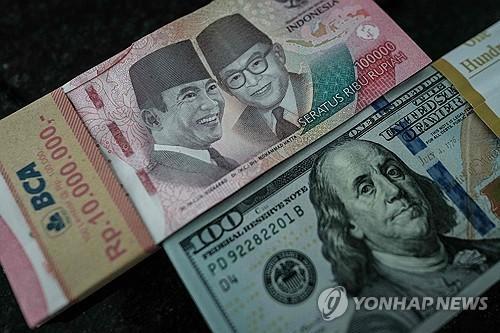
The Indonesian Rupiah has fallen to a record low, reigniting concerns of a currency crisis in Asia. A combination of a current account deficit, foreign capital outflow, weakened fiscal credibility, and increased money supply has shaken confidence in the currency.
While it is difficult to directly compare Indonesia's situation with South Korea, which boasts a large current account surplus and ample foreign reserves, experts caution that South Korea should monitor the Rupiah's decline due to simultaneous occurrences of won depreciation, rising money supply, and structural dollar demand.
Rupiah Surpasses 18,000 Mark, Reviving Crisis Concerns
Last month, the Rupiah surpassed 18,000 per dollar, marking its lowest point in history. On June 30, it continued to trade around 17,900 per dollar, maintaining its downward trend.
The immediate cause appears to be the strength of the dollar. However, the Rupiah's weakness is viewed as a precursor to financial crisis for several reasons.
Foreign capital has been fleeing the Indonesian stock market this year. According to Reuters, foreign investors have sold a net $3.89 billion in Indonesian stocks in 2026, with the Jakarta Composite Index dropping nearly 30% at one point. The current account recorded a deficit of $4.01 billion in the first quarter, the largest since the fourth quarter of 2019.
Additionally, President Prabowo Subianto's key promise of a 335 trillion Rupiah (approximately $29 billion) free nutrition program has increased fiscal burdens. Authorities hastily reduced the budget to 268 trillion Rupiah and are considering further cuts of about 40 trillion Rupiah, but the fallout continues.
Concerns also linger over the MSCI index. MSCI has extended its review of Indonesia's emerging market status until November. If it determines that market accessibility improvements are insufficient, Indonesia could be downgraded from emerging to frontier market status.
While it is premature to declare a repeat of the 1997-98 Asian financial crisis, the simultaneous occurrence of currency depreciation, capital outflow, fiscal instability, and questions about foreign reserves is raising alarm bells.
Current Account Deficit and Foreign Capital Outflow Compound Issues
The first vulnerability is the current account. According to Indonesia's central bank, the country recorded a current account deficit of $4 billion in the first quarter, equivalent to 1.09% of GDP.
A current account deficit does not automatically signal a crisis. However, if it persists, reliance on external capital inflows will inevitably increase.
The problem is that this external capital is becoming unstable. Continued foreign selling exacerbates stock market weakness and increases dollar demand, which in turn puts pressure on the Rupiah.
Kim Geun-ah, an emerging markets strategist at Hana Securities, noted in a report on June 26 that the risk of a downgrade remains due to MSCI's extended review of Indonesia's status. She explained that foreign investors are likely to remain cautious until they see actual implementation of market accessibility improvements.
Indonesia's foreign reserves stood at $144.9 billion at the end of May, down $1.3 billion from the previous month. This marks five consecutive months of decline since January. The central bank stated that this amount covers 5.6 months of imports and 5.5 months of government external debt repayments.
While this exceeds the international standard of three months of imports, prolonged currency defense could accelerate the decline more than expected.
Indonesia Raises Interest Rates and Cuts Free Meal Budget

Interventions in both the spot and derivatives markets have also been intensified. To attract foreign portfolio capital, the interest rate structure for Rupiah-denominated securities has been adjusted.
The government is also under fiscal pressure.
The Korea International Trade Association's Jakarta office cited concerns over government fiscal discipline and policy credibility as factors behind the Rupiah's decline. There are growing fears that President Prabowo's expansion of free meals, subsidies, and social spending could lead to increased issuance of government bonds and borrowing, raising risk premiums across Indonesian financial assets.
In fact, the Indonesian government has completely suspended its free meal program during the school vacation period from June 22 to July 13. The National Nutrition Agency and other relevant departments plan to provide free meals only during the school term moving forward.
The government is also considering cutting the related budget by about 40 trillion Rupiah this year. While the program has not been abolished, the Rupiah's decline and fiscal burdens are beginning to constrain politically significant spending plans.
It is not accurate to say that Indonesia is on the brink of a currency crisis. Its foreign reserves still exceed the minimum standards required by international financial institutions, and inflation remains under control. The central bank is also utilizing both interest rates and market interventions.
However, the current situation exemplifies the typical "emerging market stress" scenario, characterized by a weak currency, current account deficit, foreign capital outflow, and concerns over fiscal credibility. This is why warnings about a potential crisis in Indonesia's economy are emerging.
South Korea Faces Won Weakness, but Direct Comparison is Challenging
South Korea is also grappling with a weakening won.
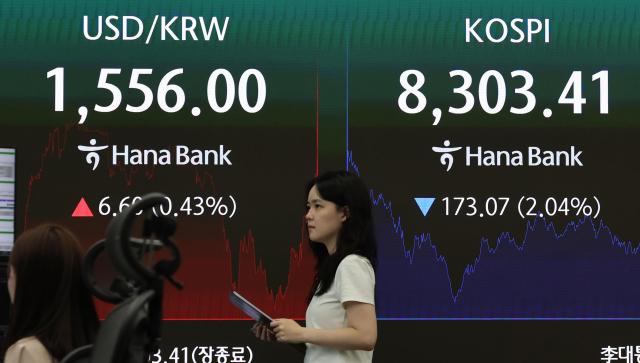
On June 30, the won-dollar exchange rate closed at 1,549.4 won, up 4.2 won from the previous trading day, influenced by the yen's largest weakness in 40 years. At one point during the day, it surpassed 1,550 won for the first time in 16 trading days.
The average won-dollar exchange rate for June was 1,526.59 won, marking the third highest level in history after January 1998's 1,701.5 won and February's 1,626.8 won during the financial crisis. It was also higher than the average exchange rate of 1,461.98 won during the global financial crisis in March 2009.
While both the won and Rupiah are experiencing weakness in a strong dollar environment, South Korea differs from Indonesia in that it continues to generate foreign currency inflows rather than outflows.
According to the Korea Customs Service, South Korea recorded a trade surplus of $36.1 billion in June, surpassing the $30 billion mark for the first time. This surplus was driven by a recovery in semiconductor exports and improvements in the goods balance.
South Korea's foreign reserves also stood at $426.99 billion at the end of May, nearly three times that of Indonesia. Based solely on foreign reserves, the likelihood of South Korea facing a foreign currency shortage in the short term is limited.
Old M2 at 10% Level is Concerning; Excess Liquidity Must Be Monitored
However, there are valid reasons for South Korea to take lessons from Indonesia's situation. Both countries are experiencing rapid increases in money supply compared to major economies.
According to the Bank of Korea, the M2 money supply growth rate in April was 5.7% year-on-year. However, when considering the old M2, which includes income securities, the growth rate reached 10.3%.
This rate is similar to or even steeper than Indonesia's money supply growth, which recorded annual M2 growth rates of 9.2% in April and 10.8% in May. Concerns about expanding money supply, fiscal spending, and capital outflows have led to shaken confidence in the Rupiah, which may also be a warning sign for the won.
During the same period, the M2 growth rate in the United States was about 4.7% in April and about 5.6% in May, while Japan remained at around 2.5%. Russia's M2 growth rate was 12.3% in April and 13% in May, but this was largely due to wartime fiscal policies stemming from the Ukraine conflict.
If excess liquidity increases dollar demand while the exchange rate approaches crisis levels, it could undermine confidence in the won. This is why South Korea should heed the lessons from the Rupiah's decline.
* This article has been translated by AI.

Copyright ⓒ Aju Press All rights reserved.