

SEOUL, July 03 (AJP) -The market has finally started asking the uncomfortable question.
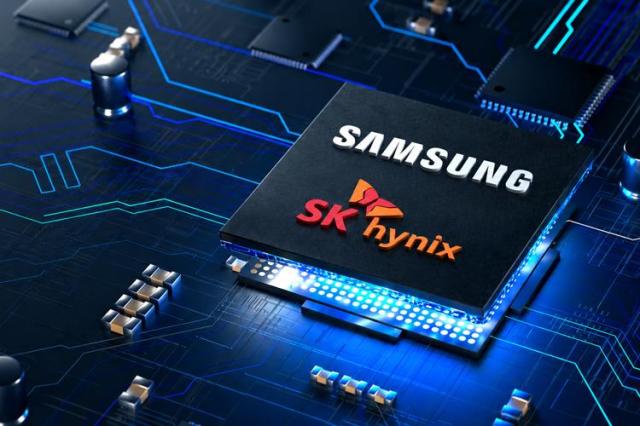
For the last 18 months, investors treated AI memory as a one-way trade. High-bandwidth memory (HBM) shortages, exploding AI server demand and the near-duopoly of Samsung Electronics and SK hynix turned South Korea into the center of the global AI hardware story.
After Seoul unveiled a string of government-backed semiconductor mega projects swelling above $1 trillion across Yongin, Honam and Chungcheong, investors are beginning to wonder whether the industry is building the next supercycle—or simply the next overcapacity cycle.
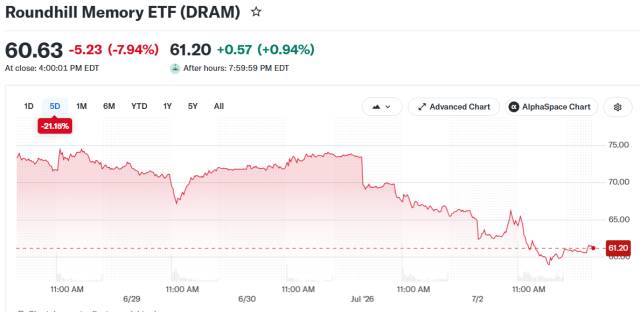
The sharp selloff in chip shares and the collapse of the Roundhill Memory ETF (DRAM), whose largest holdings are Micron, SK hynix and Samsung Electronics, illustrates that concern.
After becoming Wall Street's hottest thematic ETF only weeks earlier, DRAM has already surrendered more than 20 percent in five trading days as investors rushed to lock in profits. Samsung Electronics and SK hynix effectively control the world's HBM market - 80 percent - and around 60 percent of global DRAM production.
Together they represent roughly three-quarters of the DRAM ETF's portfolio, meaning investors buying the "AI memory trade" are largely buying Korea.
That concentration creates extraordinary upside as well as the downside.
Whenever Samsung and SK hynix simultaneously expand production, they are no longer responding to the market—they become the market.
Unlike logic chips where TSMC manufactures products designed by dozens of customers, memory remains a commodity business where supply discipline determines profitability. History has repeatedly shown that the industry's biggest downturns followed periods when dominant producers expanded capacity simultaneously.
The government is wagging the industry's tail
The latest investment announcements mark a structural shift.
Instead of companies gradually adding capacity according to market signals, Seoul is actively compressing construction schedules by years, providing infrastructure, tax incentives and regulatory fast tracks to create multiple semiconductor clusters simultaneously.
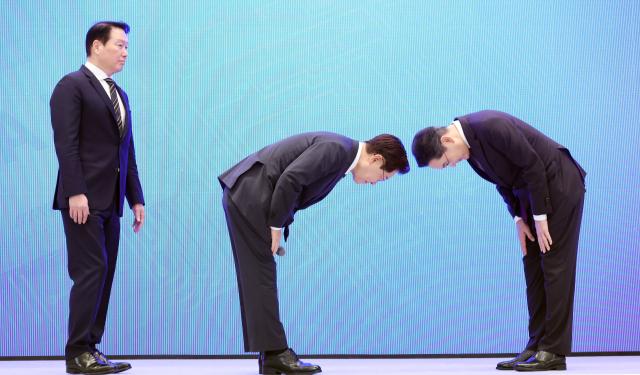
President Lee Jae Myung outright called the chiefs of Samsung Electronics Jay Y. Lee and SK Group chairman Chey Tae-won "national heroes" and bowed to them deeply on nationalized television after announcing capex plan of 800 trillion won ($520 billion) to build four chip fabs in Jeolla area, south of Korea, separate to the Yongjin cluster where 2,000 trillion won projects are under way.
The aim is to seize AI leadership before competitors catch up. Every major economy—from the United States to China—is subsidizing semiconductors.
But the approach also raises a classic policy dilemma.
Governments excel at accelerating investment. They rarely excel at timing industry cycles.
Semiconductors remain among the most cyclical industries in the global economy. New fabs typically require four to seven years before reaching meaningful production. By then, demand conditions can look entirely different.
Ironically, the stronger current earnings become, the larger the eventual supply response tends to be. Today's HBM shortages have produced record profits, record margins and record capital spending. Tomorrow those same investments become fixed costs that cannot easily be reversed.
Taiwanese analysts have already warned that if AI infrastructure spending normalizes around the early 2030s, Korean memory makers could face precisely the moment when enormous new fabs enter full production. Morningstar and CLSA have similarly cautioned that accelerating capex increases long-term overcapacity risk, even while near-term demand remains robust.
That does not mean overcapacity is inevitable. HBM differs fundamentally from commodity DRAM.
AI accelerators require increasingly sophisticated memory stacks, advanced packaging and close integration with Nvidia, AMD and hyperscalers. Technology transitions could continue absorbing new capacity longer than previous cycles.
SK Group Chairman Chey Tae-won on June 29 likened artificial intelligence to a growing child, saying its "brain" will continue expanding as AI evolves, requiring ever-larger amounts of high-bandwidth memory. Still, he cautioned that production capacity should not expand indiscriminately and must be calibrated to market conditions.
Michael Burry's latest bearish wager has attracted outsized attention precisely because it echoes concerns quietly circulating among institutional investors.
"The Big Short" investor on Tuesday said the semiconductor and AI-related stock rally has become extremely overvalued, similar to the dot-com bubble in 2000, and disclosed fresh short positions on Nvidia Corp., Applied Materials, Inc. and the iShares Semiconductor ETF (SOXX).
Burry said that plans by two of South Korea’s largest tech companies to build a chip hub set off fresh alarm bells about whether the massive sums of money being poured into AI can ever pay off.
Every bubble eventually convinces participants that "this time is different." AI very well may prove different.
Yet if governments, investors and chipmakers all simultaneously conclude that demand will expand forever, the industry risks recreating the very supply glut that previous semiconductor generations experienced.
South Korea's semiconductor strategy is economically rational. Without aggressive investment, the country risks surrendering leadership to rivals backed by Washington, Beijing or Tokyo.
The challenge for Samsung and SK hynix is therefore no longer technological. The companies that dominate 80 percent of the HBM market now possess enough influence to move global supply on their own.
When the world's two largest memory makers accelerate together, they are not merely responding to the AI boom.
They are determining how the next semiconductor cycle will end.
Copyright ⓒ Aju Press All rights reserved.
