

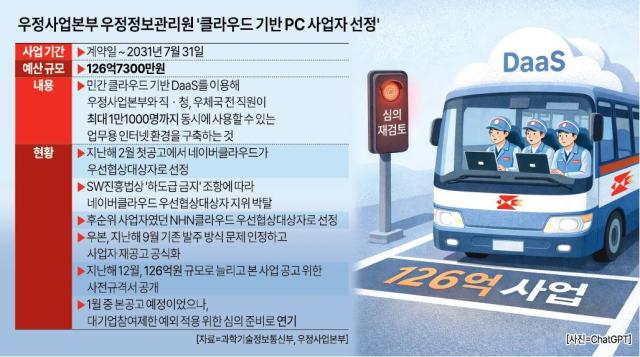
The Korea Post's public Desktop as a Service (DaaS) project, valued at 12.6 billion won, has closed with bids from KT Cloud and NHN Cloud. Naver Cloud, which competed last year, did not participate this time, highlighting distinct strategies among companies in the public cloud market.
According to the IT industry on July 3, KT Cloud and NHN Cloud submitted proposals for the DaaS project, which is set to run for approximately five years from the contract date until the end of 2031. This is the largest public DaaS project in South Korea, valued at 12.67 billion won.
The bidding atmosphere has shifted significantly from last year, when NHN Cloud and Naver Cloud were in competition. This year, KT Cloud's participation and Naver Cloud's absence have redefined the competitive landscape.
Industry analysts believe NHN Cloud is focusing on securing key references to expand its presence in the public administration market. The company has been enhancing its public AI infrastructure capabilities through operations at the Gwangju National AI Data Center and projects involving AI GPU infrastructure and government GPU initiatives. Experience in large-scale public network construction, like the DaaS project, could be leveraged for future cloud contracts with administrative and public institutions.
KT Cloud is also seen as participating in this project as part of its strategy to expand in the public cloud market. The company has consistently worked on transitioning public institutions to cloud services and expanding its AI infrastructure business.
In contrast, Naver Cloud, a competitor last year, opted not to bid this time. Analysts suggest that Naver is shifting its focus toward high-value public AX projects, such as defense AI and digital twins. Recently, Naver Cloud has been actively promoting its 'defense AI sovereignty' strategy, leveraging its omni-modal AI that integrates text, voice, video, and maps, along with its Field Engineer (FDE) system in the defense sector.
The low profitability of public DaaS projects is cited as a reason for this strategic shift. Public DaaS entails significant initial infrastructure costs for servers, storage, and networks, along with ongoing expenses for security certification (CSAP) and long-term maintenance. With rising costs for GPU and data center operations, the actual profits from such projects are considered limited compared to their scale.
Initially, this project was announced with a budget of 7.6 billion won, and many in the industry expressed concerns about its viability. Although the budget has increased to 12.67 billion won, the high costs of construction and operation still pose challenges for profitability.
Despite these challenges, companies are interested due to the reference value of the project. The Korea Post DaaS aims to serve up to 11,000 simultaneous users across the national postal service and its affiliates, making it the largest public DaaS initiative in the country. Successfully implementing this project could provide a strong reference for future cloud transition contracts with public institutions.
An industry insider noted, "Public DaaS is now more about investment for future public cloud projects rather than expecting significant profits from the project itself. Companies are increasingly adopting a strategy of focusing on their strengths rather than participating in every project in the public market."
* This article has been translated by AI.
Copyright ⓒ Aju Press All rights reserved.