

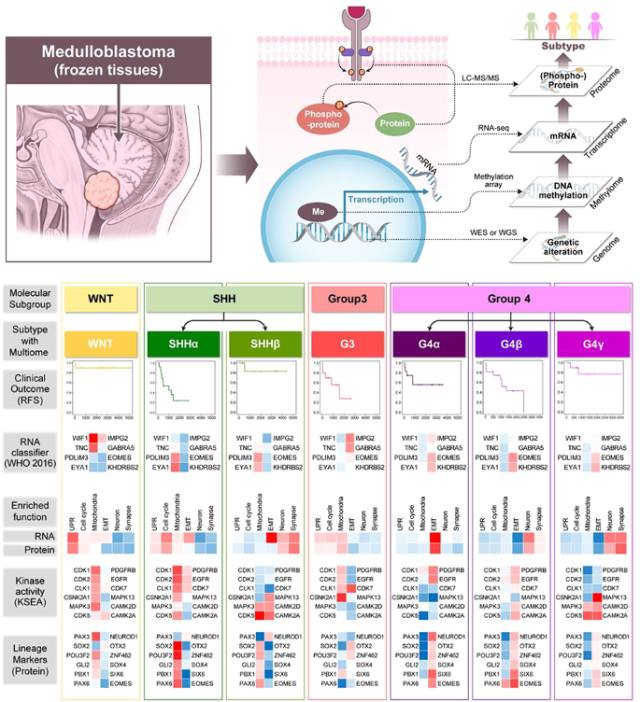
SEOUL, July 03 (AJP) - A research team led by Kookmin University's Department of Applied Chemistry Professor Kyung-Hee Kim has identified seven distinct molecular subtypes within medulloblastoma, the most common malignant brain tumor in children, a finding that points toward treating the disease with drugs matched to each tumor's specific biology rather than a single standard protocol.
The work, conducted with researchers from seven other institutions in South Korea and the United States, expands the four subtypes doctors have used since 2012 to classify medulloblastoma, splitting two of those categories into finer groups that better predict how a tumor will behave. The findings were published in Experimental & Molecular Medicine, a journal under the Nature Portfolio, which Kookmin University said carries an impact factor of 17.5 and ranks in the top one point eight percent of journals in its field.
Medulloblastoma is treated today with surgery followed by radiation and chemotherapy, a regimen that can leave lasting side effects in growing children. The bigger problem is what happens after relapse. Kookmin University said patients whose tumors return face a survival outlook that drops sharply, and doctors have lacked a fine-grained enough picture of each tumor's molecular makeup to know which drug might work for which patient.
The research team analyzed tumor samples from more than 100 medulloblastoma patients using proteogenomics, a method that layers together five kinds of biological data, the genome, the transcriptome, DNA methylation patterns, the full set of proteins in a cell and the subset of those proteins that carry phosphate tags marking them as active. Combining these layers gives a functional picture of what a tumor is actually doing, not just which genes it carries.
Since 2012, doctors have grouped medulloblastoma into four subtypes known as WNT, SHH, Group 3 and Group 4, each defined by different genetic drivers and different survival odds. The team's proteogenomic analysis split the SHH subtype into two groups, SHHα and SHHβ, and divided Group 4 into three, G4α, G4β and G4γ, bringing the total to seven. Patients with the SHHβ and G4γ subtypes showed strong activity in genes tied to neuron formation and had comparatively favorable outcomes, while those with the SHHα, G4α and G4β subtypes carried a higher risk of relapse and disease progression.
The team also mapped which protein signaling pathways were switched on in each subtype and identified genes that could serve as drug targets specific to the more aggressive groups. These included CDK1 and CDK2, enzymes that control cell division, PARP, a protein involved in repairing DNA damage, CLK1, which regulates how genetic instructions are spliced together, and MET, a receptor that can drive tumor growth when overactive. Because inhibitors already exist for several of these targets, the researchers said the findings offer a possible starting point for subtype-specific treatment rather than the one-size-fits-all approach now in use.
The study was carried out under the National Cancer Center's cancer proteogenomics research program, a long-running initiative that applies the same multi-layered molecular analysis to hard-to-treat cancers. Joining Kim's Kookmin University team were Jong Bae Park of Kyung Hee University, Seung-Ki Kim of Seoul National University Hospital, Jong Hyuk Yoon of the Korea Brain Research Institute, Jason K. Sa of Korea University, Youngwook Kim of the National Cancer Center, Harim Koo of the University of Ulsan, and Antonio Iavarone of Columbia University in the United States.
Kim said, in comments translated from Korean, "By comprehensively analyzing cancer proteogenomic data that reflects the actual function of tumors, we have presented a new classification system that allows for a more precise understanding of the molecular diversity of medulloblastoma." She added that the results are expected to serve as foundational data for developing patient-tailored treatment strategies and targeted therapies.
Copyright ⓒ Aju Press All rights reserved.
