SEOUL, July 03 (AJP) - South Korea's ambition to build a "Chip Republic" expanded well beyond semiconductors on Friday, as four of the country's largest conglomerates pledged a combined 297 trillion won ($194.3 billion) to build artificial intelligence data centers, robot factories, defense systems and aerospace infrastructure across Korea's southeastern province of Gyeongsang.
SK Telecom pledged the largest share at 140 trillion won, followed by Samsung at 60 trillion won, Hanwha at 55 trillion won, and Hyundai Motor Group at 42 trillion won. The announcements came at a state-backed investment briefing in Jinju, South Gyeongsang Province.
The pledges build on a broader blueprint President Lee Jae Myung unveiled on June 29, when Samsung Electronics and SK hynix committed to an 800 trillion-won semiconductor expansion initiative centered on four new fabrication plants in Jeolla Province, an advanced packaging hub in the central Chungcheong region, and a supply chain cluster in Gyeongsang Province. Friday's briefing filled in that Gyeongsang piece and expanded it out to sectors including AI data centers, robotics, defense technology, and aerospace across a region that has long been the heart of South Korea's heavy industry.
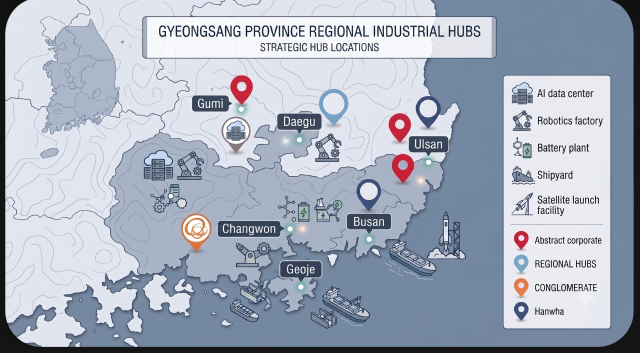
SK Telecom presented the most infrastructure-focused blueprint, framing Ulsan as the starting point for what it called Asia's largest AI infrastructure hub. The company will build a 100-megawatt hyperscale data center in the city by the fourth quarter of 2027, then scale up toward five gigawatts of AI data center capacity nationwide starting in 2029 and 15 gigawatts over the medium to long term, backed by about 140 trillion won, including foreign capital it is still working to attract. "The core elements of AI data center infrastructure are semiconductors, energy solutions, and the capability to build and operate data centers," said Jung Jae-heon, president of SK Telecom. "SK not only possesses all of these capabilities but already has experience building and operating AI data centers."
Samsung Electronics, together with Samsung SDI, Samsung Electro-Mechanics and Samsung Heavy Industries, pledged 60 trillion won toward what it called a global Physical AI innovation cluster, spanning humanoid robot manufacturing in Gumi, solid-state batteries in Ulsan, AI server components in Busan and high-value vessels in Geoje. "To overcome the slowdown in our existing manufacturing growth engines, we will pursue an AI-driven factory in Gumi by building a humanoid mass-production system and carrying out a manufacturing AI transformation," said Roh Tae-moon, Samsung Electronics' chief executive and head of its DX division.
Hanwha pledged 55 trillion won through 2040 for space and AI, aiming to build what Vice Chairman Kim Dong-kwan called integrated space infrastructure spanning independent launch vehicles, satellite networks and a defense AI data center in Changwon. "Securing space sovereignty starts with developing an independent launch vehicle," Kim said, adding that South Korea "can leap into becoming a country with world-class defense AI, not simply a country strong in hardware alone."
Hyundai Motor Group pledged 42 trillion won over the next 10 years to convert its Ulsan plant, the world's largest single automobile factory, into a base for AI-based highly autonomous vehicles built toward Level 4 autonomy, the threshold for robotaxi service, while expanding into aerospace and energy projects across the region. "By making additional investments in new business areas in Gyeongsang Province, the origin of Hyundai Motor Group, we will cultivate it into a core hub for future advanced industries," said Vice Chairman Jang Jae-hoon.
Copyright ⓒ Aju Press All rights reserved.