

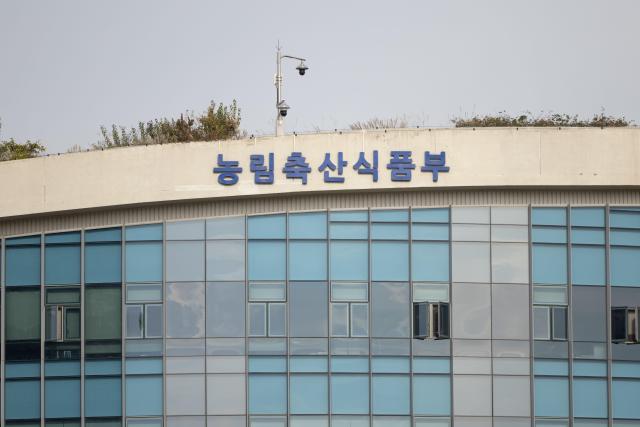
Ministry of Agriculture, Food and Rural Affairs in Sejong City, South Korea. [Photo by Yoo Dae-gil]
South Korea's first agricultural and forestry satellite, developed entirely with domestic technology, is set to launch on July 7. If successful, the government plans to utilize the satellite for land surveys and water resource management starting next year.
The Ministry of Agriculture, Food and Rural Affairs announced on July 5 that the agricultural satellite will be launched aboard SpaceX's Falcon 9 rocket from Vandenberg Space Force Base in California at 4:10 PM (KST). Jointly developed by the Rural Development Administration, the Korea Forest Service, and the Korea Aerospace Research Institute, the satellite aims to collect data across various agricultural policies.
The satellite boasts a resolution of 5 meters and a 120-kilometer observation width, allowing it to regularly capture images of the Korean Peninsula every three days. It is equipped with five spectral bands advantageous for assessing crop and forest resource growth, providing a precise observation foundation tailored to the country's agricultural and forestry structure.
The success of the satellite's launch will be determined on the same day. Hong Seok-young, head of the Agricultural Satellite Center at the Rural Development Administration, stated, "According to SpaceX's website, we will know whether the satellite has successfully separated from the rocket 2 hours and 22 minutes after launch. The Korea Aerospace Research Institute will oversee communications, confirming the satellite's final placement about three hours post-launch."
If the satellite successfully reaches orbit, it is expected to transform the paradigm of agricultural policy. Automation of land management and verification of direct payment systems is anticipated. The satellite will conduct comprehensive surveys of farmland across the nation, continuously monitoring uncultivated land and illegal structures, while comparing and analyzing satellite images with agricultural management registration data using artificial intelligence (AI) to prevent fraudulent claims. This is expected to reduce the personnel and costs associated with field surveys by half.
The ability to manage the supply of key agricultural products will also be significantly enhanced. The satellite will continuously collect data on the cultivation areas of sensitive vegetables like garlic and onions, as well as the growth status of staple crops such as rice and soybeans, enabling precise predictions of production levels. This proactive approach will help respond to price fluctuations and detect early signs of pests and diseases due to abnormal weather.
Additionally, the satellite will contribute to securing the "golden time" for disaster response in agriculture and forestry. It will periodically monitor reservoirs and irrigation facilities, sharing real-time damage maps with local governments in the event of flooding. It will also automatically analyze the scale of damage from forest disasters like wildfires and landslides, aiding in urgent recovery decision-making.
The agricultural satellite is set to begin pilot services next year. Starting in the fall, the Ministry of Agriculture, Food and Rural Affairs will compare actual ground values with satellite imagery to verify quality.
Kim Jeong-wook, head of the Agricultural Innovation Policy Office at the Ministry of Agriculture, Food and Rural Affairs, emphasized, "The launch of this agricultural satellite is significant as it establishes a model for independently collecting and innovating essential information for our agricultural sector without relying on foreign satellite imagery. We aim to establish a data-driven decision-making system characterized by precision, broad coverage, and timeliness, ensuring tangible outcomes in scientific agricultural policy that the public can feel."
The Ministry of Agriculture, Food and Rural Affairs announced on July 5 that the agricultural satellite will be launched aboard SpaceX's Falcon 9 rocket from Vandenberg Space Force Base in California at 4:10 PM (KST). Jointly developed by the Rural Development Administration, the Korea Forest Service, and the Korea Aerospace Research Institute, the satellite aims to collect data across various agricultural policies.
The satellite boasts a resolution of 5 meters and a 120-kilometer observation width, allowing it to regularly capture images of the Korean Peninsula every three days. It is equipped with five spectral bands advantageous for assessing crop and forest resource growth, providing a precise observation foundation tailored to the country's agricultural and forestry structure.
The success of the satellite's launch will be determined on the same day. Hong Seok-young, head of the Agricultural Satellite Center at the Rural Development Administration, stated, "According to SpaceX's website, we will know whether the satellite has successfully separated from the rocket 2 hours and 22 minutes after launch. The Korea Aerospace Research Institute will oversee communications, confirming the satellite's final placement about three hours post-launch."
If the satellite successfully reaches orbit, it is expected to transform the paradigm of agricultural policy. Automation of land management and verification of direct payment systems is anticipated. The satellite will conduct comprehensive surveys of farmland across the nation, continuously monitoring uncultivated land and illegal structures, while comparing and analyzing satellite images with agricultural management registration data using artificial intelligence (AI) to prevent fraudulent claims. This is expected to reduce the personnel and costs associated with field surveys by half.
The ability to manage the supply of key agricultural products will also be significantly enhanced. The satellite will continuously collect data on the cultivation areas of sensitive vegetables like garlic and onions, as well as the growth status of staple crops such as rice and soybeans, enabling precise predictions of production levels. This proactive approach will help respond to price fluctuations and detect early signs of pests and diseases due to abnormal weather.
Additionally, the satellite will contribute to securing the "golden time" for disaster response in agriculture and forestry. It will periodically monitor reservoirs and irrigation facilities, sharing real-time damage maps with local governments in the event of flooding. It will also automatically analyze the scale of damage from forest disasters like wildfires and landslides, aiding in urgent recovery decision-making.
The agricultural satellite is set to begin pilot services next year. Starting in the fall, the Ministry of Agriculture, Food and Rural Affairs will compare actual ground values with satellite imagery to verify quality.
Kim Jeong-wook, head of the Agricultural Innovation Policy Office at the Ministry of Agriculture, Food and Rural Affairs, emphasized, "The launch of this agricultural satellite is significant as it establishes a model for independently collecting and innovating essential information for our agricultural sector without relying on foreign satellite imagery. We aim to establish a data-driven decision-making system characterized by precision, broad coverage, and timeliness, ensuring tangible outcomes in scientific agricultural policy that the public can feel."
* This article has been translated by AI.
Copyright ⓒ Aju Press All rights reserved.