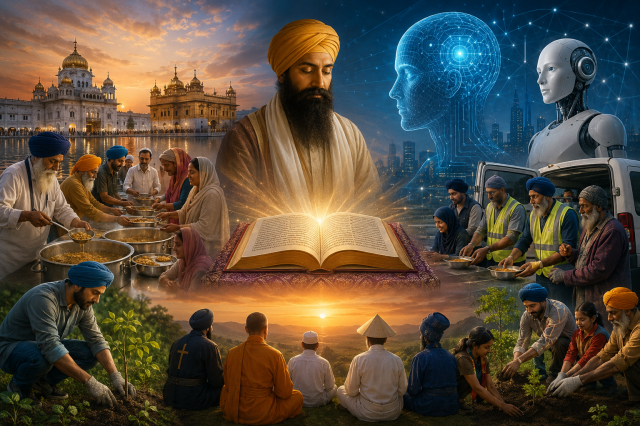
Human civilization now stands at a great turning point. The steam engine opened the Industrial Revolution, electricity created the age of mass production, and the internet connected the world into a single network. Now generative AI, physical AI, and humanoid robots are rewriting the order of human civilization once again. We hold the most advanced technology in history, yet we stand before the most important question of all. Where will technology take humanity?
AI imitates human intelligence, but it cannot take the place of human conscience. Algorithms can calculate, but they cannot love. Robots can replace labor, but they cannot serve. Technology can raise efficiency, but it cannot create community on its own. In the end, the final force that sustains civilization is the human heart, and the trust and responsibility we hold toward one another.
It is precisely here that Sikhism has been preparing an answer for humanity for more than 500 years. Guru Nanak taught that faith is not prayer alone but a life of working honestly, sharing what one has earned, and giving oneself for the weak. His teaching bears a striking resemblance to the human ethics the AI age now demands.
Generative AI is democratizing knowledge. We have entered an era in which anyone can access vast information and anyone can create something new. Yet as knowledge grows, wisdom does not necessarily grow with it. As information overflows, falsehood multiplies alongside it. A paradox has emerged in which speed has increased while reflection has diminished. This is why the world today has made AI ethics and digital trust the new tasks of civilization.
Sikhism offered its answer long ago. First, a life that remembers the Creator. Second, honest labor. Third, sharing. These are not mere religious virtues but principles of civilization that sustain a healthy society. If humanity is to keep its trust intact in the AI age, ethics must come before technology, and community must come before competition.
The rise of ESG management as a central theme of the global economy stems from the same reason. Management that values the environment, society, and governance begins with the recognition that a company is also a member of the community. Sikhism taught centuries ago that labor is a sacred duty and that wealth gains meaning only when shared with society. The idea that a company must be a community that sustains people, not merely a place that earns money, aligns precisely with the philosophy of sustainable management today.
This is also why Sikh communities around the world are among the first to open mobile kitchens and begin serving free meals when disaster strikes. They do not think of service as charity. They believe service is faith itself, the most sacred form of worship, one that protects human dignity. A single bowl of warm food not only saves the life of a hungry person but restores trust in humanity.
Looking at this spirit of Sikhism, one naturally recalls Daseok Ryu Yeong-mo, one of the great thinkers of our time. Daseok spent his life practicing the idea that truth is one and all people share one life. Rather than dividing religions, he sought the essence of life that runs through them. While studying Christianity, he also explored Buddhism, Confucianism, and the thought of Laozi and Zhuangzi, seeking to unite the wisdom of East and West into a single philosophy of life.
Daseok spoke of a God who "exists without existing." He spoke of a presence invisible to the eye yet alive in all things, a God who works within the human conscience and within life itself. This thought resonates deeply with the teaching of Guru Nanak, who valued life over form. Sikhism likewise believes that God is not the deity of one people or one religion but the Creator of all humanity.
Daseok also taught, take only as much as you eat, and share what remains with your neighbor. Greed sickens the human being, but sharing sustains the community. This bears a remarkable resemblance to the langar spirit of Sikhism. The reason Sikhism offers free meals to anyone is not merely to relieve hunger. It is to learn human equality at a table shared by all.
The Korean spirit of hongik ingan likewise carries the mission of benefiting the human world broadly. The idea of oneness in Daejongism, the compassion of Buddhism, the benevolence of Confucianism, the effortless nature of Daoism, the service of Sikhism, and the life philosophy of Daseok differ in expression, yet all point toward the path of sustaining humanity and community. This is precisely why the spirituality of Asia is great. Just as different rivers flow and finally form one sea, religions and philosophies may differ, but the purpose of loving humanity and honoring life is one.
At the center of Sikhism stands the Guru Granth Sahib, revered as a living teacher. This scripture was completed by the tenth guru, Guru Gobind Singh, on the foundation of the Adi Granth, which the fifth guru, Guru Arjan, had compiled from the hymns of the gurus and the poems of the saints. Guru Gobind Singh declared that the line of human gurus had ended and that the Guru Granth Sahib would be the eternal guru from that moment on. It was a remarkably original declaration in the history of world religion, one that made truth itself, rather than the authority of any single person, the eternal teacher of the community.
The Guru Granth Sahib contains not only the hymns of the Sikh gurus but also the poems and spirituality of Hindu and Muslim saints. The thought of Guru Nanak, that truth is not the monopoly of any one religion, lives on within the scripture itself. In Sikh temples today, the scripture is still honored as a living teacher, recited at every service and held up as the standard by which the community measures its life.
The Guru Granth Sahib urges three things upon humanity without ceasing. First, remember the Creator always. Second, labor honestly. Third, share what you have earned with your neighbor. What is remarkable is that this teaching has not aged in the slightest after 500 years. On the contrary, as AI and digital civilization advance, what humanity needs is not more information but a deeper conscience, and in this light the teaching of the scripture resounds all the more.
Today AI calculates faster than humans and processes more information. But AI cannot create a conscience of its own. Depending on what values humans instill, AI can become a tool that helps humanity or a technology that threatens it. The core competitiveness of the AI age is therefore not technology alone but ethics. What leads technology, in the end, is human spirituality.
Sikhism tells us that a person of faith is measured not by how much one prays but by how much one serves. Daseok tells us to prove the truth not with thought but with life. Hongik ingan tells us to benefit humanity broadly. The three voices come from different ages and cultures, yet they point toward one truth.
Humanity will go on building more powerful AI. Greater robots will appear. But however great the technology, a civilization that cannot love people will not last. Technology advances civilization, but love and service sustain it. This is the truth Sikhism has proven with its own history for 500 years.
Asia is the birthplace of the world's religions. From Hinduism and Buddhism to Zoroastrianism, Confucianism and Daoism, Shinto, Daejongism, and Sikhism, this continent has brought countless flowers of spirituality into bloom. Born in different ages and cultures, all of them have walked toward human dignity and the restoration of community.
Sikhism, then, is no longer a religion of India alone. It is a study of humanity that the AI age must rediscover, and a philosophy of civilization that sustains community. Stronger than the sword is faith, stronger than faith is love, and what outlasts love is service. And the path of life that Daseok Ryu Yeong-mo sought all his life is likewise completed in that very place of service and love.
In this way, Sikhism moves beyond the history of a single religion and becomes one answer that Asian spirituality offers to the future of humanity. Technology changes the world, but spirituality changes people. Only a civilization that changes people can, in the end, change the world. This is why Sikhism remains alive in the 21st century, and this is the message of Asian spirituality to which all of us must listen again today.
Daseok Ryu Yeong-mo spent his life practicing the idea that truth is one and the paths are many. The Guru Granth Sahib likewise never confined truth within a single religion. This scripture, which embraces even the voices of Hindu and Muslim saints, quietly testifies that true truth crosses boundaries and binds humanity into one.
*The author is a senior columnist of AJP.
Copyright ⓒ Aju Press All rights reserved.