

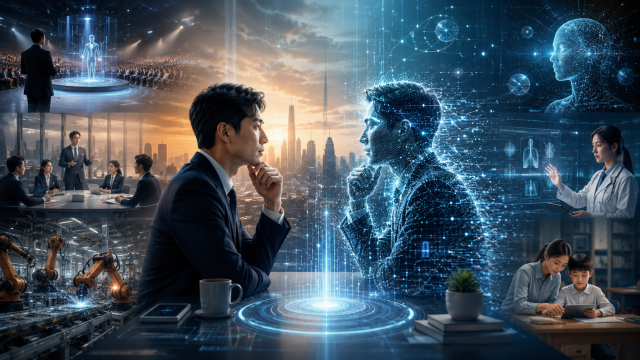
A recent report by The Wall Street Journal highlights the phenomenon of AI digital twins, signaling a significant shift in the concepts of labor, management, and human existence in the AI era.
Just a few years ago, AI was limited to tasks like summarizing documents or drafting meeting notes. Now, executives at some global companies in the U.S. are training AI on their emails, speeches, interviews, lectures, podcasts, and management philosophies to create digital avatars that closely resemble themselves. These AI digital twins are not just chatbots; they answer questions from team members, provide leadership coaching, assist in performance evaluations, and even deliver speeches at international conferences.
A notable example is Reid Hoffman, co-founder of LinkedIn, who operates an AI called 'Reid AI' trained on his writings and speeches from the past 22 years. This digital twin has conducted over 75 lectures and presentations since 2024, introducing itself in 74 languages, including French, Chinese, and Hindi, and engaging in real-time Q&A sessions with audiences at the Dubai International Conference.
This scene represents more than just a technological event; it marks a declaration that the very concept of human productivity is changing. In the past, an individual's labor and knowledge were confined by physical and temporal limits. No matter how exceptional a CEO was, they could not work more than 24 hours a day. However, in the age of AI digital twins, one person's experiences and knowledge can be infinitely replicated and operate simultaneously in numerous locations.
This could represent one of the most significant changes in the concept of labor since the industrial revolution. Just as the steam engine expanded human muscle, AI digital twins extend human intellect and judgment. While personal computers revolutionized document work and calculations, digital twins are entering a phase where they replicate human thought and decision-making itself.
Bala Satyanarayana, Chief Human Resources Officer at U.S. industrial packaging company Greif, reports that his AI twin, 'BalaBot,' has already interacted with over 3,300 employees. Workers consult the AI on sensitive issues like managing underperformers and career development. Some employees credit the coaching strategies recommended by the AI for their growth into leadership roles within the organization.
This change is highly symbolic. In the past, a company's core assets were factories and capital. Then, data and platforms became the key assets. Now, the experiences and know-how within organizations—essentially the humans themselves—are being transformed into digital assets. Ultimately, the competitiveness of companies in the AI era may hinge on 'who has better converted human knowledge into AI.'
However, this raises complex ethical and philosophical questions. Who owns the digital twin? If an employee leaves the company, does their AI counterpart leave as well, or does the company retain ownership? Furthermore, what happens if a company seeks to replace human employees with AI counterparts?
In fact, intense debates are already occurring within U.S. companies. Some employees express discomfort, stating, "I don't like that all my emails and thought processes are being fed into AI." There are also potential legal issues if AI conveys incorrect hiring guidelines or makes distorted decisions. The issue of AI's well-known weakness, 'hallucination,' remains unresolved; for instance, Reid AI provided a different answer to a favorite ice cream question than the actual Reid Hoffman.
Ultimately, AI digital twins are more likely to serve as tools for human enhancement rather than complete replacements. In other words, AI does not eliminate humans but reallocates their time. Routine tasks and everyday interactions can be handled by AI, allowing humans to focus on more creative and strategic areas.
AI digital twins could also be a crucial solution in aging societies. In countries like South Korea, where rapid low birth rates and aging are prevalent, the loss of experienced veteran workers upon retirement poses a serious issue. However, AI twins can preserve decades of on-the-job experience as digital assets. The skills of manufacturing artisans, the investigative know-how of journalists, the clinical experiences of doctors, and the educational philosophies of teachers can be passed down to future generations in digital form.
The potential for utilizing digital twins is particularly significant in the media and broadcasting sectors. If AI learns the writing style, logical structure, interviewing techniques, and reporting philosophy of veteran journalists, it could lead to groundbreaking changes in training new reporters and enhancing article quality. If AI can replicate the speech patterns and analytical styles of economic anchors and the logical frameworks of international affairs commentators, the media industry could face a completely new phase.
Application Potential and Future Directions for Korean Companies
Korean companies are already beginning to prepare for the era of AI digital twins. Samsung Electronics is enhancing personalized AI assistants through AI semiconductors and on-device AI technology, while SK Hynix is entering the next-generation AI infrastructure competition based on AI servers and HBM memory.
Additionally, platform companies like Naver and Kakao are attempting to expand the corporate AI agent market based on Korean-language specialized super-large AI. In the future, we can expect the emergence of AI digital twin services that learn the expertise of corporate CEOs, executives, sales professionals, financial analysts, journalists, and legal experts, moving beyond simple AI chatbot capabilities.
For instance, in manufacturing, AI could learn the know-how of skilled technicians to diagnose production line issues in real time. In finance, AI could learn the consultation patterns of veteran private bankers to provide personalized asset management services to clients.
In healthcare, AI twins could accumulate the diagnostic experiences of renowned doctors to reduce disparities in medical services. The same applies to the media sector.
AI that learns the analytical styles of international relations experts could provide deeper insights into major trends such as the U.S.-China power struggle, Middle Eastern geopolitics, and the AI industrial revolution in real time. Ultimately, future competitiveness will depend not on the quantity of articles produced but on how effectively human insights and experiences can be converted into AI.
However, Korean companies must adhere to three essential principles. First, the human-centered principle: AI should be used to enhance human capabilities, not replace them. Second, the data sovereignty principle: ownership and compensation structures for individual employees' knowledge and experiences must be clearly defined. Third, the ethics and accountability principle: humans must bear ultimate responsibility for AI's decision-making errors.
Digital twins are poised to become the norm. AI has now progressed beyond being a mere search tool or automation mechanism to the stage of creating a 'second self' for humans. When combined with agentic AI, the pace of change will accelerate even further. As AI begins to make its own judgments, plans, and actions, humans may find themselves largely liberated from repetitive tasks.
As a result, humans will have more time for strategic thinking, creative activities, and living fulfilling lives. Physical fatigue will decrease, and mental stress may also be alleviated. AI digital twins could become tools for a civilizational shift, returning 'rest' and 'reflection' to humanity beyond mere productivity innovation.
Ultimately, the key issue is not the technology itself but what kind of civilization humans will create through AI. The true winners in the AI era will not be the countries with the fastest machines but those that understand the harmony between humans and technology most profoundly.
※ This article was generated using generative AI and has undergone editorial review.
* This article has been translated by AI.
Copyright ⓒ Aju Press All rights reserved.