

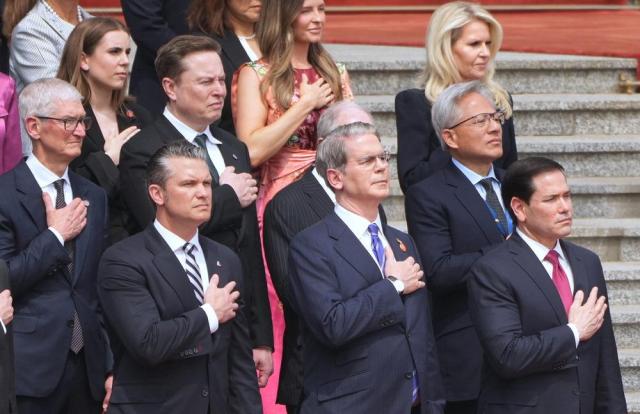
The U.S.-China summit held in May 2026 at the Great Hall of the People in Beijing was not merely a diplomatic event. It symbolized a shift in the 21st-century global order, where power dynamics are increasingly defined by artificial intelligence, semiconductors, data, platforms, energy, and supply chains, rather than just military and diplomatic relations.
Notably, the presence of top executives from major U.S. tech companies at the summit drew significant attention. Jensen Huang of NVIDIA, Elon Musk of Tesla, and Tim Cook of Apple were joined by leaders from BlackRock, Goldman Sachs, Qualcomm, Meta, Micron, Visa, Mastercard, and Boeing, effectively forming a delegation that represented not just economic interests but also technological supremacy.
This contrasts sharply with Cold War-era summits, which focused primarily on nuclear weapons and military alliances. Today, the core issues in U.S.-China relations revolve around AI, semiconductors, platforms, data, supply chains, and advanced manufacturing. The focus has shifted from “who has more aircraft carriers” to “who controls the most powerful AI ecosystem and semiconductor supply chain.”
President Trump’s decision to bring U.S. tech leaders to China was not coincidental; it served as both a warning and a negotiation tactic. The U.S. currently dominates the global AI industry in software and design capabilities, with companies like OpenAI, NVIDIA, Google, Meta, Microsoft, and Apple leading in AI algorithms, cloud computing, semiconductor design, and platforms. Notably, NVIDIA's GPUs are often referred to as the “oil” of the AI era.
In this context, Jensen Huang’s participation in Beijing was highly symbolic. A Taiwanese-American, Huang stands at the forefront of the AI revolution. NVIDIA is a dominant player in the AI training semiconductor market and symbolizes U.S. AI leadership. However, long-term growth for NVIDIA is challenging without access to the Chinese market, which is the largest manufacturing hub and a vast AI application market.
Trump is leveraging this reality, indicating that while the U.S. holds the core AI technologies, the market and manufacturing ecosystem in China remain crucial. Interestingly, this summit also marked a rare instance of private sector leaders participating directly in diplomatic discussions.
This is highly unusual, as summits typically involve diplomats and security officials. However, this time, corporate CEOs acted almost as part of the national strategy team, highlighting that U.S. national competitiveness is now intertwined with private tech companies.
The U.S. AI dominance has not emerged solely from government efforts. It is the result of a vast ecosystem involving Silicon Valley, Wall Street, academic research institutions, the Department of Defense, cloud companies, and semiconductor firms working in concert. In essence, the U.S. is forming an AI power structure that combines state and corporate interests.
Conversely, China is also making significant strides. While it is still considered behind the U.S. in foundational semiconductor technology, it excels in data scale, manufacturing application, and state-level investment. Companies like Huawei, SMIC, Baidu, Alibaba, and Tencent are rapidly building an independent AI ecosystem despite U.S. sanctions.
China's strength lies in its speed. While the U.S. relies on a free-market innovation model, China operates more like a centrally coordinated system. When deemed necessary, the central government, local governments, state-owned enterprises, and private companies can mobilize simultaneously. This concentrated nurturing model, demonstrated in high-speed rail, electric vehicles, and solar industries, is now being applied to AI.
Another critical difference is data. In the AI era, data, power, and semiconductors are paramount. China has amassed vast amounts of data due to its large population and mobile ecosystem, combined with a robust manufacturing base and enormous domestic market.
In contrast, the U.S. excels in creative innovation and foundational technologies. Companies like OpenAI, Google DeepMind, and NVIDIA are shaping the direction of global AI technology. Thus, the current AI competition is not merely a technological race; the U.S. is strong in “brainpower,” while China excels in “scale and execution.” This mutual apprehension drives both nations.
The U.S. is wary of China's potential success in combining manufacturing and AI application for technological self-sufficiency. Meanwhile, China fears that the U.S. could tighten its grip on China's AI industry through semiconductors, GPUs, and cloud systems. Ultimately, the Beijing summit can be viewed as a significant negotiation table concerning the power structure of the AI era, rather than just a discussion on tariffs.
So where does South Korea stand? Currently, South Korea occupies a uniquely delicate position. With Samsung Electronics and SK Hynix leading in memory semiconductor competitiveness, it remains among the best in the world. Additionally, companies like Naver, Kakao, LG AI Research, and Samsung Research are developing their own AI ecosystems.
However, the challenge lies in scale. The U.S. is strong in platforms and foundational technologies, while China excels in markets and manufacturing. South Korea is strong in semiconductors but relatively weaker in platforms and large-scale AI ecosystems. Nevertheless, there is no need for pessimism; rather, South Korea has significant opportunities ahead.
First, there is AI semiconductors. The core of the AI era is computational power, and AI cannot exist without memory semiconductors. South Korean companies are among the best in the world in high-bandwidth memory (HBM).
Second, there is manufacturing AI. South Korea has a strong industrial base in automotive, shipbuilding, batteries, semiconductors, and robotics. In the realm of “industrial AI,” South Korea can aim for a top-three position globally.
Third, there is culture and soft power. In the AI era, data is not the only important factor; content and culture matter too. The global influence of K-pop, K-dramas, and K-content could become valuable assets in future AI training data and digital platform competition.
Ultimately, the future world will not be driven solely by military hegemony. It will be an era where AI, semiconductors, data, platforms, culture, energy, supply chains, and finance form a vast network. The participation of U.S. tech companies in Trump's visit to China underscores this reality. They are not just business leaders; they are the “technological generals” at the forefront of 21st-century American hegemony. The scenes at the Great Hall of the People in Beijing marked a historical moment, indicating that the world has already entered an era of AI Cold War.
※ This article was generated using generative AI and has been reviewed by an editor.
* This article has been translated by AI.
Copyright ⓒ Aju Press All rights reserved.