SEOUL, July 07 (AJP) - A newly uncovered U.S. military report has revealed that American authorities recognized Dokdo as part of Korea in 1948, offering fresh documentary evidence that could strengthen the historical basis for South Korea's sovereignty over the East Sea islets.
The document, titled Report of Bombing of Liancourt Rocks, was prepared by the Far East Air Forces (FEAF) on June 24, 1948, after a U.S. Air Force bombing exercise mistakenly struck Dokdo on June 8 that year, killing 14 Korean fishermen and injuring many others.
Although the report was originally classified as "SECRET," it was later declassified and preserved by the U.S. National Archives and Records Administration (NARA).
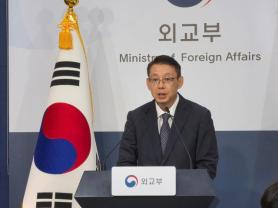
The 222-page collection of previously undisclosed U.S. government records was discovered by Jeon Gap-saeng, a research professor at Sungkonghoe University's Institute for East Asian Studies, during archival research at NARA. He recently donated the materials to the Northeast Asian History Foundation, which announced the findings Monday.
The most significant passage appears in the section titled "Mitigating Circumstances."
It states: "Although definitely established in September 1947 that Liancourt Rocks was a part of Korea..."
The sentence continues by explaining that some U.S. military personnel mistakenly assumed the islets belonged to Japan because that understanding had never become general knowledge within the military.
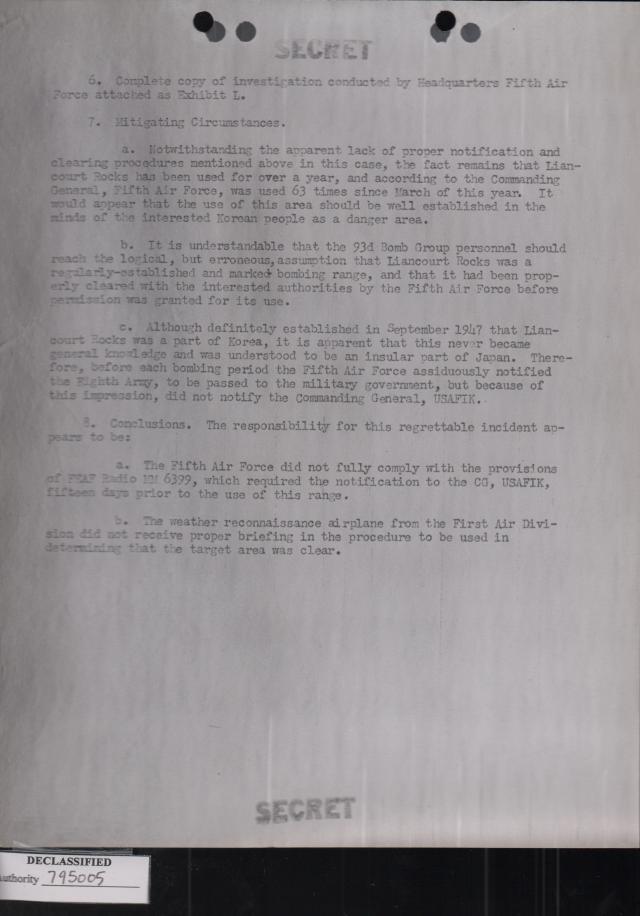
South Korean researchers say the wording is particularly significant because it was written by U.S. military officials themselves during an internal investigation, rather than by Korean authorities.
The report also indicates that the U.S. military regarded Korean authorities as having jurisdiction over Dokdo when planning bombing exercises.
According to the document, the Fifth Air Force was required to notify the commanding general of the U.S. Army Forces in Korea (USAFIK) 15 days before using the bombing range.
The report further notes that before each bombing exercise the Fifth Air Force carefully informed the Eighth Army so that the information could be passed to the military government in Korea.
Researchers at the Northeast Asian History Foundation said the notification requirement demonstrates that U.S. authorities considered Dokdo to fall under Korean administration rather than Japanese jurisdiction.
The report ultimately concluded that the tragedy resulted from failures to follow notification procedures and inadequate reconnaissance before the bombing mission.
The newly discovered records also include official documents submitted by the administrator of Ulleung Island, the local government with jurisdiction over Dokdo, as well as statements from local residents.
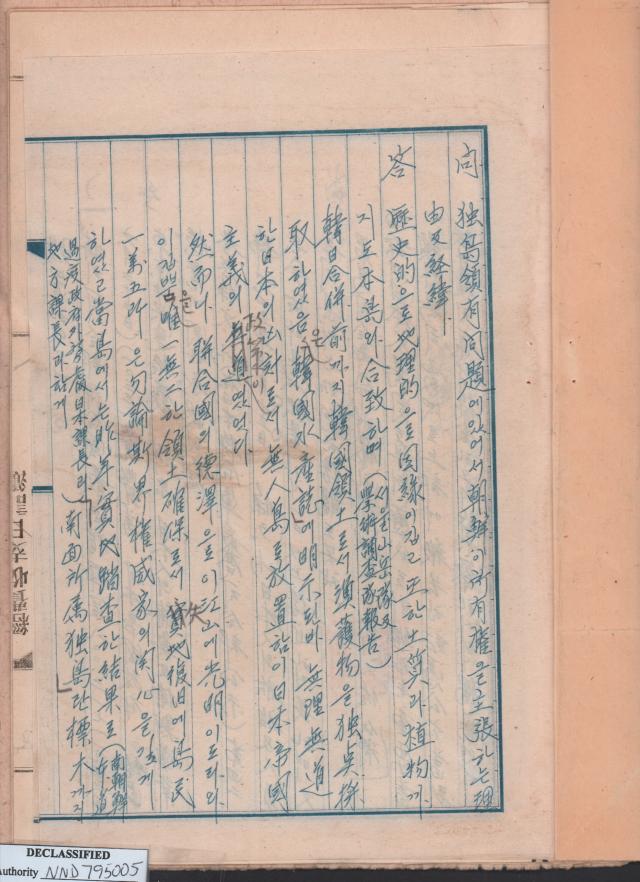
One document jointly signed by the Ulleung administrator and local officials explicitly states that residents received no prior notification of any military exercise before the bombing occurred.
The archive contains another historically important document titled Confirmation of Sovereignty over Dokdo Belonging to Ulleungdo, submitted by the Ulleung administrator to the governor of North Gyeongsang Province in 1946.
It also includes, for the first time in its original standalone form, a handwritten copy of a report prepared by Sim Heung-taek, magistrate of Uldo County, after Japan unilaterally incorporated Dokdo into its territory in 1905.
Historians have long known the contents of Sim's report, but researchers said this marks the first discovery of the document as an independent archival record.
The Northeast Asian History Foundation described the newly identified materials as important primary sources documenting how U.S. authorities viewed Dokdo during the years immediately following Korea's liberation from Japanese colonial rule.
"These records significantly strengthen the documentary evidence confirming both the U.S. military's perception of Dokdo and Korea's sovereignty over the islets during the immediate post-liberation period," a foundation official said.
Dokdo has historically been administered as part of Ulleung County in North Gyeongsang Province and has remained under South Korea's effective control since liberation from Japanese colonial rule, with Korean police stationed on the islets.
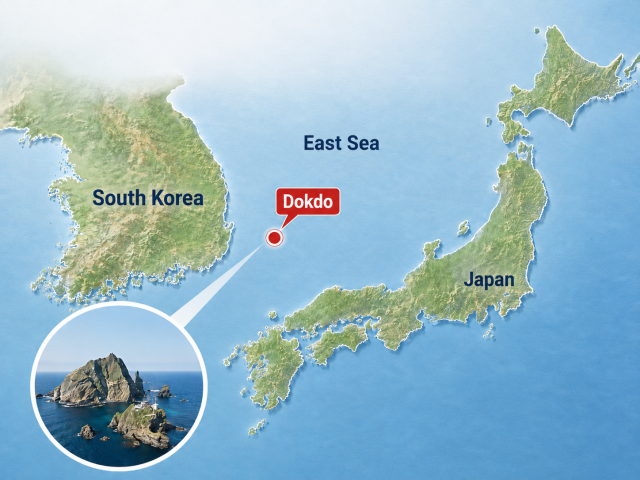
South Korea maintains that Dokdo has been Korean territory for centuries, citing historical records dating back to the Silla Dynasty, continuous administrative control through Uldo County established in 1900, and the fact that Japan incorporated the islets in 1905 during its expansion toward the colonization of the Korean Peninsula.
Following Japan's defeat in World War II, South Korea argues that Dokdo was separated from Japan together with other Korean territory and restored to Korea. Korean scholars also point to a series of U.S. military documents and occupation directives issued after the war that treated Dokdo separately from Japan.
Japan continues to claim sovereignty over the islets, which it calls Takeshima.
South Korea rejects Japan's claim, saying there is no territorial dispute because Dokdo is historically, geographically and under international law an integral part of Korean territory.
The newly uncovered U.S. military report is expected to provide additional historical evidence for future research on Dokdo and the U.S. government's understanding of the islets in the immediate aftermath of World War II.
Copyright ⓒ Aju Press All rights reserved.