

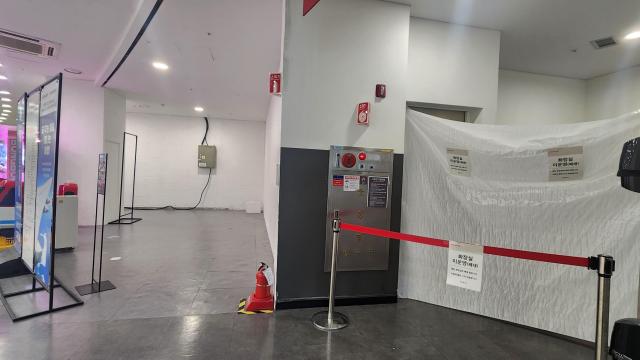
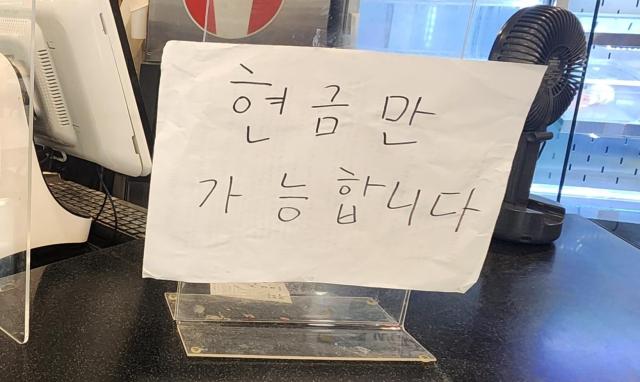
'Cash only'
At the order counter of a food service area in the Homeplus World Cup store in Seongsan-dong, Seoul, a handwritten notice stated that only cash payments were accepted. The store operator, identified as A, explained, "If customers pay by credit card, Homeplus does not settle the payments, so we have no choice but to accept only cash or bank transfers." Other vendors in the store also appeared unsettled, with two clothing retailers beginning to withdraw their operations early that morning.
Following a court decision to terminate the corporate rehabilitation process, Homeplus is effectively on the path to bankruptcy, causing widespread damage to its suppliers and small business partners. The court's ruling has diminished the likelihood of settling outstanding payments worth millions, raising concerns that not only suppliers but also subcontractors may face a cascading liquidity crisis.
According to Homeplus and industry sources, 47% of the 4,603 suppliers and partners that do business with Homeplus rely on the retailer for more than half of their total sales. A survey by the Korea Federation of Small and Medium Businesses revealed that the average outstanding payment for 150 small businesses is approximately 774 million won (about $600,000). Among these, 24% reported that their unpaid amounts exceed 1 billion won (about $770,000).
If Homeplus ultimately goes bankrupt, companies without collateral or priority claims are likely to face significant challenges in recovering their payments. As of last month, the outstanding receivables from suppliers in the agricultural, fruit, livestock, and processed food sectors alone are estimated to be around 200 billion won (approximately $154 million). Industry experts believe that the total amount of unpaid debts, including other categories, is much higher.
In response to the crisis, the government has initiated emergency support measures. A total of 440 billion won (about $340 million) in liquidity will be provided to small businesses and medium-sized enterprises that rely heavily on Homeplus. The Small Enterprise and Market Service and the Korea Venture Business Association will support 90 billion won (approximately $69 million) in emergency management stabilization funds, while 350 billion won (about $270 million) will be allocated through special guarantees from the Korea Credit Guarantee Fund and the Korea Technology Finance Corporation.
However, suppliers argue that financial assistance alone will not resolve the underlying issues. They emphasize that the urgent need is for Homeplus to stabilize its operations rather than relying on loan policies.
B, a representative of a clothing company that depends on Homeplus for 80% of its sales, stated, "Government support is just another form of debt; how long can we sustain ourselves this way?" He added, "Even if support is provided, it will only be a temporary fix." He stressed that to maintain their businesses and pay overdue amounts to subcontractors, the remaining 67 Homeplus locations must operate normally and settle accounts properly. According to the Korea Federation of Small and Medium Businesses, 85.3% of Homeplus's suppliers are unable to pay for raw materials and subcontracting fees on time due to the current situation.
Suppliers are also calling for decisive action from the major shareholder, MBK Partners, and the creditor representative, Meritz Financial Group. On July 1, 182 Homeplus suppliers issued a statement warning that if Homeplus goes bankrupt, hundreds of small partners will also fail, resulting in thousands of employees losing their jobs. They urged the government to provide active support and called on Meritz to immediately offer emergency operating loans.
Previously, the Seoul Bankruptcy Court decided on July 3 to terminate Homeplus's corporate rehabilitation process but left the door open for potential recovery. The court indicated that if Homeplus successfully secures 200 billion won (approximately $154 million) in new funding within the 14-day appeal period, the rehabilitation process could be reinstated.
* This article has been translated by AI.
Copyright ⓒ Aju Press All rights reserved.