
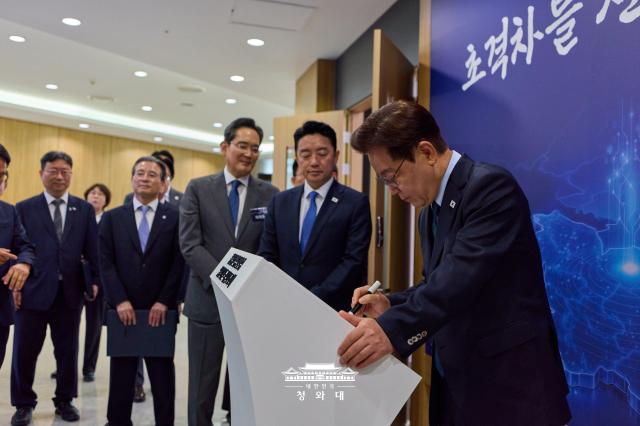
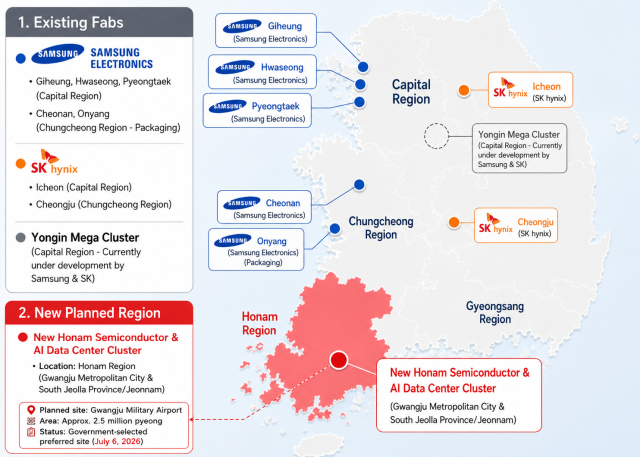
SEOUL, July 06 (AJP) - South Korea will build its planned Honam semiconductor cluster on the site of the Gwangju military airport after the government selected the location as the preferred site for the project, the presidential office said on Monday.
The decision was reached during a public-private review meeting on the government's three flagship regional development projects chaired by President Lee Jae Myung, Presidential Chief of Staff Kang Hoon-sik said. The government will complete the site selection process through consultations among relevant ministries as quickly as possible, Kang said.
According to the presidential office, companies participating in the discussions concluded that the Gwangju military airport site offers the best conditions for the project. The site can secure about 2.5 million pyeong of land, while its existing flat terrain, developed for airport operations, is expected to reduce construction time for the industrial complex.
The location is also close to downtown Gwangju and a KTX high-speed rail station, providing favorable conditions for securing skilled workers and supporting residential infrastructure, Kang said. The site also offers efficient logistics access through road, airport and port networks.
The presidential office said President Lee will hold monthly public-private review meetings to monitor progress on the semiconductor cluster and the government's three regional mega projects. Lee also plans to establish a dedicated task force within the presidential office to oversee implementation and coordinate relevant ministries, according to Kang.

Candice Kim
Candice Kim is a dedicated business and technology reporter specializing in the intersection of high-tech innovation and fast-paced consumer trends. Her core beats span the semiconductor, IT, cosmetics, and retail sectors, where she provides in-depth coverage of industry titans including Samsung Electronics, SK hynix, and LG Electronics, alongside leading consumer brands like Olive Young and Musinsa. Whether analyzing complex silicon supply chains or tracking the latest shifts in beauty and fashion retail, Candice is committed to delivering sharp, accurate reporting that keeps readers informed on the forces shaping today's most dynamic markets.
Copyright ⓒ Aju Press All rights reserved.
Related News
-
 Korea's Lee orders speed in "Chip Republic" projects
President Lee Jae Myung announces 3 Mega Project on June 29 with Samsung and SK chiefs on his side. (Courtesy of the presidential office) SEOUL, July 06 (AJP) -South Korea's ambition to transform itself into a "Chip Republic" is expected to gain traction as President Lee Jae Myung on Monday ordered officials to fast-track implementation of the country's three AI mega projects, declaring that "speed is everything" in the global race for technological supremacy. "The outcome will depend on who moves faster," Lee said during a public-private review meeting on the projects at the presidential office. "The government must remove every foreseeable obstacle so companies can focus solely on investment and production. Administrative delays must never hold back investment." The remarks came a week after Lee unveiled an unprecedented state-led industrial strategy centered on semiconductors, Physical AI and AI data centers, backed by more than 800 trillion won ($520 billion) to create a second chip cluster in Honam region by Samsung Electronics and SK Group. The blueprint aims to transform South Korea from one of the world's largest memory-chip producers into a fully integrated artificial intelligence powerhouse. At the heart of the plan is the construction of a second semiconductor manufacturing belt spanning the country's southwestern Honam region, complementing the existing "K-Chip Belt" clustered around Gyeonggi Province. Samsung Electronics and SK hynix plan to build four advanced fabrication plants there, while additional semiconductor packaging facilities will be developed in the central Chungcheong region and supply-chain manufacturing bases expanded across the southeastern Yeongnam region. The nationwide strategy reflects the Lee administration's effort to spread high-tech investment beyond the Seoul metropolitan area while strengthening South Korea's competitiveness in an increasingly geopolitical race for AI infrastructure. Monday's meeting shifted the focus from announcing investment to ensuring it can be delivered. Lee instructed ministries to process permits simultaneously rather than sequentially, accelerate land acquisition, simplify environmental reviews where legally possible and secure electricity and water infrastructure before other administrative procedures are completed. He also confirmed that the government will launch a Special Committee on Semiconductor Competitiveness when the Semiconductor Special Act takes effect in August, bringing together the presidential office, central ministries and local governments to oversee execution. The president repeatedly cited delays surrounding the Yongin semiconductor cluster as an example of what his administration intends to avoid. Although SK hynix's Yongin industrial complex has already begun construction, the project required six years from site designation to groundbreaking after prolonged disputes over land compensation and environmental approvals. Samsung Electronics' neighboring national industrial complex is still undergoing land acquisition while key utility plans remain unresolved. "The Yongin complex was considered fast, but by my standards it wasn't fast at all," Lee said, urging officials to pursue parallel administrative procedures and prevent compensation disputes from slowing future projects.
-
 South Korea's 100-Year Strategy: From AI Semiconductors to Physical AI
If one word could encapsulate the modern history of South Korea, it would likely be survival. The nation has experienced the loss of its homeland, emerged from the ruins of war, and risen from the status of one of the world's poorest countries to become an industrial powerhouse. In the aftermath of liberation, South Korea had very little. It lacked resources, capital, and technology. Yet, the country rebuilt itself through the power of its people. They studied, worked, exported, built factories, constructed ships, manufactured cars, and produced semiconductors. Driven by the need to survive, they worked tirelessly, often through the night, to avoid falling behind. As a result, South Korea became a rare example of rapid economic growth in world history. However, with the advent of the AI era, South Korea now faces questions that are fundamentally different from those of the past. While its previous successes were rooted in survival, the future challenges will require leadership. In the past, competitiveness came from quickly following paths laid out by others. By learning from advanced countries, building factories, improving quality, and securing price competitiveness, South Korea could survive in the global market. But in the AI era, mere imitation is insufficient. The country must transition from being a follower to a leader, from accepting standards to setting them. This is where the concept of a Second Founding becomes relevant once again. The establishment of the South Korean government in 1948 marked a political founding. The industrialization of the 1960s and 1970s represented an economic founding. The democratization of 1987 was an institutional founding. The information age of the 2000s had characteristics of a digital founding. So, what challenges will South Korea face in the late 2020s and 2030s? It will be a national redesign for the AI era. This involves restructuring industries, education, talent, immigration, energy, defense, urban and rural areas, and capital markets to align with the demands of AI. This is not merely a policy adjustment; it is a transformation of the national operating system. Hence, it can be referred to as a Second Founding. The reasons South Korea cannot delay this transition are clear. First is the demographic issue. South Korea is one of the fastest-aging countries in the world. The birth rate remains among the lowest globally, and the working-age population is projected to decline rapidly. According to the National Statistical Office's future population projections, the working-age population (ages 15-64) is expected to decrease from approximately 37.38 million in 2020 to about 24.19 million by 2050. This is not just a demographic issue; it affects labor in industries, military personnel, tax bases, pension finances, local economies, and the entire consumer market. The necessity for South Korea to embrace AI stems not from a technological trend but from a fundamental shift in the structure of national survival. Second is the industrial challenge. Traditional manufacturing, which has fueled South Korea's growth, is under immense pressure. China is catching up or has already surpassed South Korea in nearly every manufacturing sector, including shipbuilding, automotive, batteries, steel, petrochemicals, solar energy, and electric vehicles. The United States dominates advanced technology, capital markets, platforms, and AI models. Europe has strengths in regulation, standards, and industrial automation. Japan remains formidable in materials, equipment, robotics, and precision machinery. In this competitive landscape, South Korea cannot rely solely on past methods. Being cheap and efficient is no longer enough. The focus must shift to creating higher intelligence, precision, flexibility, and added value. The answers lie in AI semiconductors, physical AI, and manufacturing AX. Third is the global order. The AI era is not merely a technological competition but a geopolitical one. The U.S. and China are clashing over AI supremacy, and semiconductor supply chains have become a core security issue. Just as oil was the key asset in 20th-century international politics, semiconductors, data, AI models, and energy are now at the forefront in the 21st century. The nation that secures more data, produces stronger AI semiconductors, and establishes more stable power grids and data centers will directly influence its national security. South Korea stands at the center of this significant reorganization. Delaying decisions risks relegation to the periphery, while strategic planning can elevate the country to a central role. Thus, the first pillar of the Second Founding is becoming a nation of AI semiconductors. South Korea already possesses world-class competitiveness in memory semiconductors. However, it must not stop there. The national strategy should expand beyond HBM, DRAM, and NAND flash to include AI accelerators, on-device AI semiconductors, advanced packaging, next-generation memory, low-power semiconductors, and automotive AI chips. The government and private sector must invest long-term in AI semiconductor development, and universities, research institutions, startups, and large corporations must operate as a cohesive ecosystem. Semiconductors are not just export items; they are central to national sovereignty in the AI era. Losing AI semiconductor capabilities would jeopardize industrial sovereignty, data sovereignty, and security sovereignty. The second pillar is establishing a nation of physical AI. AI is no longer confined to screens. It is becoming robots, vehicles, drones, smart factories, hospitals, ports, and farms. At this juncture, South Korea's manufacturing base becomes a crucial asset. The country simultaneously possesses shipbuilding, automotive, battery, semiconductor, electronics, machinery, and steel industries. By integrating AI, it can become the world's most powerful physical AI testing ground. South Korea must transform its factories with AI, turn its ports into AI logistics hubs, convert its rural areas into testing grounds for AI agriculture, and develop its cities into AI-based smart cities. Physical AI will be the second heart of South Korea's manufacturing sector. The third pillar is becoming a manufacturing AX nation. If digital transformation was about data collection, AI transformation is about enabling that data to make autonomous decisions and actions. Manufacturing AX is not merely about installing AI programs in factories. It involves reconfiguring the entire process—design, production, quality control, logistics, energy, safety, and after-sales service—based on AI. Factories will predict malfunctions, equipment will find optimal conditions, logistics will move based on demand forecasts, and companies will respond in real-time to market changes. If South Korea succeeds in manufacturing AX, it will no longer be just an exporter of products but a nation that exports factory operation methods, industrial operating systems, and AI manufacturing platforms. The fourth pillar is becoming a nation open to global talent. In the AI era, the most critical resource is not oil or iron ore; it is people. Exceptional scientists, engineers, mathematicians, semiconductor designers, roboticists, data scientists, entrepreneurs, and investors are the core of national competitiveness. The strength of Silicon Valley in the U.S. is not solely due to American talent but because the world's best minds flock there. Innovators from India, China, Israel, Europe, Southeast Asia, and the Middle East have contributed to the U.S. university and startup ecosystem. South Korea must now ask the same question: Do young talents from around the world want to come to South Korea to study, research, start businesses, and live? If it cannot answer this question, it will struggle to endure in the competition of the AI era. Fortunately, South Korea possesses strong cultural assets. K-pop, K-dramas, K-food, K-beauty, and K-content have already integrated into the daily lives of people worldwide. Once a country that sold products, South Korea has now become a nation that exports culture, sensibilities, and lifestyles. However, this cultural popularity should not remain a fleeting phenomenon. It must be linked to a talent attraction strategy. Foreign youth learning Korean should have opportunities to study AI and semiconductors at South Korean universities. Young people inspired by Korean dramas should be able to work at South Korean startups, conduct research at South Korean institutions, and explore global markets with South Korean companies. The path from a cultural powerhouse to a talent powerhouse must be paved. To achieve this, institutional reforms are necessary. Visa systems must be revised, and environments conducive to long-term settlement for foreign researchers and engineers must be created. A research ecosystem that accommodates both English and Korean, stable living conditions for families, and a corporate culture open to capable foreign talents are essential. If South Korea remains trapped in the myth of a homogenous nation, its future will narrow. This does not mean losing Korean identity; rather, it signifies integrating South Korea's culture, democracy, technology, and industry with a broader world. A truly strong nation is not a closed one but an open one. Another core element of the Second Founding is education. The current education system has not significantly deviated from the framework of the industrial age. Education focused on quickly finding answers, improving test scores, and preparing for college entrance exams cannot cultivate the talents needed for the AI era. In the AI age, the ability to ask questions, define problems, connect various fields, and collaborate with machines is crucial. From elementary to high school, education must integrate mathematics and science with the humanities and arts, coding, and philosophy. Universities should break down departmental barriers and merge AI and semiconductors with life sciences, robotics, management, and humanities. Workers must engage in lifelong retraining, and local universities should become hubs for AI innovation linked to regional industries. Regional strategies must also change. South Korea cannot rely solely on the capital region in the AI era. Semiconductor clusters, data centers, power infrastructure, smart factories, and physical AI testing sites must be distributed nationwide. Preventing local extinction requires not just budget support but planting future industries in these areas. Jeollabuk-do can become a testing ground for physical AI, agricultural life sciences, robotics, and smart manufacturing, while Chungcheong can focus on semiconductors, batteries, and biotechnology. Yeongnam can serve as a hub for the AI transformation of shipbuilding, automotive, and machinery industries. Honam, Gangwon, and Jeju can also create new models combining energy, data centers, tourism, and healthcare AI. Regions should not be viewed merely as administrative units but as experimental grounds for future industries. Capital markets must also adapt. The AI era requires massive long-term investments. One semiconductor factory, one data center, or one AI research institute can demand investments ranging from billions to tens of billions of dollars. The venture and startup ecosystem must become bolder. A financial culture that punishes failure cannot usher in the AI era. The strength of the U.S. lies not only in technology but also in a capital market willing to take risks. South Korea must establish a long-term innovation financing system that involves the National Pension Service, policy finance, private venture capital, large corporate investments, and university funds. AI semiconductors, physical AI, and manufacturing AX should not be evaluated solely on short-term performance. Investments must be made with a 10- to 20-year outlook. The role of the government must also evolve. In the past, during the industrialization era, the government built roads, ports, and industrial complexes. In the AI era, the government must create data highways, AI infrastructure, power grids, and regulatory sandboxes. The state must support foundational research, infrastructure investment, talent development, and international standard competition that the private sector cannot handle alone. However, the government should not control everything. It should set the direction while the private sector accelerates progress, universities and research institutions generate knowledge, and capital markets take on risks. The underlying spirit uniting all these tasks is clear: South Korea must transition from Survival Korea to Great Korea. Survival Korea is a nation that endures. Great Korea is a nation that opens pathways. Survival Korea withstands crises. Great Korea transforms crises into opportunities. Survival Korea chases others. Great Korea compels the world to follow. Great Korea does not merely signify a country with a large economy. It represents a civilization-leading nation where technology and industry, culture and talent, democracy and market economy, humanity and nature coexist harmoniously. It is a country where the world not only purchases South Korean semiconductors, drives South Korean cars, and enjoys South Korean content but also learns from South Korea's systems and values, education and industrial models, AI ethics, and manufacturing innovations. How will historians record today's South Korea by the mid-21st century? The answer lies in our choices today. Will it remain a nation that hesitates in fear of the AI revolution, or will it be remembered as a country that transformed the AI revolution into an opportunity and opened the path to a new civilization? South Korea has already achieved several miracles: the Miracle on the Han River, the Miracle of Democratization, and the Miracle of Information Technology. What is now needed is the miracle of AI civilization. The starting point is AI semiconductors, the expansion is physical AI, the execution strategy is manufacturing AX, and the sustainability lies in becoming a nation open to global talent. South Korea's time is not yet over. Perhaps the real beginning is just now. The AI era presents both a crisis and an opportunity. History has always favored nations that are prepared for the future. What South Korea needs now is neither pessimism nor vague optimism but a clear recognition of reality and a bold national vision. It is essential to expand opportunities that begin with semiconductors into physical AI, execute them through manufacturing AX, and sustain them with a global talent openness strategy. This is the declaration of the Second Founding for South Korea in the AI era, paving the way from Survival Korea to Great Korea.※ This article was generated using generative AI and has been reviewed by an editor. * This article has been translated by AI.
-
 Senior Economic Advisor Compares Mega Projects to Park Chung-hee Era Industrialization
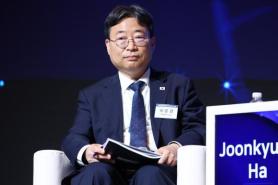
Ha Jun-kyung, Senior Economic Advisor at the Blue House Ha Jun-kyung, Senior Economic Advisor at the Blue House, described the government's "three mega projects" as a large-scale national industrial transformation initiative, comparable in scope to the industrialization during the Park Chung-hee era. In an appearance on the YouTube program "Jung Joon-hee's Saturday Debate" on July 4, Ha stated, "If we consider the industrialization of the Park Chung-hee era as the first phase, we are now entering the second phase of industrialization. This is a different level, comparable to past industrialization efforts." He explained that while past industrialization was characterized by imbalance, the current approach aims for balanced industrialization. "This is not a catch-up model following advanced countries; rather, it is a leading model of industrialization," he said. He added that regions will also have opportunities for growth, emphasizing that rapid construction will create many jobs and significantly benefit the economy. Ha also shared insights on the reactions of major corporations involved in the projects. He noted, "The chairpersons of the participating companies are very grateful to the president. It has provided a good opportunity to think about balanced development across the country, something they had not considered before, and they realized that 'this is something we must do.'" He mentioned that companies were contemplating moving abroad due to difficulties in finding suitable conditions domestically. Addressing concerns about policies favoring large corporations, he stated, "We are responding strongly to collusion and unfair trade practices. We have made it difficult for large companies to operate as they did in the past." Regarding the power supply plan for the Honam semiconductor cluster, he acknowledged the need to expand renewable energy while also mentioning the potential use of nuclear power. He said, "It is certain that the renewable energy sector will become more active, but there may be a need for nuclear power to handle parts that are difficult for renewables alone. The right approach is to overcome technological challenges with technology." On concerns about real estate speculation, he remarked, "We must prevent people from profiting or speculating by taking advantage of rising land prices. As the projects progress, measures to address these issues will also emerge." Additionally, regarding the potential use of excess tax revenue from advancements in artificial intelligence for a proposed "citizen dividend," he clarified, "We are not in a situation to take extreme actions. The president's clear directive is to use it to enhance potential growth rates."* This article has been translated by AI.